A Painting Exchange with Words about Hobbema's Wooded Landscape
This is a painting swap and collaboration that James proposed the other day where he gives me a painting to write about and I give him one. He had done this last year and wanted to do it again. Last year’s, Painting impressions with Zachary - with words, wonder.
I Gave James the Tower of Babylon
I gave James Pieter Bruegel‘s The Tower of Babel - Wikipedia. I have tried to see the actual work twice and was foiled both times. I’ve studied it formally and have a deep fascination for the breadth and detail in the work. You can read James’ words on the piece in his site: James’ words on the Tower of Babel Painting.
Meindert Hobbema’s Wooded Landscape
To me, James offered up a painting hanging in the National Galleries Scotland by Meindert Hobbema, Wooded Landscape.
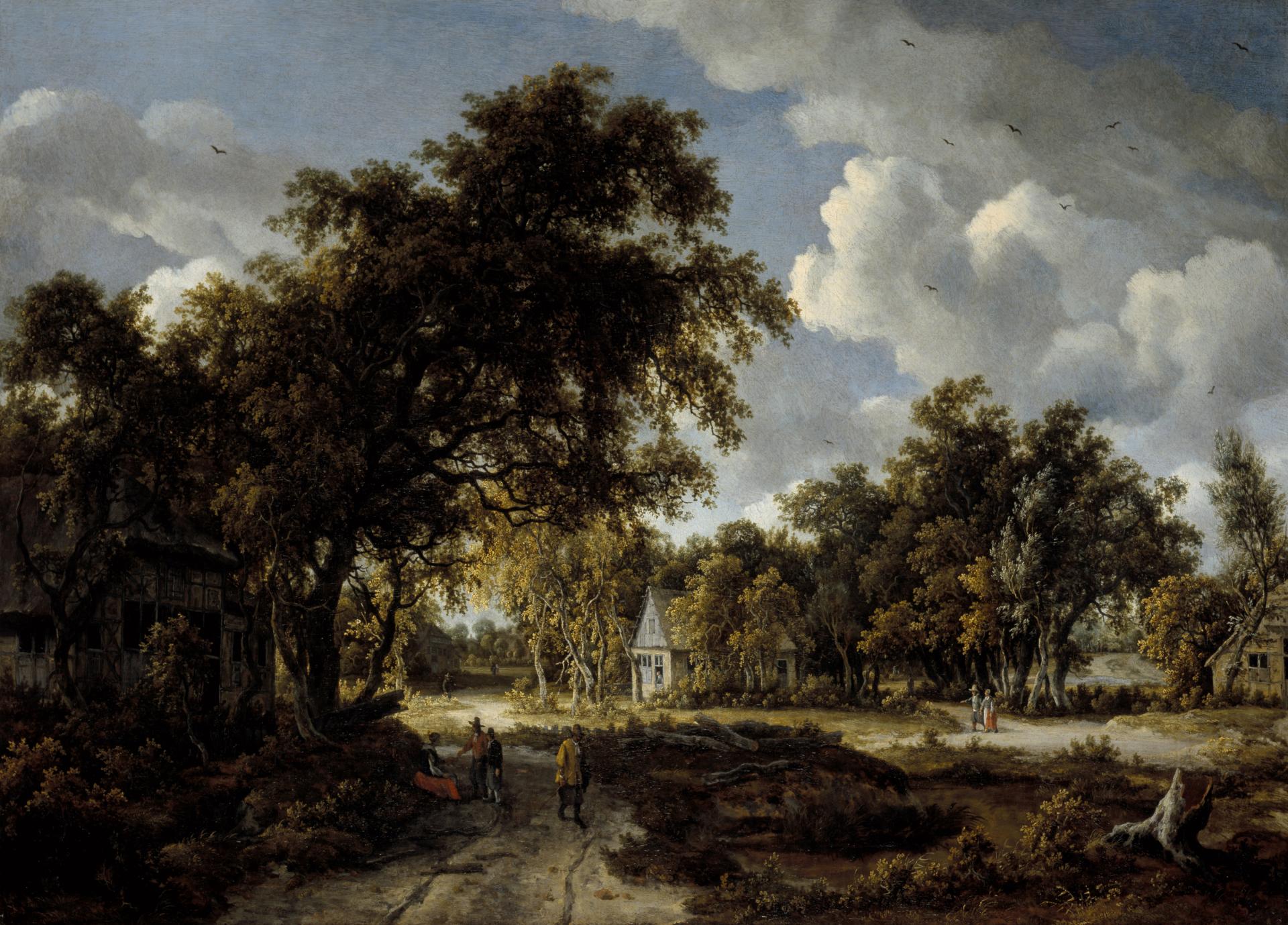
When first looked at Meindert Hobbema’s Wooded Landscape my eye quickly saw the people, the path, the woods, and boldly clouded sky. The people in action, as if captured in a photo, are very reminiscent of Pieter Bruegel the Elder paintings of towns people in a mix of action, but this with with far few people and action. It has that life captured and people living their lives in the painting of Early Northern Renaissance painters like the works of those who came out of a Bruegel (elder or younger) or Bosch studio.
Looking at the people they seem to be wearing the dress of the English pilgrims who came to the US in the early to mid–1600s. Many of these pilgrims spent time in or near Leiden, Netherlands before heading off to the Americas. The men in their tall hats with sizable brims and wide band fits that pilgrim dress quite closely. The women’s modest dress and the men’s cut of their coats is very much akin to the paintings of pilgrims that Americans know.
But, the woodsy nature setting is a little different from Dutch paintings and are something I more often associate with English or German paintings. The sky framed by the trees seems like it is snippets of the long sky so common in the Netherlands, but also like it was dropped into England as well.
Staring at the painting for a while I kept trying to get it to tell me where it was.
The skies fit the long sky paintings of Dutch pastoral scenes or the vast paintings of Dutch fleet under sail or in combat on the North Sea. The large clouds billowing is common in both Dutch and British paintings, and very much a John Constable focus years later where the clouded skies are prominent and a focus.
But, in this painting the clouds are there, but occluded by the woods. The woods are a bit dark and provide shadows and cover for the people and buildings. But, as we back out a bit and pay attention to where the light shines it is on the blue grey building with a woman looking out, as if she is in anticipation of someone arriving or returning. With the one of the paths moving somewhat through the middle of the painting and out and away, that is mostly darkened, so not the focus. But, the light is favorable to the path to the right mid-ground with a man and woman walking toward the meeting of the paths near the front of the house with the woman looking out. Is the couple walking the awaited arrival? Or are they just walking through like the others.
In the foreground in the shadow of the trees on the left there are a couple of people talking to a woman and possibly touching hands or one handing something to the other, as the woman sits in front of a rather dark house. Across from her is a tree that has been toppled some time ago and weathered. There are rough piles of large tree trunks somewhat piles, was there a storm in the not too distant past? Are the clouds a new storm coming (but isn’t there always a storm brewing)?
One interesting element missing is a patron and person clearly in focus in the painting. It isn’t the people, nor their built environment that is the focus, which 100 to 200 years prior van Eyck, Memling, and others would have leaned into in their painting. Hobbema’s painting is more organic and not as structured as artist from earlier years. But, Hobbema is a contemporary of Vermeer and there is some rhyming of pale Northern light in this piece somewhat akin to what is found in a Vermeer. In the look across time the rough details in the distance of the couple walking past the house a ways ahead, but the leaves and foregrounds have soft details and rough shapes and not the pristine details of prior generations of Netherlandish painters.
The Gallery Painting Annotation
I tried to steer clear of the gallery’s annotation for the painting at the start, but reading it and mention that this is likely a imaginary place, makes a bit of sense as the mix of Dutch / Netherlandish styles, but the woods were something I couldn’t place (but I’m mostly thinking of flying over the Netherlands today with the vast swathes of farms, flat, and mostly a lack of woods). There are many tells that this is a Dutch painter, but there are pieces that seem to come from elsewhere, or a time in a place I am not quite familiar.
The gallery note of a made up place would make sense of the billowing clouds of darkening long sky, but paired with wonderful sun dappled woods and a potential village are added to a more pastoral and flat scene-scape. With Hobbema known for their wooded landscapes, I think of Thomas Kinkade’s cozy town cottages and paintings of the 1980s to early 2000s and the request and offers of payment to add more warmly lit candles and touches of light. But, with Hobbema was the request, “add more woods”?
Where Do I Land?
The painting has entertained me with the exercise of trying to sort out where this would be, what is the story being told (or what myriad of stories can come out of the painting), or is the painting just a painting to be a painting. Was this painted for a Dutch audience or a British one, as both around this time leaned toward large scenery and sky paintings. Constable is a half century or more yet to arrive.
This is now a painting I would like to see. I could also craft stories from this painted scene, with each visit to view and craft some new tale, much like sitting in a cafe with a street view and many tables of customers and telling the stories of the table guests and passers by.
Web Mentions
This post can receive webmentions. Webmentions are currently not displayed, but they are received.