Off the Top: Community Entries

Showing posts: 16-30 of 94 total posts


7 December 2007

Pffft! Social Graph, We Need the Portable Social Network

In reading Alex Rudloff's "Privacy as Currancy" post I had two thoughts reoccur: 1) privacy is a currency back by trust; and 2) Pfffft! Social graph? Where is my Portable Social Network?

I agree with what Alex stated about wanting to move out of Facebook as my trust in them is gone completely (mostly driven by even though they apologized (poorly) Facebook still receives trackings of all your travels on the internet after you opt out, Om Malik's Zuckerberg's Mea Culp, Not Enough, and Brian Oberkirk's Facebook Harder to Shake than the Columbia Record Tape Club (a great read on the hurdles of really getting out of Facebook)). I will likely blog about the relationship between privacy and trust in another post in the not too distant future, as I have been talking about it in recent presentations on Social Software (Going Social and Putting Users First).

The Dire Need for Portable Social Networks

When Alex states:

Beacon had me so freaked out that I walked through what would happen if I simply removed my account (my natural, gut reaction). The fact is, I'd lose contact with a lot of people instantly. There's no easy way for me to take my data out and apply it somewhere else. There is no friend export and there isn't anywhere suitable for me to go.

I think we need portable social networks (or Social Network Portability as it is also known) before we need the social graph. Part of the interest in the social graph (mapping the relationships) is based on Facebook, but Facebook is a really poor interface for this information, it has some of the connections, some of the context, but it is not granular and does not measure strength (strong or weak ties) of relationships on a contextual and/or a preferential interest level. This social graph does little to help us move from one social software service to another other than to show a linkage.

There are strong reasons for wanting and needing the Portable Social Network. One is it makes it easy to drop into a new social software service and try it with social interactions with people whom we are already having social interactions. Whilst this is good it is also really important if something tragic or dire happens with a social software service we are already using, such as it is shut down, it is no longer performing for us, or it has given us a reason to leave through loss of trust. As I noted in the past (Following Friends Across Walled Gardens") leaving social software services is nothing new (even predates people leaving Delphi for Prodigy and Prodigy for AOL, etc.), but we still are not ready for this seemingly natural progression of moving house from one walled off social platform for another.

The Call for Action for Portable Social Network is Now

I am finding many of my friends have put their Facebook account on in hibernation (Facebook calls it &#quot;deactivation") and many have started taking the painful steps of really getting all of their information out of Facebook and planning to never go back. My friends have not sorted out what robust social software platform they will surface on next (many are still using Flickr, Twitter, Pownce, Tumblr and/or other options along with their personal blogs), but they would like to hold on to the digital statements of social relationship they made in Facebook and be able to drop those into some other service or platform easily.

One option could a just having a Smart Address Book or as Tim O'Reilly states Address Book 2.0. I believe that this should be a tool/service should have the relationships private and that privacy is controlled by the individual that owns the address book, possibly even accounting for the privacy request of the person whose address is in the address book. But, this is one option of many.

The big thing is we need Portable Social Networks now! This is not a far off in the future need it is a need of today.

[Comments are open on the syndicated post at Pffft! Social Graph, We Need the Portable Social Network :: Personal InfoCloud]


4 December 2007

Finding Real Community

This past week was really rough, but a good lightbulb moment for community. My wife had a bad fall on steps and badly broke her ankle. The response has been overwhelming from the people in our physical neighborhood, but also on Twitter and to a lesser degree on Facebook. The ability to hear from people offering condolence but offering assistance has been incredible. I lost track of the feedback on Twitter after 80 responses, all from a group of friends and collaborators I share with regularly. I have a similar number of connections in Facebook, but only received 10 or so responses (largely because the interface in Facebook is poor for tracking all presence messaging with social networks that scale (I have discussed this before in Facebook for Business or LinkedIn Gets More Valuable and Can Facebook Change Its DNA?).

An Expanded Network of Caring

The people in the neighborhood bring food and offering help has been really comforting. I hear many people now living neighborhood where they do not know their neighbors and do not have this caring. I feel very fortunate to have a traditional neighborhood that cares.

The Twitter responses blew me away, as the sincerity and support went far beyond any offerings of connections in the past. Twitter has acted like a local neighborhood but with global connections. There are continual complaints about Twitter not being real community, but the short messages (140 characters), the interface, and flow to people I have personal contact with (not face to face, but just as real) is utterly impressive. Twitter triggered IMs, SMS, and messaging through Twitter. It was simple best wishes to many offers of being available for support to talk and offers to send anything needed.

This really floored me as it is an extension of humanity in the most touching way (other than face-to-face). Twitter has been my social environment for humor, sharing, calls for assistance (out and responding to), and in many ways that my old physical office space used to provide, but now the people connected are many more and it is far more manageable. I have grown accustom to this closeness and alternate means of socializing, but was still amazed with the real caring response.


14 October 2007

Facebook for Business or LinkedIn Gets More Valuable

Michael Arrington writes about Facebook has LinkedIn in their Crosshairs, but I have been finding Facebook becoming increasingly less valuable the more people I have connected in it. The converse is opposite for me, LinkedIn becomes incredibly more valuable the more people I have in it. The reason for my derived value is simplicity.

LinkedIn Scales Quite Well the More Connections a Person Has

LinkedIn focusses on a simple set of things (your connections, changes to your connections, simple activities by your connections, and connecting with other people) and lets the person using the service derive value. LinkedIn lets be easily download the updated vCard, which drops into my address book in two different applications, which I have syncing with my mobile device (now that I have a mobile device that does not suck). LinkedIn is partly passive for me as I leave it own in a tab in my browser and check it a few times a day, but where a contact updates their status I can update my address book and it is a trigger for me to send a note, using the services they prefer (I keep track of that). LinkedIn is moving to opening its service with an API as they blogged (The LinkedIn API Opportunity). This will permit other services that can add value and are also great at what they do to pair the services, like Dopplr or a calendar to show availability (a particular need of mine). LinkedIn understands the information in their service has value and is more valuable outside their service for many people. But, LinkedIn also understands a good interface that is not cluttered, and there for it can scale.

Facebook Scales Poorly the More People A Person is Connected To

Facebook has a few things going for it, a huge mass of people with accounts and it has a fairly good lifestream interface for one's friends. The value for people using Facebook for themselves is much less than the high dollar valuations given to it (the valuation is not because it is a great service or tool, but because they have a ton of accounts in the service that creates value for advertisers). A few weeks ago I posted some Facebook frustrations in Twitter that stated:

"Facebook is driving me absolutely nuts - there is no way to manage information or conversations"
"Facebook is like a grade school lunch room, cacophony and chaos as the rule of nature"
&auot;FAcebook has a lot of valuable bits of information flowing through it from my contacts, but it FAILS to allow be to do anything with them"

Unlike Twitter, which allows me to favorite bits of information that I find valuable, Facebook does not grasp that the information has value. They do not grasp that those of us people who use their service are sharing things with those we connect with (friends, acquaintances, work relations, etcera) and we would like these people to see this information. Facebook interface started breaking for me finding information shared for my seeing (along with many others) with about 75 connections. It became virtually unusable with 150 people. There is information about events, blog posts, published journal articles, job changes, travel to cities I will be in (the Dopplr application is helpful, but if does not make a connection to those people in Facebook and the information I should be seeing), and other helpful valuable information for me.

Not only was I having this problem, but I was getting many e-mails and messages through Twitter with my friends and contacts severe problems with the poor (at best) Facebook platform. Nearly every person I heard from had many instances of broken communication because Facebook has yet to sort out volumes of information and surface it in a manner that can be valuable for the people it is intended to communicate with.

Facebook developers have a huge amount of learning about information, information flow, and information use in people's lives. Information is part of social interaction and what makes literate beings stand out is doing something, often using and reusing information. One common statement about Facebook from friends of all ages is it is a service to connect to people and play Scrabble on, but that is the end of the value. Facebook really needs to wake up and build real APIs that allow ease of holding on to the information people share as part of their being social humans sharing. When Facebook broke the FacebookSync.app it ruined one of the solid values Facebook provided, updating my address book with ease from information my friends were sharing with me.

Facebook Groups Have Learned Nothing from Group Messaging Platforms

One area that is really frustrating is Facebook#039;s groups. Many groups start with good intentions of providing a place to gather and message around a subject area. But, most groups already have listserves and other discussion platforms and the walled garden and horrible group discussion board platform make the Facebook platform a distraction and only providing a means for communication fractured across channels. Finding valuable information in Facebook groups or reading and following along is horribly painful, there has been some good advancement in groups discussion forums in the past 20 years, but Facebook seems to have ignored all things good with groups.

There are some exceptions to this rule, as the Facebook group for Victoria Secret Pink has been brought up as an example by more than five of my clients in the last five months or so. The Pink group has good community leaders and engages the people in the group to connect with others.

Successful Social Group Filtering is Needed

One of the fixes that Facebook needs is the same fix that every group discussion platform (listserves, threaded discussions, and web platforms) needs. Popular discussion boards have problems as they scale and over time with repetitive discussions. After people have been lurkers or participants in a discussion services for a few months (some people grasp this much more quickly) trends appear. The trends are the identifying people we find add value for us personally (every person has different valued contributors) and there are subjects that we want to listen to and participate in and those we have little interest in. The next step for these tools will be to surface people we find valued contributions from and subjects we want to pay attention to and others that we want to not listen to (unless one of our valued contributors jumps in the conversation). Not all contributors are valuable to us in all groups, so that needs to have granular listening attributes and we need to have fuzzy semantic terms (we set a word or few and terms that are related to these words will draw our reader's attention and filter them out for us to easily see and follow). These solutions are also needed in RSS feeds and aggregated information services.

The Future of LinkedIn and Facebook

LinkedIn already is a good business tool with value and they need to protect what they do well, which is holding on to people we have met and interacted with outside LinkedIn and use LinkedIn to connect with others with similar interests or needs. Opening up the API for LinkedIn could help people share their linked in profile though mobile devices so to gather a digital business card or easily get a link to it as we meet people, not hours, days, or weeks later.

Facebook has a decent platform that offers more than the pure social network tools before it (Ryze, Friendster, Orkut, or MySpace), but it still has an really long way to go. It gets about 40% right, but it can easily just be another step forward for social networking tools, unless it starts solving some of the difficult problems. A Facebook like tool that gets communication and sharing right at scale for professionals will do really well. Tools like this are needed inside the firewall for enterprise and Facebook does have value in its current state for business, but it is really limited.

The promised addition of grouping contacts in Facebook will help provide a better tool for profession needs separating out value from the playful, but it will need a lot more than that. Facebook really needs to open up and to get a clue about people and information and the needs people have for information, such as holding on to that information and using it outside the system. Facebook is just fodder for the next social software service that does this right, on top of the 45% of things that Facebook got right and be the next media darling worth billions that never amounted to much.


30 August 2007

A Stale State of Tagging?

David Weinberger posted a comment about Tagging like it was 2002, which quotes Matt Mower discussing the state of tagging. I mostly agree, but not completely. In the consumer space thing have been stagnant for a while, but in the enterprise space there is some good forward movement and some innovation taking place. But, let me break down a bit of what has gone on in the consumer space.

History of Tagging

The history of tagging in the consumer space is a much deeper and older topic than most have thought. One of the first consumer products to include tagging or annotations was the Lotus Magellan product, which appeared in 1988 and allowed annotations of documents and objects on one's hard drive to ease finding and refinding the them (it was a full text search which was remarkably fast for its day). By the mid-90s Compuserve had tagging for objects uploaded into its forum libraries. In 2001 Bitzi allowed tagging of any media what had a URL.

The down side of this tagging was the it did not capture identity and assuming every person uses words (tag terms) in the same manner is a quick trip to the tag dump where tags are not fully useful. In 2003 Joshua Schacter showed the way with del.icio.us that not only allowed identity, upon which we can disambiguate, but it also had a set object in common with all those identities tagging it. The common object being annotated allows for a beginning point to discern similarity of identityĵs tag terms. Part of this has been driven on Joshua's focus on the person consuming the content and allowing a means for that consumer to get back to their information and objects of interest. (It is around this concept that folksonomy was coined to separate it from the content publisher tagging and non-identity related tagging.) This picked up on the tagging for one's self that was in Lotus Magellan and brings it forward to the web.

Valuable Tagging

It was in del.icio.us that we saw tagging that really did not work well in the past begin to become valuable as the clarity in tag terms that was missing in most all other tagging systems was corrected for in the use of a common object being tagged and the identity of the tagger. This set the foundation for some great things to happen, but have great things happened?

Tagging Future Promise

Del.icio.us set many of out minds a flutter with insight into the dreams of the capability of tagging having a good foothold with proper structure under them. A brilliant next step was made by RawSugar (now gone) to use this structure to make ease of disambiguating the tag terms (by appleseed did you mean: Johnny Appleseed, appleseeds for gardening/farming, the appleseed in the fruit apple, or appleseed the anime movie?). RawSugar was a wee bit before its time as it is a tool that is needed after there tagging (particularly folksonomy related tagging systems) start scaling. It is a tool that many in enterprise are beginning to seek to help find clarity and greater value in their internal tagging systems they built 12 to 18 months ago or longer. Unfortunately, the venture capitalists did not have the vision that the creators of RawSugar did nor the patience needed for the market to catch-up to the need in a more mature market and they pulled the plug on the development of RawSugar to put the technology to use for another purpose (ironically as the market they needed was just easing into maturity).

The del.icio.us movement drove blog tags, laid out by Technorati. This mirrored the previous methods of publisher tagging, which is most often better served from set categories that usually are derived from a taxonomy or simple set (small or large) of controlled vocabulary terms. Part of the problem inherent in publisher tags and categories is that they are difficult to use outside of their own domain (however wide their domain is intended - a specific site or cross-sites of a publisher). Using tags from one blog to another blog has problems for the same reason that Bitzi and all other publisher tags have and had problems, they are missing identity of the tagger AND a clear common object being tagged. Publisher tags can work well as categories for aggregating similar content within a site or set of commonly published sites where a tag definition has been set (but that really makes them set categories) and used consistently. Using Technorati tag search most often surfaces this problem quickly with many variation of tag use surfacing or tag terms being used to attract traffic for non-related content (Technorati's keyword search is less problematic as it relies on the terms being used in context in the content - unfortunately the two searches have been tied together making search really messy at the moment). There is need for an improved tool that could take the blog tags and marry them to the linked items in the content (if that is what is being talked about - discerning predicate in blog tags is not clear yet).

Current Tools that Advanced

As of a year ago there were more than 140 social bookmarking tools in the consumer space, but there was little advancement. But, there are a few services that have innovated and brought new and valuable features to market in tagging. As mentioned recently Ma.gnolia has done a really good job of taking the next steps with social interaction in social bookmarking. Clipmarks pioneered the sub-page tagging and annotation in the consumer tagging space and has a really valuable resource in that tool. ConnectBeam is doing some really good things in the enterprise space, mostly taking the next couple steps that Yahoo MyWeb2 should have taken and pairing it with enterprise search. Sadly, del.icio.us (according to comments in their discussion board) is under a slow rebuilding of the underlying framework (but many complaints from enterprise companies I have worked with and spoken indepth with complain del.icio.us continually blocks their access and they prefer not to use the service and are finding current solutions and options to be better for them).

A Long Way to Go

While there are examples that tagging services have moved forward, there is so much more room to advance and improve. As people's own collection of tagged pages and objects have grown the tools are needed to better refind them. This will require time search and time related viewing/scanning of items. The ability to use co-occurance of tag terms (what other tags were used on the object), with useful interfaces to view and scan the possibilities.

Portability and interoperability is extremely important for both the individual person and enterprise to aggregate, migrate, and search across their collections across services and devices (now that devices have tagging and have had for some time, as in Mac OS X Tiger and now Vista). Enterprises should also have the ability to move external tagged items in through their firewall and publish out as needed, mostly on an employee level. There is also desire to have B2B tagging with customers tagging items purchased so the invoicing can be in the customers terminology rather than the seller terminology.

One of the advances in personal tagging portability and interoperability can easily be seen when we tag on one device and move the object to a second device or service (parts of this are not quite available yet). Some people will take a photo on their mobile phone and add quick tags like "sset" and others to a photo of a sunset. They send that photo to a service or move it to their desktop (or laptop) and import the photo and the tag goes along with it. The application sees the "sset" and knows the photo was transfered from that person's mobile device and knows it is their short code for "sunset" and expands the tag to sunset accordingly. The person then adds some color attribute tags to the photo and moves the photo to their photo sharing service of choice with the tags appended.

The current tools and services need tools and functionality to heal some of the messiness. This includes stemming to align versions of the same word (e.g. tag, tags, tagging, bookmark, bookmarking). Tag with disambiguation in mind by offering co-occurrence options (e.g. appleseed and anime or johnny or gardening or apple). String matching to identify facets for time and date, names (from your address book), products, secret tag terms (to have them blocked from sharing), etc. (similar to Stikkit and GMail).

Monitoring Tools

Enterprise is what the next development steps really need to take off (these needs also apply to the power knowledge worker as well). The monitoring tools for tags from others and around objects (URLs) really need to fleshed out and come to market. The tag monitoring tools need to become granular based on identity and co-occurance so to more tightly filter content. The ability to monitor a URL and how it is tagged across various services is a really strong need (there are kludgy and manual means of doing this today) particularly for simple and efficient tools (respecting the tagging service processing and privacy).

Analysis Tools

Enterprise and power knowledge workers also are in need of some solid analysis tools. These tools should be able to identify others in a service that have similar interests and vocabulary, this helps to surface people that should be collaborating. It should also look at shifts in terminology and vocabulary so to identify terms to be added to a taxonomy, but also provide an easy step for adding current emergent terms to related older tagged items. Identify system use patterns.

Just the Tip

We are still at the tip of the usefulness of tagging and the tools really need to make some big leaps. The demands are there in the enterprise marketplace, some in the enterprise are aware of them and many more a getting to there everyday as the find the value real and ability to improve the worklife and workflow for their knowledge workers is great.

The people using the tools, including enterprise need to grasp what is possible beyond that is offered and start asking for it. We are back to where we were in 2003 when del.icio.us arrived on the scene, we need new and improved tools that understand what we need and provide usable tools for those solutions. We are developing tag islands and silos that desperately need interoperability and portability to get real value out of these stranded tag silos around or digital life.


20 August 2007

Why Ma.gnolia is One of My Favorite Social Bookmarking Tools

After starting the Portable Social Network Group in Ma.gnolia yesterday I received a few e-mails and IMs regarding my choice. Most of the questions were why not just use tags and del.icio.us. After I posted my Ma.Del Tagging Bookmarklet post I have had a lot of questions about Ma.gnolia and my preference as well as people thought I was not a fan of it. I have been thinking I would blog about my usage, but given my work advising on social bookmarking and social web, I shy away talking about what I use as what I like is likely not what is going to be a good fit for others. But, my work is one of the reasons I want to talk about what I like using as nearly every customer of mine and many presentation attendees look at del.icio.us first (it kicked the door wide open with a tool that was light years ahead of all others), but it is not for everybody and there are many other options. Much of my work is with enterprise and organizations of various size, which del.icio.us is not right for them for privacy reasons. I still add to del.icio.us along with my favorite as there are many people that have subscribed to the at feed as they derive value from that subscription so I take the extra step to keep that feed as current.

Ma.gnolia Offers Great Features for Sociality

I have two favorite tools for my own personal social bookmarking reasons Ma.gnolia and Clipmarks (I don't think I have anything publicly shared in Clipmarks). First the later, I use Clipmarks primarily when I only want to bookmark a sub-page element out on the web, which are paragraphs, sentences, quotes, images, etc.

I moved to try Ma.gnolia again last Fall when something changed in del.icio.us search and the results were not returning things that were in del.icio.us. My trying Ma.gnolia, by importing all of my 2200 plus bookmarks not only allowed me to search and find things I wanted, but I quickly became a fan of their many social features. In the past year or less they have become more social in insanely helpful and kind ways. Not only does Ma.gnolia have groups that you can share bookmarks with but there is the ability to have discussions around the subject in those groups. Sharing with a group is insanely easy. Groups can be private if the manager wishes, which makes it a good test ground for businesses or other organizations to test the social bookmarking waters. I was not a huge fan of rating bookmarks as if I bookmarked something I am wanting to refind it, but in a more social context is has value for others to see the strength of my interest (normall 3 to 5 stars). One of my favorite social features is giving "thanks", which is not a trigger for social gaming like Digg, but is an interpersonal expression of appreciation that really makes Ma.gnolia a friendly and positive social environment.

Started with Beauty, but Now with Ease

Ma.gnolia started as a beautiful del.icio.us (it was not the first) and the beauty got in the way of usability for many. But, Ma.gnolia has kept the beautiful strains and added simple ease of use in a very Apple delightful moments sort of way. The thanks are a nice treat, but the latest interactions that provide non-disruptive ease of use to accomplish a task, without completely taking you away from your previous flow (freaking brilliant in my viewpoint - anything that preserves flow to accomplish a short task is a great step). Another killer feature is Ma.gnolia Roots, which is a bookmarklet that when clicked hovers a semi-transparent layer over the webpage to show information from Ma.gnolia about that page (who has linked to it, tags, annotations, etc.) and makes it really easy to bookmark that page from that screen. The API (including a replica of the del.icio.us API that nearly all services use as the standard), add-ons, Creative Commons license for your bookmarks, many bookmarklet options, and feed options. But, there are also the little things that are not usually seen or noticed, such as great URLs that can be easily parsed, all pages are properly marked up semantically, and Microformats are broadly and properly used throughout the site (nearly at every pivot).

Intelligently Designed

For me Ma.gnolia is not only a great site to look at, a great social bookmarking site that is really social (as well as polite and respectful of my wishes), but a great example for semantic web mark-up (including microformats). There is so much attention to detail in the page markup that for those of us that care it is amazingly beautiful. The visual layer can be optimized for more white space and detail or for much easier scrolling. The interactions, ease of use, and delightful moments that assist you rather than taking you out of your flow (workflow, taskflow, etc.) and make you ask why all applications and social sites are not this wonderful.

Ma.gnolia is not perfect as it needs some tools to better manage and bulk edit your own bookmarks. It could use a sort on search items (as well as narrow by date range). Search could use some RedBull at times. It could improve with filtering by using co-occurance of tag terms as well as for disambiguation.

Overall for me personally, Ma.gnolia is a tool I absolutely love. It took the basic social bookmarking idea in del.icio.us and really made it social. It has added features and functionality that are very helpful and well executed. It is an utter pleasure to use. I can not only share things easily and get the wonderful effects of social interaction, but I can refind things in my now 2,500 plus bookmarks rather easily.


13 August 2007

Open Conversations and Privacy Needs for Business

I thought I would share the latest press bit around this joint, Thomas Vander Wal was quoted in Inc Magazine What's Next: Shout it Out Loud (or in the August 2007 issue beginning on page 69). The article focuses the need and desire for companies to share and be open with more of their data and information. Quite often companies are getting bit by their privacy around what they do (how their source their products/resources, who they donate money to, etc.) and rumors start. It is far more efficient and helpful to be open with that information, as it gets out anyway.

Ironically, in the same paper issue on page 26 there is a an article about When Scandal Knocks..., which includes a story about Jamba Juice and a blog post that inaccurately claimed it had milk in its products, which could have easily been avoided if Jamba Juice had an ingredients listing on its web site.

The Flip Side

There are two flip sides to this. One is the Apple converse, which is a rare example of a company really making a mythic organization out of its privacy. The second is companies really need privacy for some things, but the control of information is often too extreme and is now more harmful than helpful.

Viable Privacy

I have been working on a much longer post looking at the social software/web tools for and in the enterprise. Much of of the extreme openness touted in the new web charge is not a viable reality inside enterprise. There are a myriad of things that need to be private (or still qualify as valid reasons for many). The list include preparations for mergers and acquisitions, securities information dealings (the laws around this are what drive much of the privacy and are out dated), reorganizations (restructuring and layoffs, which organizations that have been open about this have found innovative solutions from the least likely places), personal employee records, as well as contractual reasons (advising or producing products for competitors in the same industry or market segment). Out side of these issues, which normally add up to under 30 to 40% of the whole of the information that flows through an organization, there is a lot of room for openness in-house and to the outside world.

Need for Enterprise Social Tools Grasping Partial Privacy

When we look at the consumer space for social software there are very few consumer tools that grasp social interaction and information sharing on a granular level (Ma.gnolia, Flickr, and the SixApart tools Vox and LiveJournal are the exceptions that always come to mind). But, many of the tools out there that are commonly used as examples of social web tools really fall down when business looks at them and thinks about privacy and selective sociality (small groups). The social web tools all around really need to grow up and improve in this area. As we are seeing the collaboration and social tools evolve to more viable options we start to see their more glaring holes that do not reflect the reality of human social interaction.

Closing the Gap

What we need is for companies to be more open so the marketplace is a more consumer and communicative environment, but we also need our still early social web tools to reflect our social realities that not everything is public and having tools that better fit those needs.

[Cross-posted at Personal InfoCloud: Open Converastions... with comments open on that posting.]


24 July 2007

Sharing and Following/Listening in the Social Web

You may be familiar with my granular social network post and the postings around the Personal InfoCloud posts that get to personal privacy and personal management of information we have seen, along with the Come to Me Web, but there is an element that is still missing and few social web sites actually grasp the concept. This concept is granular in the way that the granular social network is granular, which focusses on moving away from the concept of "broad line friends" that focus on our interest in everything people we "friend", which is not a close approximation of the non-digital world of friend that we are lucky to find friends who have 80 percent common interests. This bit that is missing focusses on the sharing and following (or listening) aspects of our digital relationships. Getting closer to this will help filter information we receive and share to ease the overflow of information and make the services far more valuable to the people using them.

Twitter Shows Understanding

Twitter in its latest modifications is beginning to show that it is grasping what we are doing online is not befriending people or claiming friend, but we are "following" people. This is a nice change, but it is only part of the equation that has a few more variables to it, which I have now been presenting for quite a few years (yes and am finally getting around to writing about). The other variables are the sharing and rough facets of type of information we share. When we start breaking this down we can start understanding the basic foundation for building a social web application that can begin to be functional for our spheres of sociality.

Spheres of Sociality
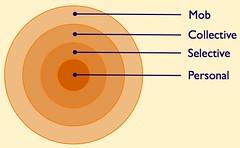
Spheres of Sociality The Spheres of Sociality are broken into four concentric rings:

  1. Personal
  2. Selective
  3. Collective
  4. Mob

There are echos of James Surowiecki's Wisdom of Crowds in the Spheres of Sociality as they break down as follows. The personal sphere is information that is just for one's self and it is not shared with others. The selective sphere, which there may be many a person shares with and listens to, are closed groups that people are comfortable sharing and participating with on common interests (family, small work projects, small group of friends or colleagues, etc.). The collective sphere is everybody using that social tool that are members of it, which has some common (precise or vague) understanding of what that service/site is about. The last sphere is the mob, which are those people outside the service and are not participants and who likely do not understand the workings or terminology of the service.

These sphere help us understand how people interact in real life as well as in these social environments. Many of the social web tools have elements of some of these or all of these spheres. Few social web tools provide the ability to have many selective spheres, but this is a need inside most enterprise and corporate sites as there are often small project teams working on things that may or may not come to fruition (this will be a future blog post). Many services allow for just sharing with those you grant to be your followers (like Twitter, Flickr, the old Yahoo! MyWeb 2.0, and Ma.gnolia private groups, etc.). This selective and segmented group of friends needs a little more examination and a little more understanding.

Granular Sharing and Following

Unequal AccessThe concepts that are needed to improve upon what has already been set in the Spheres of Sociality revolve around breaking down sharing and following (listening) into more discernible chunks that better reflect our interests. We need to do this because we do not always want to listen everything people we are willing to share with are surfacing. But, the converse is also true we may not want to share or need to share everything with people we want to follow (listen to).

In addition to each relationship needing to have sharing and listening properties, the broad brush painted by sharing and listening also needs to be broken down just a little (it could and should be quite granular should people want to reflect their real interests in their relationships) to some core facets. The core facets should have the ability to share and listen based on location, e.g. a person may only want to share or listen to people when they are in or near their location (keeping in mind people's location often changes, particularly for those that travel or move often). The location facet is likely the most requested tool particularly for those listening when people talk about Twitter and Facebook. Having some granular categories or tags to use as filters for sharing and listening makes sense as well. This can break down to simple elements like work, play, family, travel, etc. as broad categories it could help filter items from the sharing or listening streams and help bring to focus that which is of interest.

Breaking Down Listening and Sharing for Items

 YourselfOthers
ShareYesYes/No

Where this gets us it to an ability to quickly flag the importance of our interactions with others with whom we share information/objects. Some things we can set on an item level, like sharing or just for self, and if sharing with what parameters are we sharing things. We will set the default sharing with ourself on so we have access to everything we do. This follows the Spheres of Sociality with just personal use, sharing with selective groups (which ones), share with the collective group or service, and share outside the service. That starts setting privacy of information that starts accounting for personal and work information and who could see it. Various services have different levels of this, but it is a rare consumer services that has the selective service sorted out (Pownce comes close with the options for granularity, but Flickr has the ease of use and levels of access. For each item we share we should have the ability to control access to that item, to just self or out across the Spheres of Sociality to the mob, if we so wish. Now we can get beyond the item level to presetting people with normative rights.

Listening and Sharing at the Person Level

 Others
Settings
Listen/FollowYesNo
Granular
Listen/Follow
YesNo
Granular ShareYesNo
Geo Listen/FollowYesNo
Geo ShareYesNo

We can set people with properties that will help use with default Sphere of Sociality for sharing and listening. The two directions of communication really must be broken out as there are some people we do not mind them listening to the selective information sharing, but we may not have interest in listening to their normal flow of offerings (optimally we should be able to hear their responses when they are commenting on items we share). Conversely, there may be people we want to listen to and we do not want to share with, as we may not know them well enough to share or they may have broken our privacy considerations in the past, hence we do not trust them. For various reasons we need to be able to decide on a person level if we want to share and listen to that person.

Granular Listening and Sharing

Not, only do we have needs and desires for filtering what we share and listen to on the person level, but if we have a means to set some more granular levels of sharing, even at a high level (family, work, personal relation, acquaintance, etc.). If we can set some of these facets for sharing and have them tied to the Spheres we can easily control who and what we share and listen to. Flickr does this quite well with the simple family, friends, contacts, and all buckets, even if people do not use them precisely as such as family and friends are the two selective buckets they offer to work with (most people I know do not uses them precisely as such with those titles, but it provides a means of selective sharing and listening).

Geo Listening and Sharing

Lastly, it is often a request to filter listening and sharing by geography/location access. There are people who travel quite a bit and want to listen and share with people that are currently local or will be local to them in a short period, but their normal conversations are not fully relevant outside that location. Many people want the ability not to listen to a person unless they are local, but when a person who has some relationship becomes local the conversation may want to be shared and/or listened to. These settings can be dependent on the granular listening and sharing parameters, or may be different.

Getting There...

So, now that this is out there it is done? Hmmm, if it were only so easy. The first step is getting developers of social web and social software to begin understanding the social relationships that are less broad lines and more granular and directional. The next step is a social interaction that people need to understand or that the people building the interfaces need to understand, which is if and how to tell people the rights granted are not reciprocal (it is seems to be a common human trait to have angst over non-reciprocal social interactions, but it is the digital realm that makes it more apparent that the flesh world).


21 July 2007

Inline Messaging

Many of the social web services (Facebook, Pownce, MySpace, Twitter, etc.) have messaging services so you can communication with your "friends". Most of the services will only ping you on communication channels outside their website (e-mail, SMS/text messaging, feeds (RSS), etc.) and require the person to go back to the website to see the message, with the exception of Twitter which does this properly.

Inline Messaging

Here is where things are horribly broken. The closed services (except Twitter) will let you know you have a message on their service on your choice of communication channel (e-mail, SMS, or RSS), but not all offer all options. When a message arrives for you in the service the service pings you in the communication channel to let you know you have a message. But, rather than give you the message it points you back to the website to the message (Facebook does provide SMS chunked messages, but not e-mail). This means they are sending a message to a platform that works really well for messaging, just to let you know you have a message, but not deliver that message. This adds extra steps for the people using the service, rather than making a simple streamlined service that truly connects people.

Part of this broken interaction is driven by Americans building these services and having desktop-centric and web views and forgetting mobile is not only a viable platform for messaging, but the most widely used platform around the globe. I do not think the iPhone, which have been purchased by the owners and developers of these services, will help as the iPhone is an elite tool, that is not like the messaging experience for the hundreds of millions of mobile users around the globe. Developers not building or considering services for people to use on the devices or application of their choice is rather broken development these days. Google gets it with Google Gears and their mobile efforts as does Yahoo with its Yahoo Mobile services and other cross platform efforts.

Broken Interaction Means More Money?

I understand the reasoning behind the services adding steps and making the experience painful, it is seen as money in their pockets through pushing ads. The web is a relatively means of tracking and delivering ads, which translates into money. But, inflicting unneeded pain on their customers can not be driven by money. Pain on customers will only push them away and leave them with fewer people to look at the ads. I am not advocating giving up advertising, but moving ads into the other channels or building solutions that deliver the messages to people who want the messages and not just notification they have a message.

These services were somewhat annoying, but they have value in the services to keep somebody going back. When Pownce arrived on the scene a month or so ago, it included the broken messaging, but did not include mobile or RSS feeds. Pownce only provides e-mail notifications, but they only point you back to the site. That is about as broken as it gets for a messaging and status service. Pownce is a beautiful interface, with some lightweight sharing options and the ability to build groups, and it has a lightweight desktop applications built on Adobe AIR. The AIR version of Pownce is not robust enough with messaging to be fully useful. Pownce is still relatively early in its development, but they have a lot of fixing of things that are made much harder than they should be for consuming information. They include Microfomats on their pages, where they make sense, but they are missing the step of ease of use for regular people of dropping that content into their related applications (putting a small button on the item with the microformat that converts the content is drastically needed for ease of use). Pownce has some of the checkboxes checked and some good ideas, but the execution of far from there at the moment. They really need to focus on ease of use. If this is done maybe people will comeback and use it.

Good Examples

So who does this well? Twitter has been doing this really well and Jaiku does this really well on Nokia Series60 phones (after the first version Series60). Real cross platform and cross channel communication is the wave of right now for those thinking of developing tools with great adoption. The great adoption is viable as this starts solving technology pain points that real people are experiencing and more will be experiencing in the near future. (Providing a solution to refindability is the technology pain point that del.icio.us solved.) The telecoms really need to be paying attention to this as do the players in all messaging services. From work conversations and attendees to the Personal InfoCloud presentation, they are beginning to get the person wants and needs to be in control of their information across devices and services.

Twitter is a great bridge between web and mobile messaging. It also has some killer features that add to this ease of use and adoption like favorites, friends only, direct messaging, and feeds. Twitter gets messaging more than any other service at the moment. There are things Twitter needs, such as groups (selective messaging) and an easier means of finding friends, or as they are now appropriately calling it, people to follow.

Can we not all catch up to today's messaging needs?


7 July 2007

Yahoo Takes Shot at Own and Customer's Foot

I just got an e-mail that Yahoo Photos is closing September 20, 2007 at 9pm. I have been finding the closing of the site somewhat odd, mostly because the many of the people I know and run across that use Yahoo Photos rely on Yahoo Photos to always be there. They are often infrequent users. They like and love the service because it is relatively easy to use and "will always be there". Many real people I know (you know the 95 percent of the people who do not live their life on the web) visit Yahoo Photos once or twice a year as it is where holiday, travel, or family reunion photos are stored. It would seem that this user base would need more than a year's notice to get valuable notification that their digital heirlooms are going to be gone, toast, destroyed, etc. in a few short months.

It the good will lost through a class action lawsuit against Yahoo! brought by its regular people user base (the core of its business) will not make things better. You know legal action is coming as photos are a valuable part of people's life and memories. Many of the regular people do not check their e-mail regularly as they have more than one or two accounts. Many people I know chose Yahoo Photos over other competitors, because Yahoo had been around longer and understood how to maintain their memories over time. To many Yahoo Photos is not an experiment that would go away.

Yahoo Is Many Things To Many People

I absolutely love Flickr and have never really been a Yahoo Photos user, as I mostly put my own photos on my own servers prior to Flickr. Part of Yahoo's quandary goes back to last a memo last Fall, names the Peanutbutter Manifesto, which was written by Brad Garlinghouse. Garlinghouse railed against the Yahoo multi-headed approach to services. Some services were new and innovative, while others were older and more tradtional. To the novice it would look like they served the same purpose. Yahoo Photos and Flickr do both serve digital photos and provide online photo galleries. Flickr has been providing a good source of ad revenues and Photos has not been as profitable. This seems on the surface to be smart decision, but to the millions more users of Photos than in Flickr this will do little more than bring ill will. Ill will is not something Yahoo can really afford these days.

Innovation and Incorporation of Ideas

Yahoo in the past few years has been buying innovative companies that provide value and unique ways of interacting with people and information on the web. Yahoo has also been innovating in-house with its research labs and now, Brickhouse. Having similar service running allows for one to be innovative and test the waters, while keeping one a safe resource that is familiar to the many who want stability over fresh and innovative. Companies must understand these two groups of people exist and are not fully interchangeable (er, make that they are rarely interchangeable). Innovation takes experimentation and time. Once things are found to work within the groups accepting innovation the work becomes really tough with the integration and use testing with the people who are not change friendly (normally a much larger part of an organization's base).

It would have seemed the smart move to be mindful that Flickr is the innovation platform and Photos is the stable use platform. The two groups of use are needed. Those in the perpetual beta and innovation platform are likely to jump to something new and different if the innovation gets stale. The stable platform users often are surprised and start looking to move when there is too much change. It is a real smart understanding that is needed of who the people are that use, love, and depend on these services. Real smarts are needed to keep these two different communities happy and loyal. When this works well the innovation group is happily the test bed for new helpful tools for the stable platform (which will need beta testing of its people using the service as well).

Irony Run Rampant

While Yahoo is aiming to show it does not grasp the two different use groups of its two photo platforms, nor the loayalty the much larger group has entrusted in Yahoo, many other companies are following the trail Yahoo has put in place by setting up beta programs for their own innovation of products. Google has its labs, but is moving its second generation attempts into its labs. Nearly every large consumer facing web organization has set up labs and/or has been buying small innovative web properties to boost their relevance and ability to build to the future more easily. Most organization outside Yahoo are innovating, testing, and moving solid broadly usable components into their stable large use base products. These other organizations understand loyalty and their customer base. I really thought Yahoo grasped this, with Jerry Yang taking over I had thought a new smart direction was in the works. A Yahoo that snubs its loyal users who believed they placed their prized possessions in the hands of an enduring web property, is new but not innovative and not a lasting property.


17 June 2007

Stitching Conversation Threads Fractured Across Channels

Communicating is simple. Well it is simple at its core of one person talking with another person face-to-face. When we communicate and add technology into the mix (phone, video-chat, text message, etc.) it becomes more difficult. Technology becomes noise in the pure flow of communication.

Now With More Complexity

But, what we have today is even more complex and difficult as we are often holding conversation across many of these technologies. The communication streams (the back and forth communication between two or more people) are now often not contained in on communication channel (channel is the flavor or medium used to communicate, such as AIM, SMS, Twitter, e-mail, mobile phone, etc.).

We are seeing our communications move across channels, which can be good as this is fluid and keeping with our digital presence. More often than not we are seeing our communication streams fracture across channels. This fracturing becomes really apparent when we are trying to reconstruct our communication stream. I am finding this fracturing and attempting to stitch the stream back together becoming more and more common as for those who are moving into and across many applications and devices with their own messaging systems.

The communication streams fracture as we pick-up an idea or need from Twitter, then direct respond in Twitter that moves it to SMS, the SMS text message is responded back to in regular SMS outside of Twitter, a few volleys back and forth in SMS text, then one person leaves a voicemail, it is responded to in an e-mail, there are two responses back and forth in e-mail, an hour later both people are on Skype and chat there, in Skype chat they decide to meet in person.

Why Do We Want to Stitch the Communication Stream Together?

When they meet there is a little confusion over there being no written overview and guide. Both parties are sure they talked about it, but have different understandings of what was agreed upon. Having the communication fractured across channels makes reconstruction of the conversation problematic today. The conversation needs to be stitched back together using time stamps to reconstruct everything [the misunderstanding revolved around recommendations as one person understands that to mean a written document and the other it does not mean that].

Increasingly the reality of our personal and professional lives is this cross channel communication stream. Some want to limit the problem by keeping to just one channel through the process. While this is well intentioned it does not meet reality of today. Increasingly, the informal networking leads to meaningful conversations, but the conversations drifts across channels and mediums. Pushing a natural flow, as it currently stands, does not seem to be the best solution in the long run.

Why Does Conversation Drift Across Channels?

There are a few reasons conversations drift across channels and mediums. One reason is presence as when two people notice proximity on a channel they will use that channel to communicate. When a person is seen as present, by availability or recently posting a message in the service, it can be a prompt to communicate. Many times when the conversation starts in a presence channel it will move to another channel or medium. This shift can be driven by personal preference or putting the conversation in a medium or channel that is more conducive for the conversation style between people involved. Some people have a preferred medium for all their conversations, such as text messaging (SMS), e-mail, voice on phone, video chat, IM, etc.. While other people have a preferred medium for certain types of conversation, like quick and short questions on SMS, long single responses in e-mail, and extended conversations in IM. Some people prefer to keep their short messages in the channel where they begin, such as conversations that start in Facebook may stay there. While other people do not pay attention to message or conversation length and prefer conversations in one channel over others.

Solving the Fractured Communication Across Channels

Since there are more than a few reasons for the fractured communications to occur it is something that needs resolution. One solution is making all conversations open and use public APIs for the tools to pull the conversations together. This may be the quickest means to get to capturing and stitching the conversation thread back together today. While viable there are many conversations in our lives that we do not want public for one reason or many.

Another solution is to try to keep your conversations in channels that we can capture for our own use (optimally this should be easily sharable with the person we had the conversation with, while still remaining private). This may be where we should be heading in the near future. Tools like Twitter have become a bridge between web and SMS, which allows us to capture SMS conversations in an interface that can be easily pointed to and stitched back together with other parts of a conversation. E-mail is relatively easy to thread, if done in a web interface and/or with some tagging to pull pieces in from across different e-mail addresses. Skype chat also allows for SMS interactions and allows for them to be captured, searched, and pulled back together. IM conversations can easily be saved out and often each item is time stamped for easy stitching. VoIP conversations are often easily recorded (we are asking permission first, right?) and can be transcribed by hand accurately or be transcribed relatively accurately via speech-to-text tools. Voice-mail can now be captured and threaded using speech-to-text services or even is pushed as an attachment into e-mail in services as (and similar to) JConnect.

Who Will Make This Effortless?

There are three types of service that are or should be building this stitching together the fractured communications across channels into one threaded stream. I see tools that are already stitching out public (or partially public) lifestreams into one flow as one player in this pre-emergent market (Facebook, Jaiku, etc.). The other public player would be telecoms (or network provider) companies providing this as a service as they currently are providing some of these services, but as their markets get lost to VoIP, e-mail, on-line community messaging, Second Life, etc., they need to provide a service that keeps them viable (regulation is not a viable solution in the long run). Lastly, for those that do not trust or want their conversation streams in others hands the personally controlled application will become a solutions, it seems that Skype could be on its way to providing this.

Is There Demand Yet?

I am regularly fielding questions along these lines from enterprise as they are trying to deal with these issues for employees who have lost or can not put their hands on vital customer conversations or essential bits of information that can make the difference in delivering what their customers expect from them. Many have been using Cisco networking solutions that have some of these capabilities, but still not providing a catch all. I am getting queries from various telecom companies as they see reflections of where they would like to be providing tools in a Come to Me Web or facilitating bits of the Personal InfoCloud. I am getting requests from many professionals that want this type of solution for their lives. I am also getting queries from many who are considering building these tools, or pieces of them.

Some of us need these solutions now. Nearly all of us will need these solutions in the very near future.


1 February 2007

Lessons in Identity

There is much consternation and gnashing of teeth today over the Flickr requiring a Yahoo! login from here forward, it has even made it to the BBC - Flickr to require Yahoo usernames. One of the Flickr co-founders, Stewart Butterfield, provided rationale that would have been a little more helpful up front. The reasons from Stewart are good, but are not solid value propositions for many.

Identity Lessons

There are some insanely important lessons in this dust-up. These lessons revolve around product versus mega-brand/mega-corporation; personal management of identity; and brand trust.

Product Brand versus Mega Brand

One of the primary issues in the Flickr and Yahoo! identity merging involves the love of Flickr the brand and what is stands for in contrast to the perception of the Yahoo!. Flickr was a feisty independent product that innovated the snot out of the web and bent the web to its will to create a better experience for real people. Yahoo is seen as a slow mega corporation that, up until recently, could not sort out how to build for the web beyond 1999. Much of the change in Yahoo is credited to the Flickr team and some others like Bradley Horowitz.

The change in Yahoo! has been really slow as it is a really large company. It seems to be moving in a positive direction with the changes to Yahoo! Mail (came from buying another company who got things right) and the new Yahoo! front door, but the perception still hangs on. Similar to Microsoft's operating system and software, changes to the corporation are like trying to turn a battleship under full steam forward. It is tough changing inertia of a corporation, as not only is it internal technologies and mindsets, but brand perceptions and the hundreds of millions of user perceptions and experience that are going to go through the change.

Take the hulking beast of Yahoo and pair that with a new product and brand Flickr, which is seen as incredibly nimble and innovative and there is a severe clash in perceptions.

Personal Management of Identity

There are a couple issues that are tied up together in the Flickr and Yahoo branding problem involving identity. First, there is the issue of being personally associated with the brand. There are many people who strongly consider themself a "Flickr" person and it is an association with that brand that makes up a part of their personal identity. Many of the "Flickr" people believe they are part of the small lively and innovative new web that Flickr represents. The conflating of the Flickr brand with the Yahoo! brand for many of the "Flickr" people is schizophrenic as the brands are polar opposites of each other. Yahoo! is trying to move toward the Flickr brand appeal and ideals, but again it is turning that battle ship.

The tying one's personal identity to Yahoo! is very difficult for many "Flickr" people. Even within Yahoo! there are battles between the old core Yahoo! and the new upstarts that are changing the way things have always worked. Unfortunately, with the flood of start-up opportunities the Yahoo employees who embrace the new way forward are the people who are seemingly moving out to test the revived waters of web start-ups. This makes turning the battleship all that much harder from the inside.

Second, is managing the digital identity and having personal control over it. Many people really want to control what is known about them by one entity or across an identity. I know many people who have more than one Yahoo! account so to keep different parts of their personal life separate. They keep e-mail separate from search and photos out of their own personal understanding of privacy. Privacy and personal control of digital identity is something that has a wide variation. This required mixing of identity really breaks essential boundary for people who prefer (mildly or strongly) to keep various parts of the digital lives segregated. Many people do not want to have one-stop shopping for their identity and they really want to control who knows what about them. This wish and desire MUST be grasped, understood, and respected.

Brand Trust

All of this leads to people's trust in a brand. People have different levels of trust with different brands (even if the brands are treating their information and privacy in the same manner). Flickr greatly benefited by being a small company who many of the early members knew the founders and/or developers and this personal connection and trust grew through a network effect. The staff at Flickr was and is very attentive to the Flickr community. This personal connection builds trust.

Yahoo! on the other hand is a corporation that has not had a personal touch for many years, but is working to bridge that gap and better connect with its communities around its many products (some of this works well, but much is neglected and the bond is not there). The brand trust is thinner for a larger organization, particularly around privacy and control over digital identity. Many of the large companies make it really difficult to only have one view of your identity turned on when you log in (myYahoo, Mail, and movie ratings are on and all other portions are not logged in - for example).

Conversely, there are those who would like to use their Yahoo! identity and login for things like OpenID login. Recently, Simon Willison (a recent ex-Yahoo) did just this with idproxy.net. And, yet others would like to use other external to Yahoo! logins to be used as a single sign on. Part of this is single sign on and another part is personal control over what digital parts of one's live are connected. It is a personal understanding of trust and a strong belief for many that this perception of trust MUST be respected.

One approach that should NEVER happen is what Google is doing with Dodgeball. This past two weeks I have been contacted by a few people using Dodgeball (I use this service), which was bought and is owned by Google. I was getting contacted by people who found my Dodgeball account by entering my Gmail identity. The problem is I never connected my Gmail to Dodgeball and was going to drop Dodgeball over the required joining of the identities. Google in this instance flat out failed at protecting my identity and privacy, but it does that regularly (personally believe that Google is not Evil, but they are not competent with privacy and identity, which is closely tied with Evil). Had Yahoo! done this with Flickr it would have been really over the top. [I have introduced people at Google to the Digital Identity Gang to better understand digital identity and privacy issues, which is a great sign of them knowing they need to do much better.]

Conclusion

There are a lot of tangents to identity, brand, and personal association that seem to have been left out of the equation in the Yahoo! and Flickr identity merger. A more mature approach to identity at Yahoo! would not have required Flickr members to change over, as for many the changes to value added by conflating the identities is not of interest to those who have not done so yet. For many of those that are feeling hurt it is part of their personal identity that is bruised and broken. Hopefully, Yahoo! has grasped this lesson and will treat other acquisions (Upcoming, del.icio.us, and particularly My Blog Log (among others)) differently.


23 November 2006

Adding Another SocialNet to Your List of Too Many?

Phil Gyford makes his plea for a single social network sign-on or as it was stated last week by Jeremy Keith on Twitter, "portable social network with XFN".

This post continues at Following Friends Across Walled Gardens at Personal InfoCloud. This covers identity services, Local InfoCloud, trusted friends, and web services. Comments are turned on there.


1 October 2006

Sydney Update

A little update... The trip to Sydney has been fantastic, even if I have been working, preparing for presenting, prenting or deeply enjoying other's presentations at Web Directions and OZ IA. I am finally getting out to see Syndey and the bits around it today. I have been here since Monday morning and it is now Sunday, but that is the way it is and I would not change it.

Oddly, I not only lost a day getting here, crossing the dateline, but I lost a day once I got here as Monday and Tuesday really blurred into one another. This trip was one of the more brutal trips, as far as personal disconnectedness (jet lag to some), that I have experienced. It took until about Wednesday night for all my bits to start feeling like there were all in the same place. By Thursday everything was running "normal".

I have been spending a fair amount of time with people from the Web Directions conference, as they are the ones who made this fantastic trip possible. I have met many incredible people and I have been made aware of the vast talent that is in Australia. Count me stunned as I wash of the paint of ignorance that has kept my eyes from noticing this sooner. But, on the web I have no idea where anybody is (this year I have not been sure where I am at times). I have been really impressed with the people that are here from Western Australia both in their knowledge/skills and friendly nature. I became aware of the incredible Port 80 on this trip, which seems to be one of the most vibrant web sharing groups I know of. I was surprised to learn that Site Point is from Melbourne as I have been reading their site and books for years. I even found out that Google Maps was started here before being bought by Google (is Google the new Microsoft with the "not invented here" tag for all their killer services?) and is still driven from here.

To all I me at Web Directions and OZ IA, please keep in touch. In fact, just shoot an e-mail from the contact button/link to make this easier. I met many people who have inspired me and light a fire under my desire to spend time projects I care about and be the best I can be. The passionate discussions about things we all care about have been wonderful as well. The world on this trip became insanely flat, as I have had a really difficult time sorting out where I am (that should change shortly as I get out and actually see a little of Sydney and what makes Sydney unique).

I am already thinking about how I can get back to see more places and the people again, but on their home turf. It would be nice to see people in Western Australia, Melbourne, ACT, Brisbane, etc. There is so much greatness here in Australia, I am glad much of what I have learned and discovered is only a mouse click away, but seeing people face to face and hearing stories of their efforts to make a better web for more and more people is what it is all about. I am going to come away from this trip deeply inspired. Thank you.


22 August 2006

The Tension of Sharing

In today's culture there is a serious tension between creative types, publishers & owner of rights, and other creative types. Society and culture has traditionally been handed down through generations and each innovation is built upon. Today we are living in a world that is trying to monetize this sharing and handing from one creator to another, which is placing money as a higher value than advancing culture and society. Today in the New York Times the latest iteration of the clamping down is presented in the article, Now the Music Industry Wants Guitarists to Stop Sharing, which is about sharing guitar tabs online.

We Can Advance Culture and Society Faster Today Than Ever Before

This sharing of guitar tabs has always been around, as has sharing most other music insights from one musician to another. This sharing is how nearly all of us have learned, embraced, and improved our skills. Not only do musicians learn this way, just as they always have, but it also how designers learn and share. The web not only made this quicker and easier, but web designers and developers have always been able to peek at the under pinnings of each others markup and design. This sharing helped move the web along more quickly than many technologies and mediums that came before it. The web is built on a creative culture mindset of free sharing. Part of this extension is nearly all creative cultures have advanced in recent years because of the web. Creativity has been democratized and the ability to get from zero to 7 is made very easy. It has been a time of immense innovation and a vast spreading of innovation.

One of the odd things is the corporate culture, which does not move at as fast of a pace (look at the ironic juxtaposition of Microsoft, which enabled innovation and was incredibly innovative, often by using the innovation of others (bought or "borrowed") is not a big corporation that is very slow moving and more reactive than innovative (on a whole, as I do realize there are some incredibly innovative segments inside Microsoft - particularly in the Live area and things that Ray Ozzie touches). It is the corporate culture of those that do not create but try and "own" what is the result of the creative process that are trying to stand in the way of traditional sharing in society and culture. It is ironic that what they spend their time suing to inhibit is what created the items of value they are claiming they are protecting.

Creativity Needs Sharing and It will Find Ways Around Control

There are many ironies in the top-down control industry, in that they are trying to kill what makes them money. The RIAA has tried to kill peer-to-peer sharing, but with the horrible state of radio the best way to learn about new music is to use peer-to-peer services. Recent studies show nearly all of the music on in iTunes and iPods is actually owned by the person using that device. Research around how people find the music they purchase points to open sharing of that music. That is how I do it and many of the others that I know.

Let me illustrate... Recently I ran across a Steely Dan making of Peg video on YouTube, which I really enjoyed. It was about the deep geek side of musicians sharing how they recorded and produced their hit song Peg. They were sharing their secrets, for a small price. But in this instance it was free on YouTube. I doubt that Steely Dan or anybody related to the DVD that this video came from authorized its use. But, because of watching the YouTube segment I bought the Steely Dan Aja DVD. I would have never known about it had I not run across the sample on YouTube. Not only did I buy it but in my circle of friends I know seven others that did the exact same thing, watched it on YouTube and then bought it.

This is a story of free sharing about musicians sharing their craft with others so to improve upon the whole of the craft. This is the thing that the New York Times article highlights as being a problem. But, it is the corporations around creativity that have put a noose around their prospective industries by getting their friends in U.S. Congress to regulate sharing and creativity and make it a crime in the Digital Millenium Copyright Act (PDF).

I am finding that much of the music I enjoy is not coming out of the corporations, but the creators and innovators who are connecting with their audience directly. Last evening I watched a video on YouTube that we are interested in picking up. I clicked a little bit on YouTube and discovered The Dualers from London, who I am quite impressed with. The Dualers are a ska/raggae duo/band who do not have backing of a record company, but made it into the pop charts in 2004 and stayed there for a bit. Ska/raggae is a type of music that is out of fashion with the record companies, but still has a large following. It is music that still resonates not too far out in the long tail. YouTube is one of the means that The Dualers promote their works. They have sold over 35,000 CDs, which is atleast $350,000 if they are sold for $10 a pop, which would be much better than a deal a record company could offer them starting out.

How to Ease the Tension?

A large part of fixing the current problem is fixing the laws and getting people in upper management and in control of the media companies organization that litigate rather than adapt. We need to return to embracing creativity and sharing. We need to do this in a manner that creators can make a living, which may include cutting back on the role of the middle men. I see a shift toward media outlets that can innovate, iterate, and help support the creators as well as support the media outlets. The radio industry is in serious trouble in its current iteration and may need to move to a more segmented and broader distribution like XM and/or Yahoo Music and LastFM and MySpace as social means of finding new music and connecting directly with bands/creators.

I have been quite interested in some of the stories about EMI and how they have added value, creativity, and innovation for Gorillaz and even Coldplay. It seems that EMI pays attention to the community and lets the artists connect with their audience, which then helps shape their music and creativity. This sounds like the smart leadership that is needed. I have only heard these stories anecdotally, so I am not sure how much is really done by the community with interest or the artists. But, I can hope.


19 August 2006

kGTD is Getting Things Real

I/we got a love letter or what I did this summer letter from Ethan at Kinkless, you know the maker of the killer kGTD (for Getting Things Done fans on Mac) extension for OmniOutliner.

What I really enjoyed was the apology and lighthearted story. Yes, I am quite looking forward to the next iteration or two from kGTD. But, Ethan connected with his community to keep them close and let them know he still cares about them and even apologized for his absence and lack of communication. This was rare and well done. He just won the hearts of his fans (how have not had to pay for his great contribution to our digital lives).

One things to note (if you are not familiar with kGTD as you are not interested in Getting Things Done (I am not being snarky, just you are not part of the kult) or are on a platform other than Mac) is kGTD caused the software it extends to get redesigned/reengineered to better support the tool. The kGTD fans caused a spike in purchases of OmniOutliner that they embraced many of the fan requests for product improvement. In turn the OmniOutliner had performance increases and functionality improvements that made their over all product much better than it already was. It shows what a great extension or external product layered on top of another product that is open for modifying can do for the whole ecosystem. OmniOutliner had a avid fan base, but it grew even larger and more avid with this kGTD extension. All of the Omni products are great and have deep followings.

The human, "we are just like you", approach to connect with those that use and have interest in the product helps keep it real and friendly. We connect more closely with the developer and the person. It builds a better bond. I have been deeply impressed and interest rekindled.


This work is licensed under the Creative Commons Attribution-NonCommercial-ShareAlike License.