Off the Top: Time Entries
Showing posts: 1-10 of 10 total posts
The Blue Ant Trilogy and The Near Future and Everynow
This may need another edit, but it is still a bit time-foldy, but what I’m focusing on is very time-foldy.
When I read the Blue Ant Trilogy from William Gibson (Pattern Recognition, Spook Country, and Zero History) as they came out in 2003, 2007, and 2010 I wondered then how they would hold up, as they were near future scifi. Each was sat in the now and /or the just about to become. If, at the time, you were paying attention to culture (particularly around a technology focused world) all of the elements in the book were familiar to nearly familiar. Most of the roles, technology, and ways of thinking were already at the edges of society, but very very niche and not yet made it into the main consciousness. How does near future look in the future?
I regularly pull Pattern Recognition off the shelf and read snippets and it takes me back to that time in 2003. I’m a big fan of that book on many levels. But, to me it still holds up, yet I’m looking at it from the living through this at the front edge of emergent culture and technology. I still wonder how someone would read this today who was less than, say, 10 years old would read and perceive this today.
In the past week or two I’ve run into a handful of YouTube videos and blog posts / articles by people who have recently read one of the books, most often Pattern Recognition. I find interesting in that some see things in the books from 15 to 20 years ago are still coming in the near future (this really intrigues me) and others things seem quite foreign and more futuristic. Yet for some of us they have happened and became normal outside of the far edges of culture, but were far from mainstream. I was expecting reviews, at least some, to talk about how these books seemed set in the past. But, yet no, not one. They focused on, what to me is, an odd perspective continuum.
This surfacing of ideas and perceptions in a society and culture hit two scenarios and situations: 1) Common, but at the edges; 2) Things from the past that still seem futuristic as they haven’t happened in someone’s (or mainstream’s) perception lens. Yes, William Gibson’s famous, “The future is already here — it’s just not very evenly distributed” applies readily. But, there is more to this where things happen in pockets and spread more widely, but not too widely and don’t take hold broadly, nor are they known of more widely.
This phenomena isn’t just related to scifi and technology, but global understandings around mental models, and the language structures around broad cultural mental models (that are mainstream in another culture in an other part of the globe that people in another culture don’t have curiosity about and are more settled in their parochialism and pedestrian thinking to look up and notice). The scales of this and the complex mappings around it from edge cultures, out to large global cultures are more than a lifetimes of effort. But, the key piece is a response of curiosity or defending one’s own currently limited understanding. The common responses are often, “Wait, what? Tell me more.” Or, “That is wrong.” My common phrase when people discover something new that changes how they see and understand things, and they feel like they were doing things wrong, or didn’t know of other helpful possibilities, is, “You can’t know until you know.”
But, with in those interested in exploring at the edges and particularly around the fluidity of time and understandings and seeing something from the past (20 plus years in the past) that was then just happening at the edges and moved more into some cultures mainstreams and faded, as still in that same state of temporal now or about to happen. Now is different for everybody.
In 2004 I started using the term Everynow and included it in a lot of presentations and writing and ended up writing about it explicitly in the linked post in 2013. I was focussing on technology and ideas that set in play the now. But, for some reason concept of having people read a piece that is around 20 years old about the early edges of something and it being still near future, is really surprising to me. The concept of near future from 20 plus years in the past and for many (yet still a small few in the whole of it all) today becoming again (or still) the near future is wild.
The near future idea, has a sense of anticipation in it that something is coming. But, for those who went through that near future and lived it as it was happening, and to the past transition cycle, it seems odd that a near future for something in the past doesn’t just jump straight to the now stage as they experience it. Having a near future anticipatory stage for something that happened for many in the past feels odd, but it is just another reflection of experiencing the now of others viewed throw and really wide and elastic everynow.
The Poetry of Time
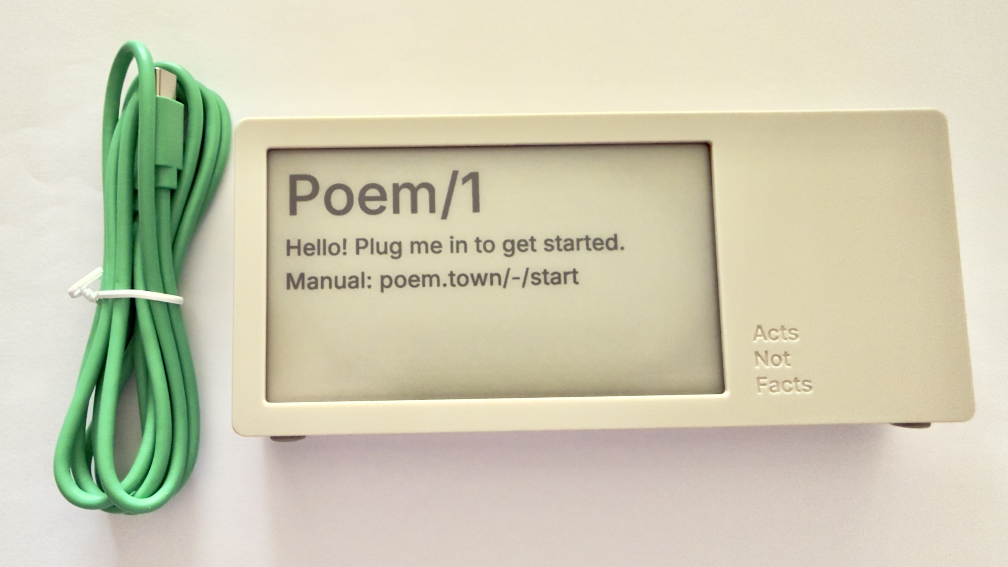
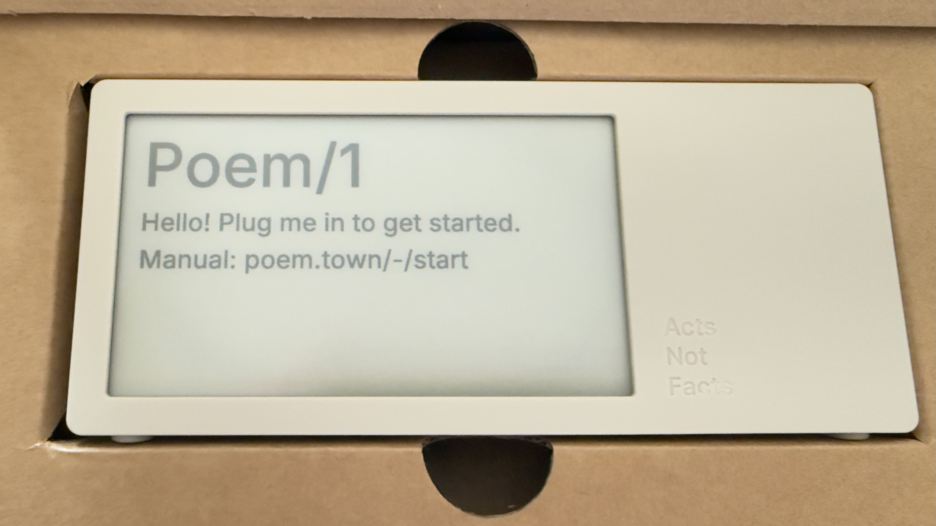
Today a package arrived that I’ve been deeply looking forward to. Part of the anticipation is the pure utter whimsy of it, part is it was a Kickstarter project that involved hardware (read hardware is hard when manufacturing is involved), and knowing the creator and watching all the steps along the way I was happy to see it and touch it. This is the Poem/1.
Most of all, this device is giving me a lot of enjoyment and, well, glee.
The Poem/1 Arrived
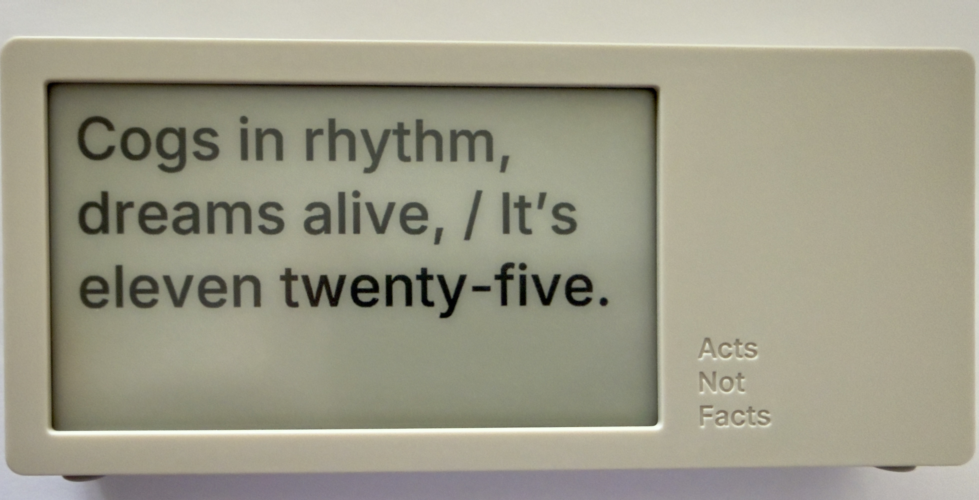
This poetry clock in the few hours I have had it running, with its e-ink display that updates every minute with a new poem for the time, which is / was generated by AI. Some of the poems are, well unique, and others are wonderful, but they can be favorited with the one button on the device.
The one button does a lot of work. It can be used to favorite a poem. There is a site with a dashboard for your device where you can push it notes you write to display, but to clear the note and get back to the clock you use the one button. There is a sleep mode with a screen saver and to clear that, you use the one button.
The Poem/1 also has one USB-C cable. There is no manual in the box. Everything you need is the new Poem/1 device, the USB-C cable, and the e-ink screen tells you the rest.
After plugging it in you get a screen with some technical details and a QR code and using your phone with the QR code it then walks you through everything from easily connecting it to your WiFi (if printers could do this…), then make a selection or two and you have poetry time. There is also a dashboard website and the setup to your device is incredibly easy as is the setting up the account on that site.
The Journey of Poem/1
About 3 years ago Matt Webb blogged about an idea he had about an AI poetry clock, My new job is AI sommelier and I detect the bouquet of progress (Interconnected). This soon got connected to an e-ink device and Matt was on his way.
Matt setup a Kickstarter, which I happily backed. It wasn’t that I was overly keen with the AI bits (I’ve been working with AI/ML going back to 2008 and stayed current and it is a thing that I treated, like most everything else, as a tool). But I enjoyed the process of little printer – BERG and its outcome from afar. Having watched Little Printer’s journey of toil to come to life from Berg London (Matt and the amazing folks there), I wanted to support Matt (who mostly did this Poem/1 project alone). This provided insite into his long journey of quickly getting to a working prototype, then the slog of finding viable parts, a manufacturer, various regulatory approvals, and iterations when due to various things there were changes made late mid-stream to add to the delays.
Matt has done a good job logging his slog and journey. There were times where I’d realized I’d forgotten about Poem/1 and not heard of any progress in a while. About that time Matt would have an update in Kickstarter or on his blog.
Then there was US Customs, which stalled things for a while (not the tariffs, which became a hurdle earlier), but there there was more paperwork needed around “what is this clock”, oddly I (the customer) was sent the forms and I knew there wasn’t a winding mechanism nor jewels in it (well I haven’t checked inside, but pretty sure there are no jewels). Matt did a great job documenting the US Customs documentation hurdle in his post, How global logistics got me over my fear of personal agents (Interconnected) (my having worked at a Custom’s Brokerage for a few years I know the many reasons brokerages are needed).
What Time Is It?
I love the ability to favorite a time. (What is your favorite time?) In a few hours I have a couple favorites that I quite like:
Puddles reflect lost skies, / At two forty-five, heart sighs.
At twelve fifty, shadows creep, / Secrets held within silence deep.
Willow branches gently sway, / It’s twelve twenty-five today.
Thank you Matt I now have favorite times and a wonderful product.
Tomorrowland IndieWeb Movie Club Review
The IndieWeb Movie Club - IndieWeb this month has Tomorrowland (2015) — The Movie Database (TMDB) as its focus this month, which was suggested by Tantek - May 2025 IndieWeb Movie Club.
Review of Tomorrowland
I finally watched the whole of Tomorrowland. My son had strongly recommended Tomorrowland after he saw it when it first came out, saying, “this is a movie you will love”. About two or three years ago I started watching it too late one evening and was about 45 minutes in and put it on hold, but didn’t get back to it.
Rather than starting where I left off, I started all over from the beginning. I didn’t remember much from my prior watching, but watching it from the start I had the same feeling and thoughts of, “this isn’t going where I thought it would go”. I had this thought a lot. The movie is largely had non-linear chronology in many spots and plays with time concepts, which is something I deeply enjoy.
Given it is 10 years beyond release, I’m not worrying about spoilers (in River Song voice or not). Much of the movie is working through crossing time and timelines from current storyline to one future timeline. The future, Tomorrowland, is a glimpse of the future created to show the possible optimistic outcome. Athena (Raffey Cassidy) is a young human-skinned bot who traverses Tomorrowland’s timeline and space to bring people in to help it become reality, but also save it. Hence, our two main characters, Frank Walker Geoge Clooney) and Casey Newton (Britt Robertson). Frank is the jaded and pessimistic creator who is back in our timeline under agreement to stay there. Casey is new to the Tomorrowland experience from her “gifted” token.
The movie leans into the Two Wolves - Wikipedia legend and storytelling device where the white wolf is positive and optimistic and the black wolf is negative and pessimistic and the one that wins is the one you feed. I felt this worked well and was a good underlying story driver.
Much of the movie was quite good, but some transitions were a bit bumpy. But, that may be intentional as much of the focus is on Casey and her perspective and at many key points she doesn’t have any understanding of what is going on, what the hole journey she is on is about, and also lacking context to have a foothold to understand what is going on. The only character that didn’t really seem fully fleshed out was the possibly evil David Nix (Hugh Laurie).
From a first watch perspective the bumpy path of the journey was a good framing and means of pulling the audience into the characters understand of what is happening.
The Wrap-up
I quite enjoyed Tomorrowland and my son’s estimate was pretty dead on. I really enjoy plays on time, timelines, and reality and this ticked the boxes well. The story was good and pulled the viewer along. The acting was good and cinematography and editing supported the time settings and moods along the storyline.
I would / will watch this again, but that will be a very different perspective. To give it a rating I’d put it at or just under 8 out of 10. It isn’t perfect nor did it put me in awe at any point, but it was quite enjoyable, ticked boxes for story focus I enjoy, and there are spots and perspectives I may be thinking about for a while.
Weeknotes - 07 February through 28 February 2021
This is a late posting of a combined set of weeknotes, which doesn’t cover much. This stretch started with a sinus series of sinus infections and then the side issues stayed. But, at the start of it went through the Covid–19 tests as a precaution (yes, the one where a swab is inserted into your nose so deeply they must be testing past lives too). The sinus issues have remain, with improvement and regression. Work has also been cycling through some deep model work where foundations and goals shift, in a very complex environment and taking mapping of models and needs from very complex into something more simple for initial framings that can adapt.
Read
“Posti (yes, the Finnish postal service) recently launched a new concept complete with good lighting, dressing rooms, an organized recycling area and wrapping stations. Designed for city-centre workers who would rather not have their goods delivered to the office, the concept allows for outfits ordered via e-comm to be tried on in a dressing room and then sent back if they don’t fit. There’s also an array of paper, boxes, ribbons and stickers for wrapping and sending gifts that would challenge even the best Japanese department store.” from - Monocle Weekend
Edition: Sunday: Finnish line
–
Matt Webb writes about Memexes, mountain lakes, and the serendipity of old ideas and focuses on note taking, particularly smart people have reservoirs of notes they have taken and can pull at them to quote and interlink ideas easily.
Listened
On the walk listened to Ted Radio Hour - It Takes Time. Which broke into four segments: Sloths with zoologist Lucy Cooke, neuroscientist Matthew Walker, architect Julia Watson on long time and deep time(also has a book Lo―TEK - Design by Radical Indigenism) , and NASA engineer Nagin Cox who talks about different time patterns needed for working with Mars day time and keeping in sync.
–
Paul Ford and Rich Ziade had another gem, well the pretty much all are, in today’s Postlight Podcast - No AI Needed: Fix The Old Before Bringing in the New as they get into the Gartner and enterprise always looking at the shiny but not dealing with the underlying messes.
The Shifting of Timetonic Plates
Much like the shifting of tectonic plates that cause earthquakes, the bi-annual shifting of timezones not in unison causes rumblings in schedules and disturbances of varying severity. This shifting of timetonic plates can be really problematic for businesses coordinating meetings, establishing seamless logistics, and syncing interaction schedules across continents and regions.
Unlike earthquakes form the shifting of tectonic plates, the timetonic plateshifts are all man made disruptions. There are many valid reasons of shifting from standard time to daylight savings (or in some regions, just daylight) time and shifting back. Part of the rationale is safety for children going to and coming home from school. But, the recent shift that was made to get more day light evening hours in the United States was driven by the outdoor entertainment industry (read BBQ makers and similar) has made the prior no difference or a week or two difference from the usual timezone differences we normally work around. Now we have nearly a month of being off kilter in the spring and two or three weeks in the fall.
One day people may realize if we are going to make shifts we should all do them in sync. Nobody is that special that they can create an hour more of daylight (as one bleary brained U.S. Congressman claimed in the need for the shift a few years back). The damage this does to commerce and extra effort this always takes when systems are out of sync in our heavily interconnected world may not be worth the cost of trying to be special.
Manufacturing Time
In addition to trying to hack a habit into existence around blogging every day (here but also counting the larger posts over at Personal InfoCloud, which is mostly working-ish), I am trying to hack my sleep cycles.
For a few years I have been running Sleep Cycle app to optimize my sleep wake up times so I am feeling more rested (read, “a lot less cranky”) by waking in the optimum sleep pattern. This has been a great tool and has really helped.
While all things are lovely on this front, I have been trying to sort out how to better optimize time or create more productive time. I haven’t been getting optimal output, which I was used to over many years. Part of the shift was slipping out of good habits, but on a recent work travel stint (I’m always a lot more productive when traveling, even though I’m lacking some resources (physical books) on the road).
In working through this productivity difference, it starting coming down to the revelation that home cycles include family time and driving my son to practices and games (I love doing this), but by the time I return in the late evening I am not as ready nor willing to sit down and work again.
While there are tasks that will engage my mind and I will get a lot of focus and crank things out (this is largely coding projects) but the late evening turns into night and then middle of the night quite easily, the evening is rather out. So, if I am trying to manufacture more time for productivity during the day the morning is the other option (in science fiction cracking open as slice in the middle of the day to add time would be a possibility, but I’m still living in my version of the now).
I am hoping to shift my 8am wake time, which ties to a midnight to 1am sleep time, back about two hours. I chipped back about 45 minutes today and hoping by week’s end to have this down.
Broken Decade Precedes It Works Decade
I had long forgotten this Carl Steadman response to Michael Sippy’s “Just One Question - What do you want for Christmas”, but the response from 1997 is fantastic and frames the 1990s as the broken decade. (I’ll wait for you to go read it)
I’m not so sure that Carl’s broken decade got better in the first half of the 2000 decade, but it really started to. We are much farther along now. Our consumer world started to improve quite a bit and slowly business systems and services are slowly improving. The initial part of Carl’s rant focusses on the number of steps to get something going. Once it is working the steps are still clunky.
Carl gets in a great rant about time and how broken it was in the 90s within technology (calendaring and syncing is still a beast and likely to for a bit longer - you understand the problem sets and pain points if you have ever tried to build syncing). With calendaring and its related activities we now have Tempo, which is freakishly close to the next step scenario I used in many of the Come to Me Web presentations and Personal InfoCloud presentations from 2003 through 2007 (I’ve been getting requests to represent them as this is what more and more developers and designers are dealing with today and need to have a better foundation to think through them). There was an internal Yahoo presentation (and follow on day of deep discussions and conversations) with a version of the Personal InfoCloud and Come to me Web flow that is nearly identical to the Tempo app video scenario and ones spelled out in Robert Scoble’s interview with Tempo CEO, which is utterly awesome that it is getting built out some 10 years later (we had the technology and tools to do this in 2004 and beyond).
Carl’s rant gets worn away over time though consumer devices, services, and applications. The refocus on ease of use and particularly the use through mobile, which requires a very different way of thinking and considering things. It thinking through design, the dependancies, and real user needs (all while keeping in mind the attention issues, screen size, networking, and device limitations). The past couple years mobile finally caught on with mainstream users and people doing real work on the mobile and tablets - Box 40% mobile access of files stored there over the last couple years. Many other business vendors have had mobile use rates of their services from mobile over the past two years. When talking to users they opt for mobile solutions over their full enterprise tools as they are much easier to use, which quickly translates into getting more work done. As Bernd Christiansen of Citrix stated in an onstage interview the employee’s most productive part of the day is often the walk from their car to the front door of the office working on their mobile devices.
This world is not fully better and fully easy to use from the days of Carl’s rant, but it is getting better. We still have quite a ways to go.
Personal Disconnectedness of Travel and Generic Architecture
Um, what does one do at 2am in the morning (after sleeping four hours and waking at 1am)? Blog.
Unfocussed Cursor Blinking
I am finding that this long distance traveling has been really increasing my personal disconnectedness time this year, where the mind, body, and soul are not joined. Some call it jetlag, but it seems deeper. There were times yesterday where my motor skills just were shot (as they normally are with long travel on the first day). Other times my mind would just freeze mid-thought or sentence. It is not a bad thing, but more of a just "is" thing. It feels like the unfocussed blinking cursor syndrome, where a window on the desktop has a blinking cursor and you believe that if you type your text will show up there (the password box on a web form), but in reality it is some completely different window (like chat session) that has focus and displays the text as you hit enter to submit.
The SimCity Model for Urban Redevelopment
At a meal yesterday (brunch at Darling Harbor or dinner at Bondi Beach) I began to think that many cities are just replications of SimCity with similar architecture, where the cities are rather modern and/or developed in the mid-1800s. You can plop down a new structure that is similar to one from another city. Much like the new buildings in Darling Harbor look strikingly like the new Baltimore, Maryland Inner Harbor. Much of Sydney yesterday felt like something on the North America West Coast, as they were built and grew up about the same times in the mid-1800s and had similar cycles of growth over time. On Pitt street in Sydney, where it is a pedestrian mall, it really felt like there were some Commonwealth flourishes, like shopping arcades, put in San Francisco's Financial District.
Architecture as Cultural and Location Grounding
This quasi-generic western culture Pacific Rim architecture washing tended to compound the personal disconnectedness I was experiencing. Not only was my being disconnected, but the physical markers of my surroundings were off kilter as well. I somewhat experienced that in Berlin last Fall with the new modern architecture around Potsdam Platz. I felt far more grounded and connected in Friedrichshain as it was not modern and had native architectural elements that were not pan-global.
When I travel to Europe I like doing my time correction to resolve the personal disconnectedness is Amsterdam as it is distinctly Amsterdam. I know internally that I am in a different city, different country, and different culture. But, in Amsterdam they speak English very well and are technically adept (often leading to better understanding of mobile usage and other technosocial interactions that are missing in America as it lags Europe with technical adoption on many many fronts.
Similarly, I found Innsbruck to be similar to Amsterdam in its distinctive architectural elements, but even its modern architecture was very germanic. Growing-up I was a model railroad fan, but many of the buildings were not similar to the architecture I knew growing up on the West Coast of the United States as the larger makers of pre-built buildings and models for model railroads was from Germany, the Netherlands, or Belgium (I really do not remember the name of the company), but when taking a train from Schiphol to Amsterdam many of the post-war-modern (World War II) buildings looked straight out of the scene set catalogs for modern railroads. But, there were many buildings in Innsbruck that had the same architecture mixed in to the Tyrolean architecture.
2 Feet, Thousands of Miles, and Time
My first afternoon in Amsterdam I ran in to Mike Kuniavsky in the hotel. Then Ben arrived and we stood in the hallway near the registration desk chatting and trying to work out logistics. My GMS phone has SMS and so did Mike's phone, with a Dutch SIM chip. He sent the introductory hello SMS ping to my phone so that I would have his local number. Once it was sent we waited for a minute or two to have the ping leave Amsterdam, go to the U.S. hit my carrier, route the ping back to my phone in Amsterdam a couple feet from the phone that sent the SMS.
I know this has been done thousands if not millions of times already, but the time bubble was wonderful. The length of time it took seemed like forever, particularly SMS at home can hit in seconds (with the exception on CDMA networks which seconds are about a minute or two). Yet, when thinking of the vast miles the ping traveled in that short a period of time it is still astounding.
Time theories and information gathering
Ftrain's accordian time I found to be enjoyable. I enjoy time theories and find this to be close to my own personal favorite as accordian time accounts for the percieved difference in time. Some folks have a, so called, strong inner clock that is in step with metered time.
Chronological time is problematic for many as their lives feel wholly out of step with the beating minutes regulated to 60 seconds. Time seems to move in spurts and is quasi-random. My personal time theory to account for the difference in perceived time is that everybody is on a different time pace and some folks do have time moving faster for them, while others have time moving far more slowly. These differences are synched at night so that we all can work and play together. This is just an unsubstantiated theory on my part, but I am happy to find others thinking of other time measurements that can account for perceived differences in time.
Alan Lightman has a collection of time scenarios in his Einstein's Dreams. I found ED a wonderful quick read that added a wonderful collection of time theories to my existing stack. It has been a few years since I read ED, but it seems about right to pull it off the shelf and have another go.
Time, or perceived time, is important to understand when developing applications and information structures. Different individuals will become frustrated if they can not find the information they seek when they desire that information. This is partially dependant on the persons perception of the passage of time or their relation to metered time. A person who normally has time passing slowly may find most information is easily found, but if they are trying to trackdown the address for a date or interview in a relatively short time before the event the persons perception of time may increase. This impacts the perceived ease of finding information or re-retrieving that information. The frustration for this person may increase as they can feel the minutes or seconds slipping away. This cognative element is helpful to understand as we test and build interfaces.