Off the Top: Blog Entries

Showing posts: 1-15 of 95 total posts


7 June 2026

Slideshare is Back Functioning Well

I’ve been thinking about how much of a relief it was to see Slideshare get a refurbishment. A few weeks back I went to Slideshare following a link that I didn’t pay attention to where it was going. But, when I got to Slideshare I was pleasantly pleased that it was not only working, but seemingly in good shape. I looked and it seems like all of my old presentations are still there even it it looks like my old view and download counts were reset at some point, c’est le vie.

I was a really early user of Slideshare and was the 6th or 7th person outside Slideshare shown the concept by Rashmi. My early sharing of my presentations by common web options and commonly frustration and needing a good service was a small piece of what got Slideshare moving. I think in Keynote, as one of my tools for having progressive reveals and animations to get ideas set. Slideshare doesn’t quite allow for that, but it is a good option for sharing.

I have a lot of blog posts which have presentations embedded from Slideshare when Rashmi and Jon ran it and then LinkedIn. Things broke in recent years when it left LinkedIn. I now need to track down all of my posts with Slideshare embeds and sort out what I need to do up update the embeddings. A lot of the progressions through explaining and breadth of things that folksonomy can help with are in Slideshare, and so much more.


6 June 2026

Personal Blog Data Analysis - Looking at 25 Years

After adding sparklines to my category lists (Updated Categories with Sparklines and Search is Now in Production) I wanted to have a deeper dive looking at my categories and blog analytics over 25 years.

Category Long Tail

I done a very quick capture of category usage to look at the distribution of use. A question from James about whether my category distribution looked like a long tail distribution and I thought it may, but also looking at the numbers and not having a visualization I wasn’t sure. Charting the use, it really was a very long tail / power law distribution.
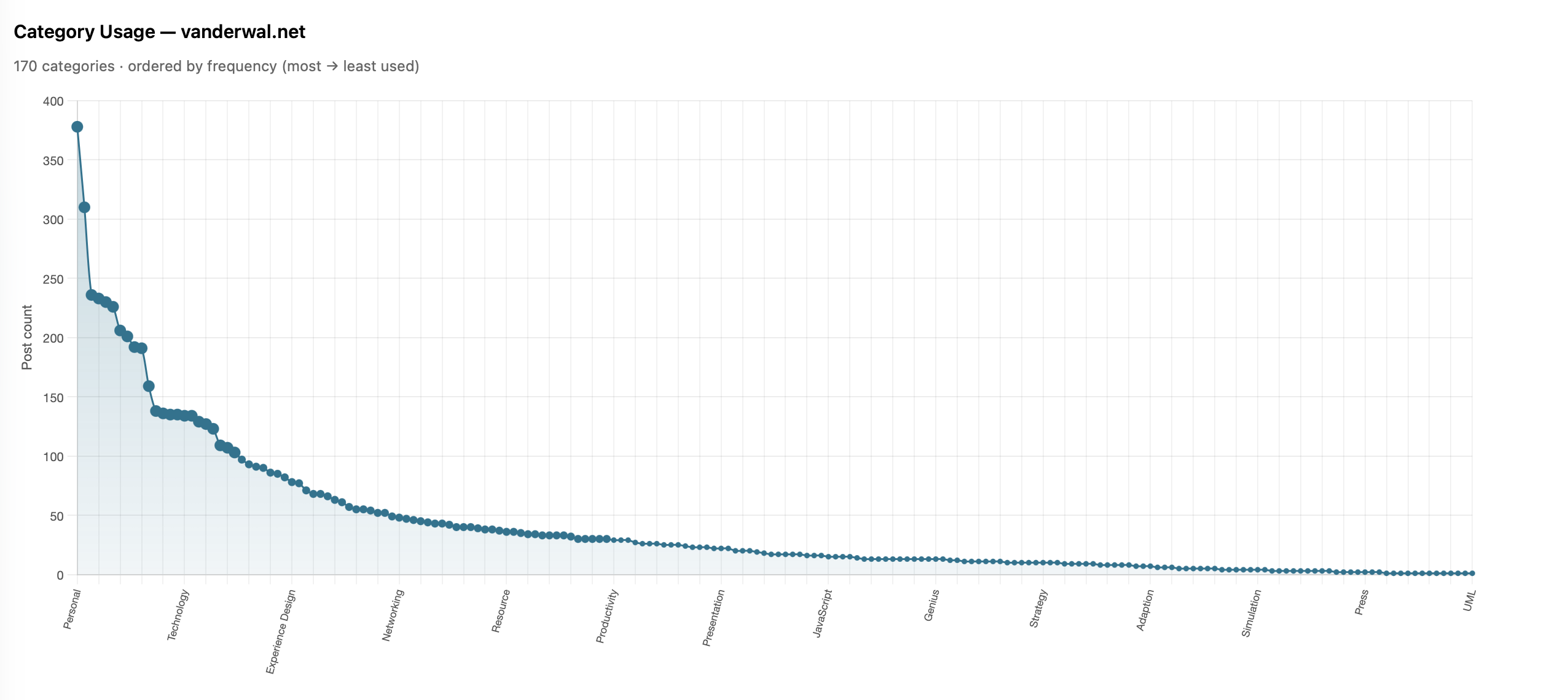
this chart is described in the test that follows

I shared it with James and he also ran his and ended up with much the same (Is there a power law of category use? - James’ Coffee Blog). There have been a few discussions of late around category use and some lean into having just a few categories. I have just over 200 categories now as most of my blog post have more than one subject and I use the categories to have an way to jump to related posts that cover the same subject. When I built my site’s CMS I wanted to have the capability to have multiple categories on each post. I have multiple categories for my own purposes, but also I’m cognizant that readers may have other terms.

With the long tail use of categories I know readers may stumble across a post through web search or a link from else where and having a category term that is familiar can get them to other things I may have posted. I view the web as being able to connect with others and blog posts are sharing things I have interests in or curiosity around and being able to connect with others in a similar mindset is the aim. So a handful of categories, particularly across 25 years and over 2,100 posts, doesn’t help build those connections.

More Analysis on Blog Posts and Categories

This distribution of categories really pushed my interest and curiosity of what the last 25 years of blogging looks like. I joke that Twitter ate my blog, but the sparklines sort of show that. I wanted to see the trends on my blog more closely (I have the archive of my Tweets and I’ll analyze them later and then bring the two analysis together).

To prep for the analysis I pulled my site’s database data local and put it into SQLite (it is already on Mac - Apple and quick) to connect locally with Jupyter Notebooks and use Plotly for interactive data visualizations in the notebook. I had a series of questions, somewhat common data analytics questions I’ve used since grad school looking at analysis over time.

Posts per Month
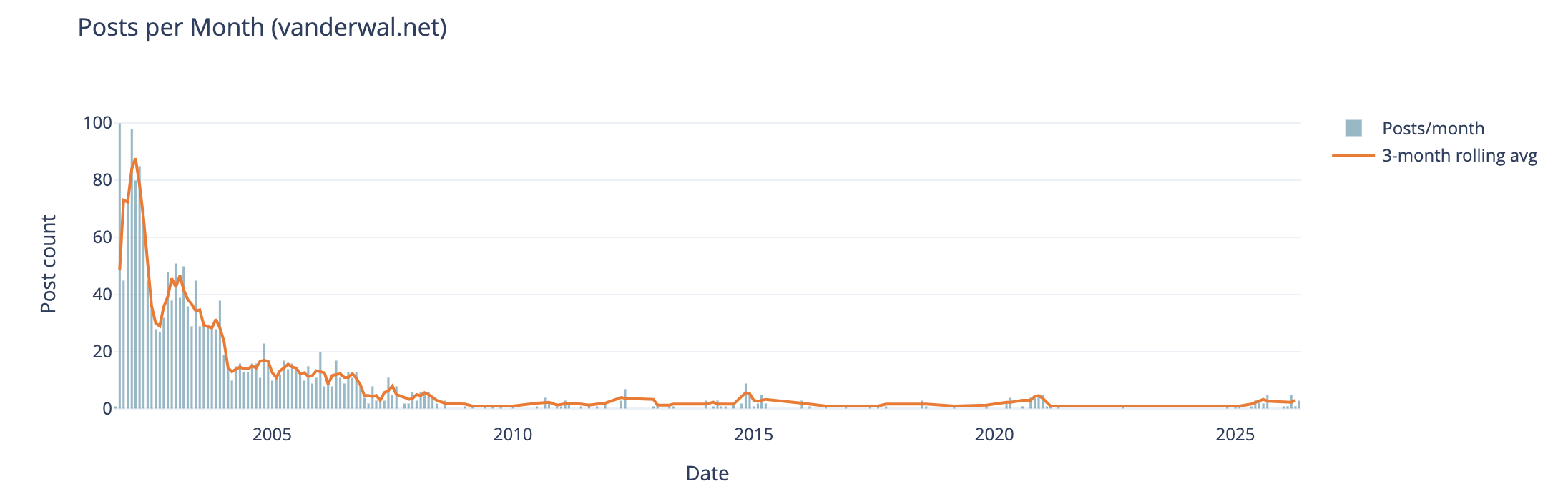
this chart is described in the test that follows

The first analysis is my blog posts by month over 25 years. In my early years I was posting frequently, often in shorter posts (but we will look at that next), and then around 2005 (when started engaging with Twitter) things dropped off. Also at this time I also started blogging more serious subjects at Personal InfoCloud, but those were not all that frequent (I’ll dig into this at some point later too).

My hunch that I posted much more early on and drop off around the time I engaged with Twitter, seem to hold up.

Post Length Over Time
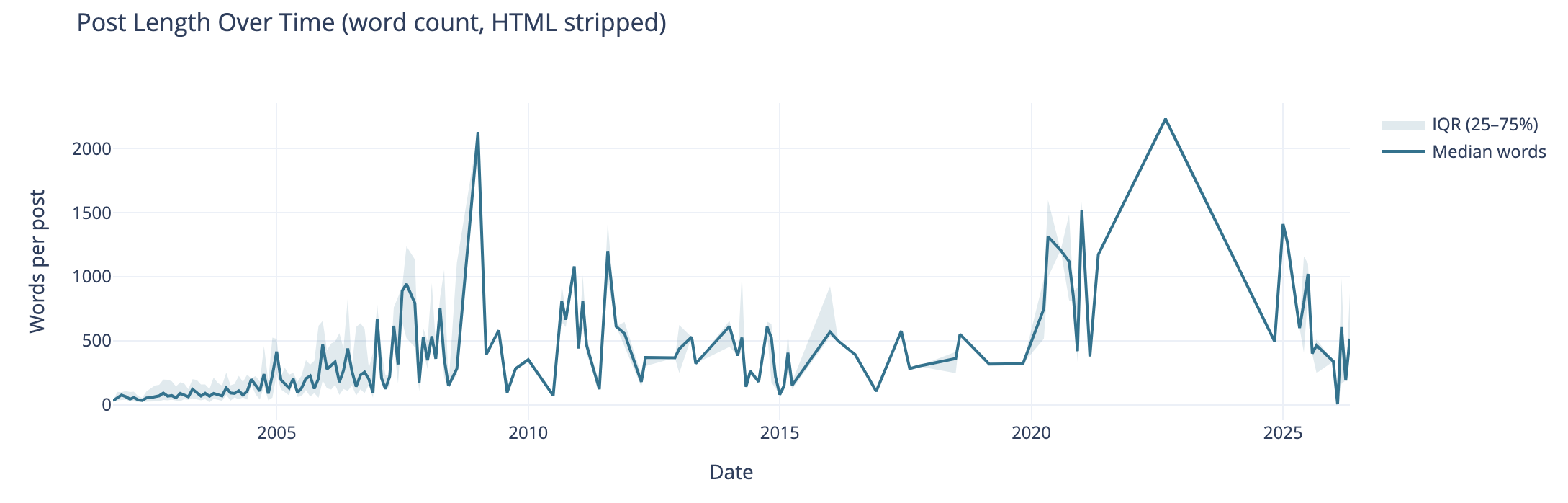
this chart is described in the test that follows

Post length over time also can tell the story of why post volume shifted. I wasn’t posting a lot of short post, but posting longer posts, but less frequently. I’m really curious what I posted in June of 2009 that caused the spike. The spike on the right end in 2020 and beyond are partly attributed to posting weeknotes, which tended to be longer than normal.

I know that my writing muscles went from a few hundred words early on to posts being around 1k and more. I found my comfortable blog post writing length was around 1.2k words. I write to find out and capture what I think, but rarely edit for brevity or other editing benefit, at least on this blog.

Median Categories per Post
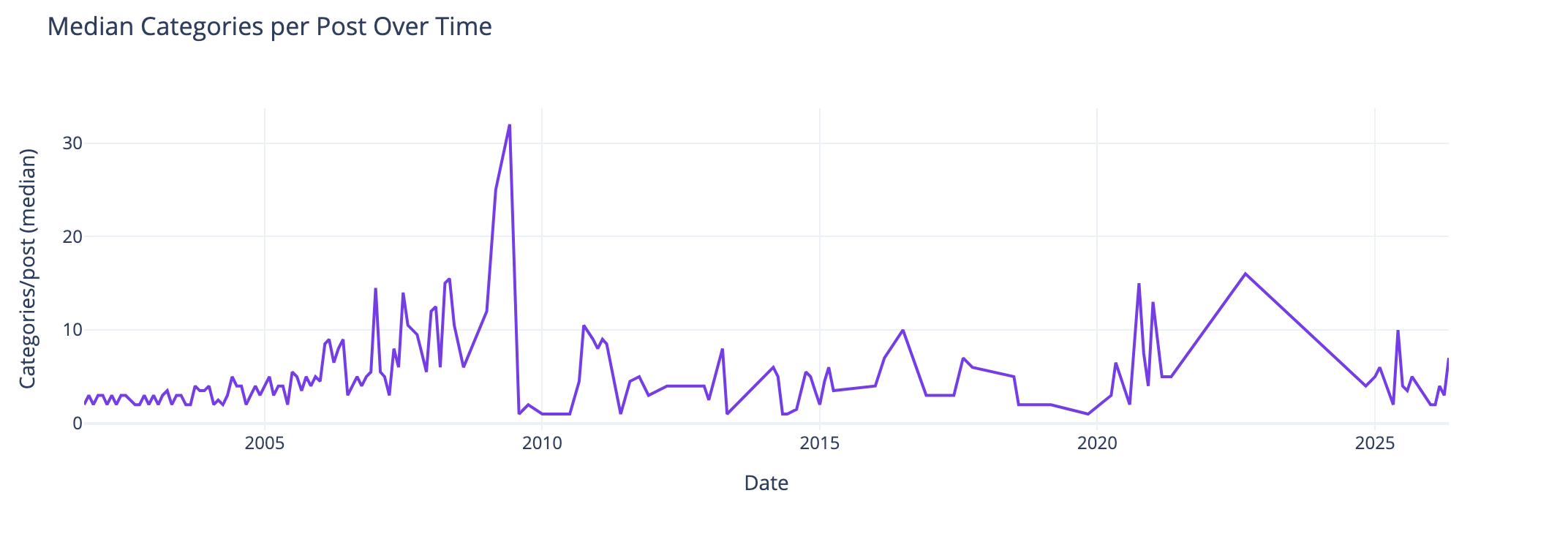
this chart is described in the test that follows

This view of the median number of categories per post over time I found interesting and I didn’t know what my expected outcome was going into this analysis. The numbers pretty much are in line with longer posts have more categories to cover slightly more breadth in a post. Again June 2009, not sure. The spike spike on the right aligns with weeknotes, which cover multiple subjects in one post.

Distribution of Categories per Post
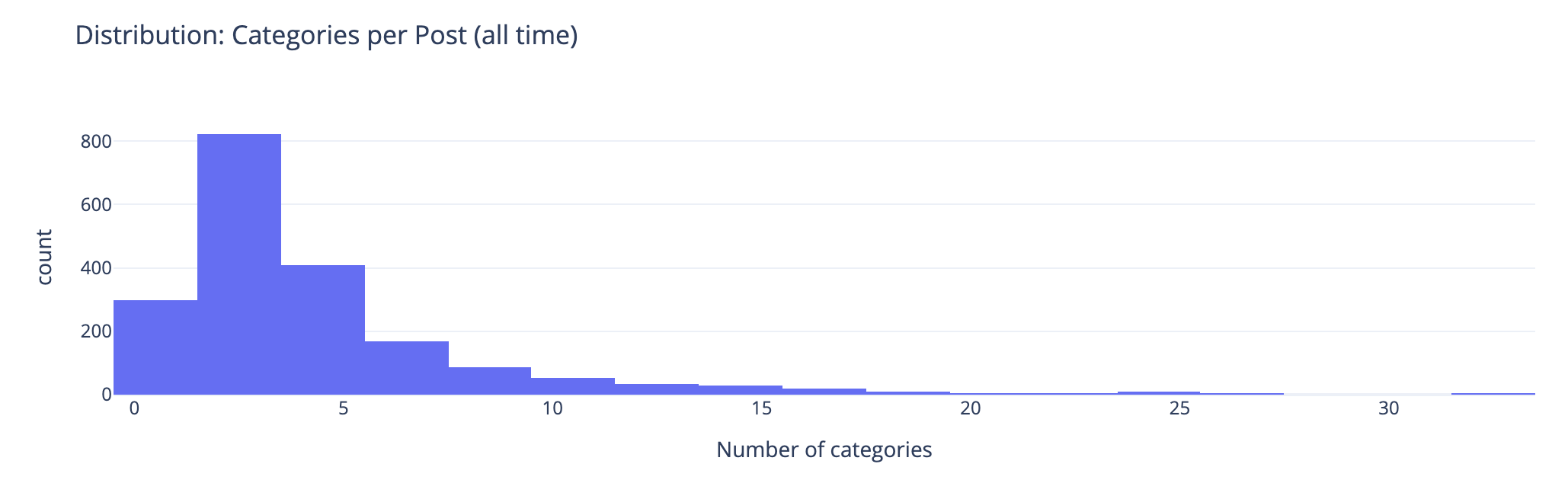
this chart is described in the test that follows

This chart groups number of categories on posts. This shows the second bar has the most number of posts (822 posts) have 2 or 3 categories on the posts. The third bar has 408 posts with 4 or 5 categories on them. This lines up well with the frequency and volume of posts early on which were shorter. Looking at the prior chart most posts had 10 or fewer categories on them.

Combined Timeline for Posts, Length, and median
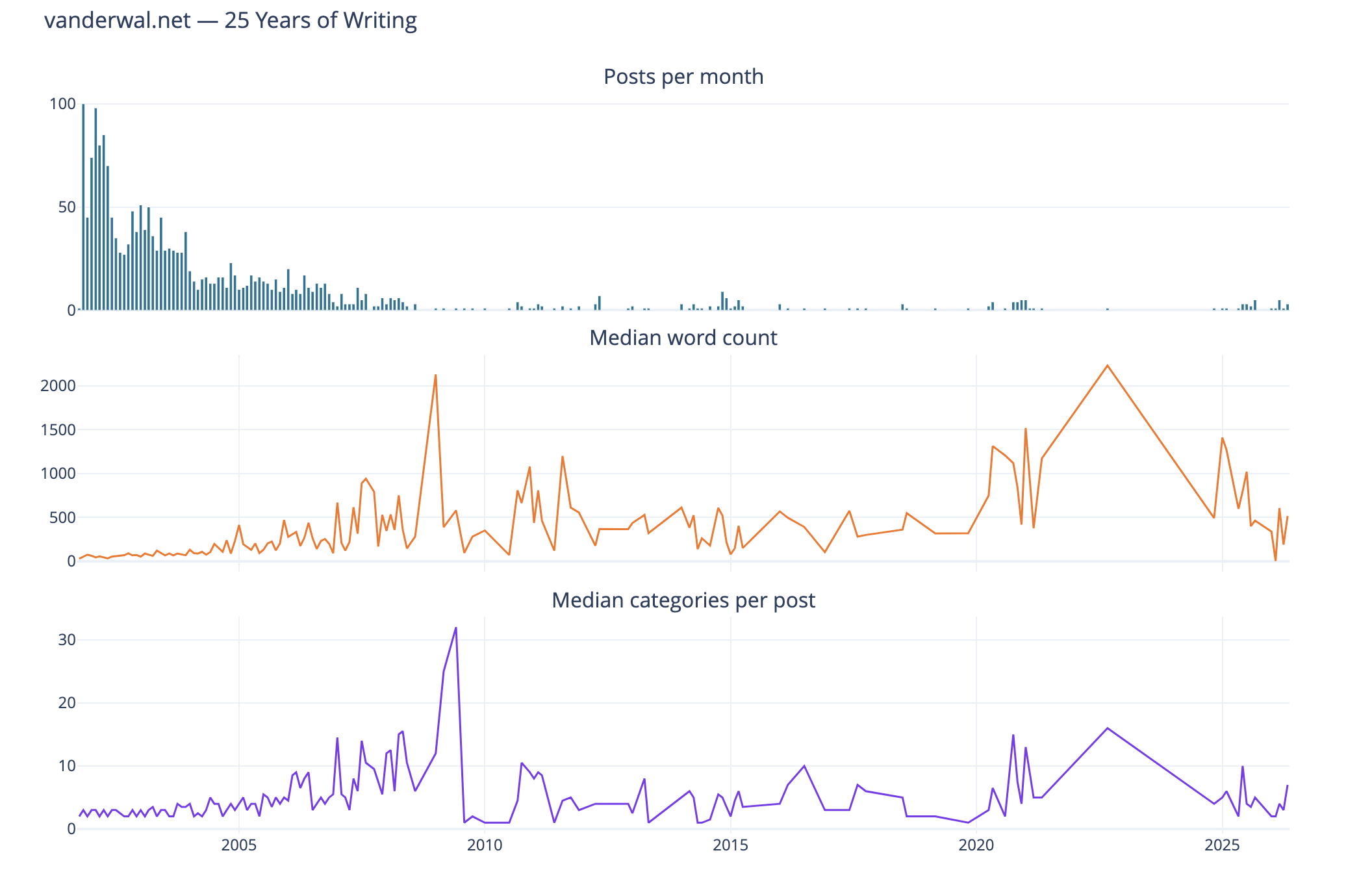
this chart is described in the test that follows

I like this combined chart that reinforces early on with high volume of posts of shorter length and few categories on them. What I find interesting is the correlation of line trends for word count per post and categories per post. This ties closely with the longer posts have more categories.

Seasonal Patterns
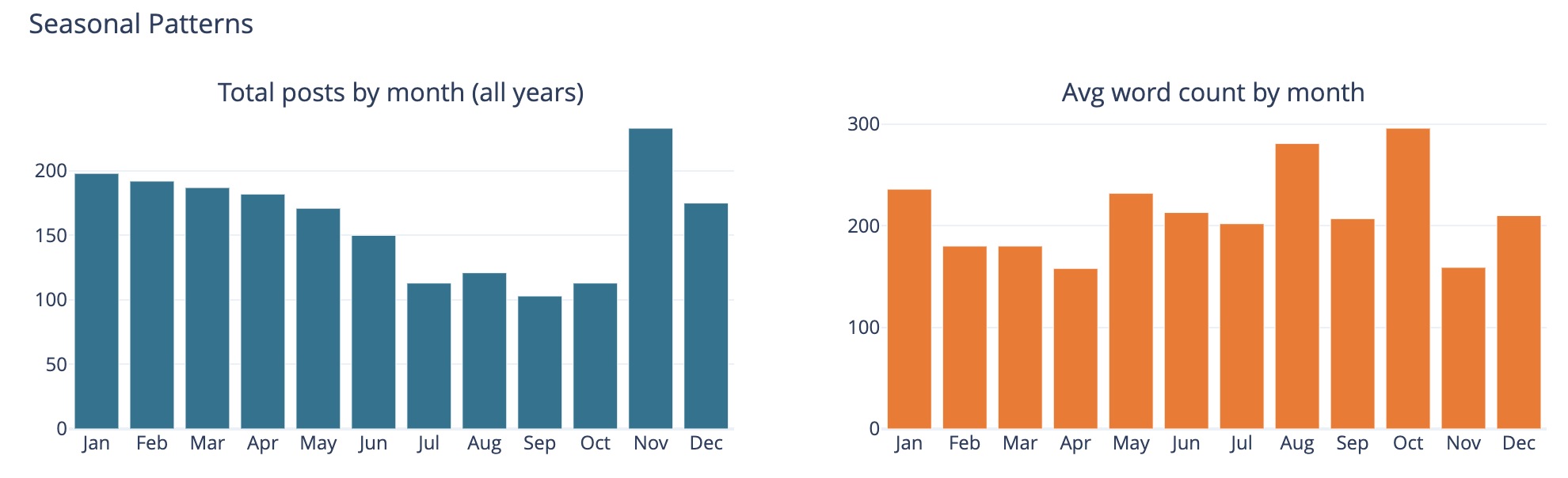
this chart is described in the test that follows

The bar chart on the left is total number of posts by month and on the left it is average word count on posts by month.

This was largely a curiosity to see what was there, but also a common analysis trend analysis to see if there are explanations of other trends looking at seasonal comparisons. The posts by month is not surprising to me as summer and early fall months have often been busy. I am not all that sure what the word count by month tells other than the correlation between more posts and shorter post length correlation showing up.

Top Category Activity Over Time
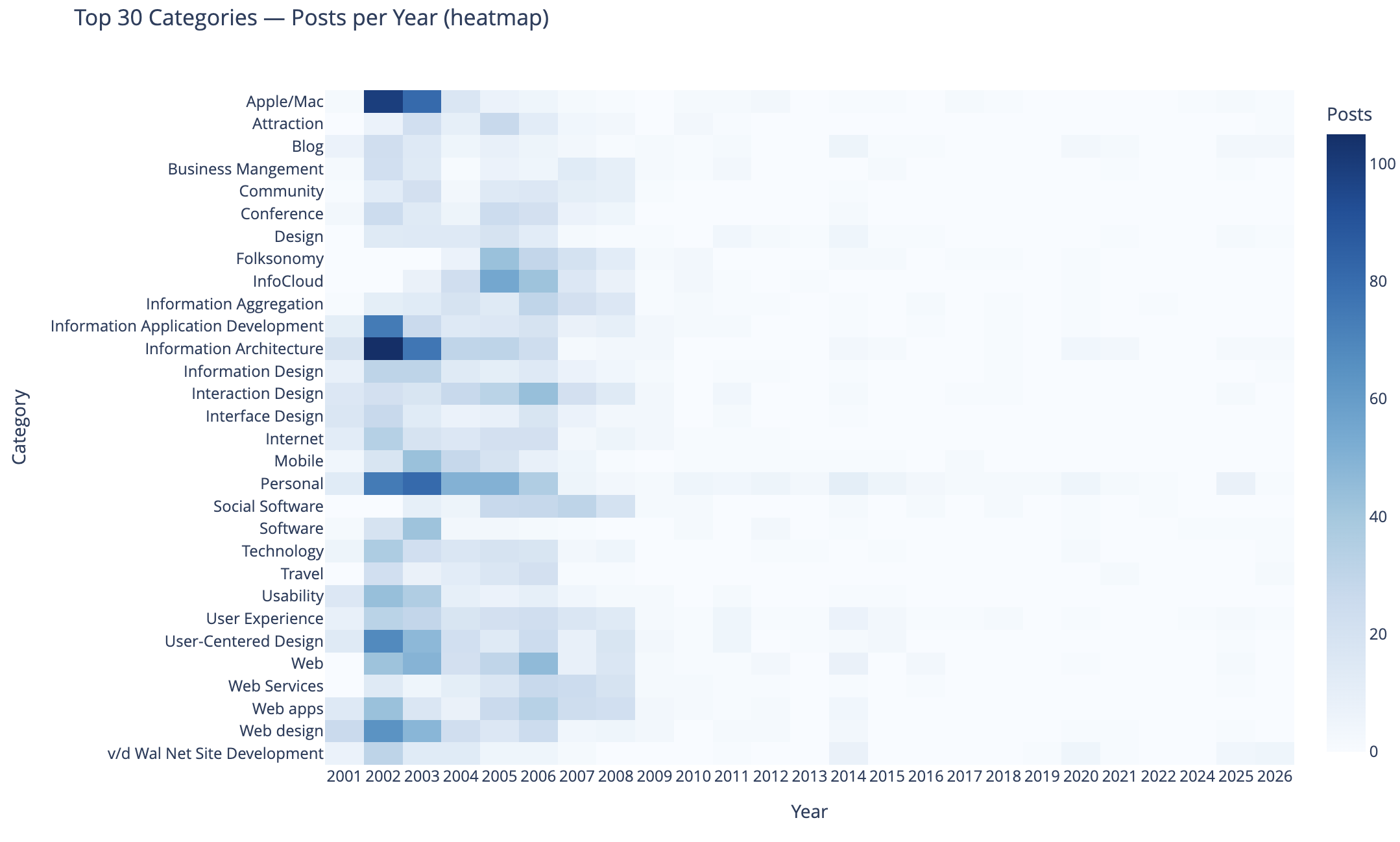
this chart is described in the test that follows

This chart shows the top 30 categories (by use) and their activity over time.

In this heat map Apple categorized posts were sure common, as well as Information Architecture, Information Application Development, Personal, User-Centered Design, and Web Design were also common. Personal and this site’s development.

The heat map being far more dense on the left in early years is skewed by volume of posts and makes activity in the middle and right (more recent years) difficult to see. I need to spend more time on this analysis and chart to separate out the early years and segment things so time outside of the early years can have trends more easily seen. I may want to select a different visualization, but if I can break things out by time that should help. Also running 3 time segements with the same top 30 categories across them and then the top 30 within each time segment could be interesting.

To 40 Co-Occuring Category Pairs
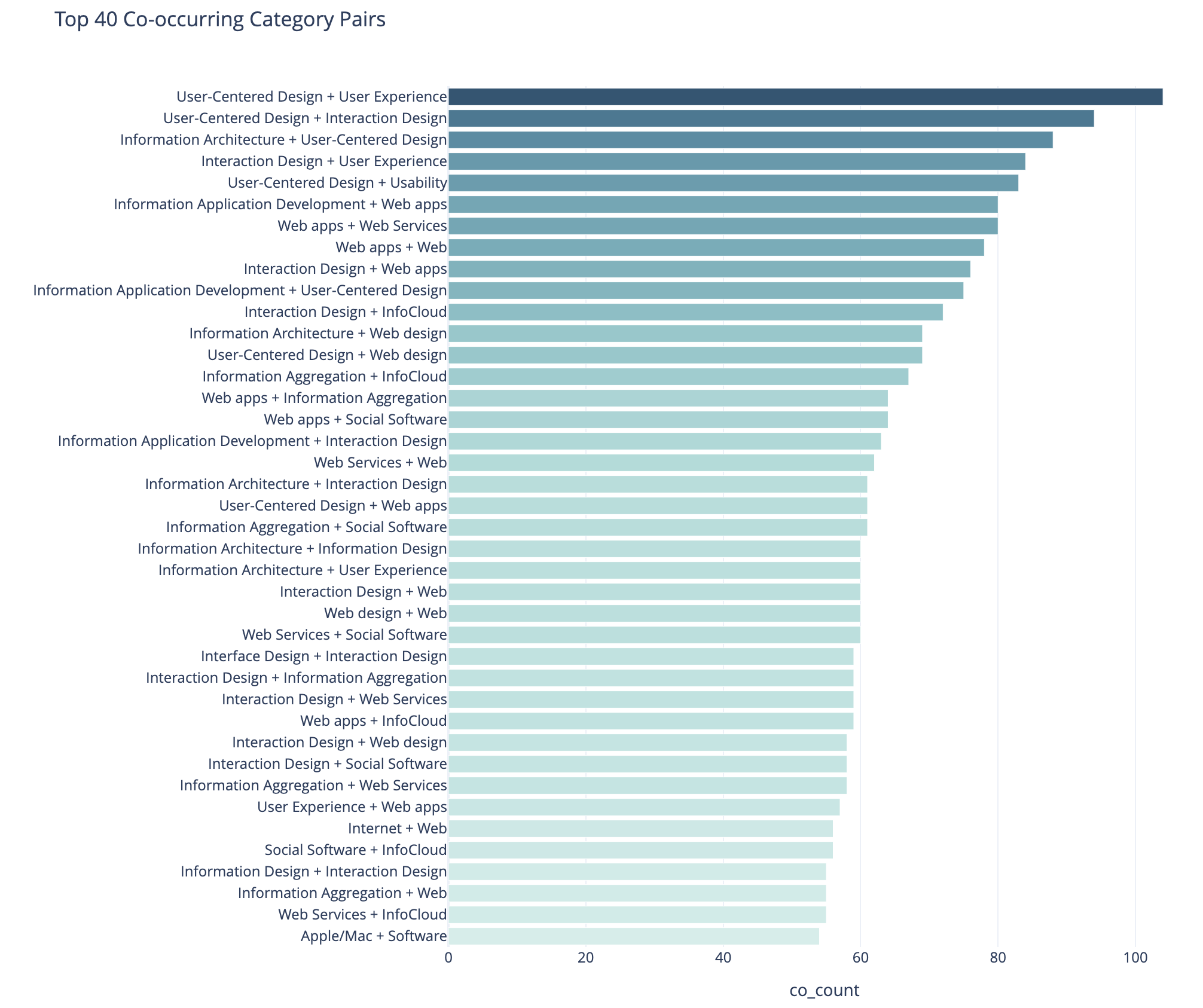
this chart is described in the test that follows

This cart of co-occurring category pairs is in part preparatory work for bringing concurrent tags into the category pages here for understanding and filtering needs for users.

The top 5 pairs are all related to UX, IA, and User-Centered Design and these being the type of concurrence isn’t a surprise to me. The broad UX community had rather divergent use of terms at times and one person’s IA was and other’s UX. For readers who think about these posts in one manner could find other similar content by the term they are familiar with using. Pretty much this whole list is application development, web design and development, web apps, and pan-UX related.

I don’t know how useful this is for broad insights. When I get to adding the concurrent categories on the category pages this will likely be more helpful on a category by category view.

Category Co-occurence Network Graph
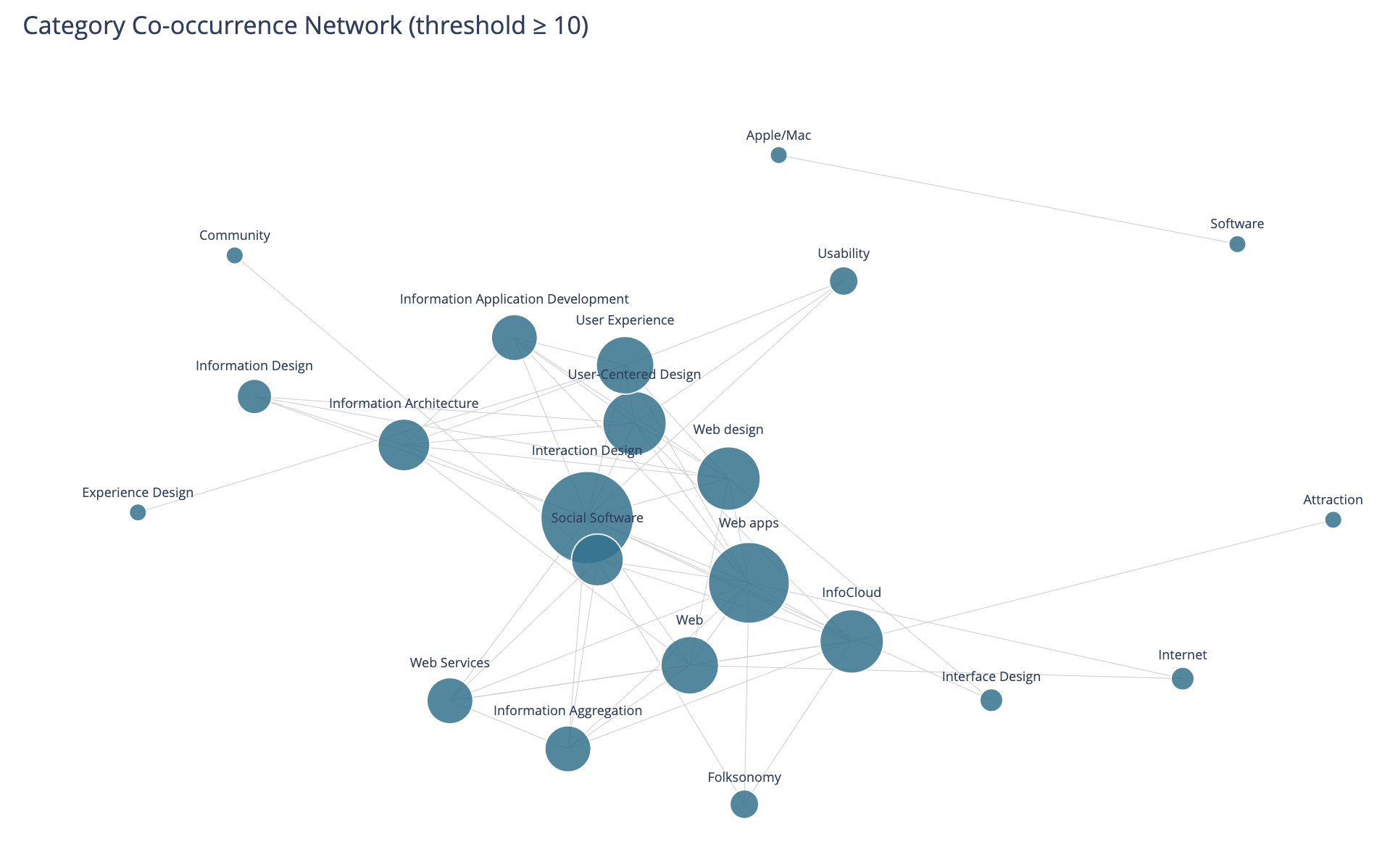
this chart is described in the test that follows

This chart looks at the top thirty categories that have 10 or more co-occurrence of categories.

This I find more interesting than the prior in that this has Social Software and Folksonomy showing up and showing its relationships. The largest category in this view is Interaction Design and its multiple connections. I am entertained by the standalone pairing of Apple and Software, that at the scale limited for the data these only connect to each other.

I need to rerun this with higher acceptance to get more included. But, also this graph isn’t interactive in Jupyter, and every time I went to zoom in it collapsed the graph and I couldn’t move a node out of the way was disappointing.

Helpful as a Good First Pass

This analysis and data visualizations were helpful to see into my 25 years of posts. There are some analysis sets and data visualizations that need more work. Most of these are more helpful with Plotly in Jupyter and the ability to interact with the visualizations.

I am really curious with what this will look like when I look at Twitter usage and notes. Obsidian on top of my notes make note making easier and far more helpful with backlinks / wiki links. I started using it on top of my directory with notes in June 2020 that had around 2k notes in it going back to 2003. Now there are around 6k to 7k and in the past about half of these notes would have been on one of my blogs.


30 May 2026

Updated Categories with Sparklines and Search is Now in Production

I made a couple of updates I have long wanted to make to this site. I’ve been wanting to see frequency of categories used on my blog for more than 15 years (or pretty much since I’ve had category list pages). I have also wanted to have blog search and the utter mess that Google Search has become in recent years, where my site isn’t showing at all at times has driven this. These additions will likely iterate and adapt a bit going forward.

Updates to Category Lists with Sparklines

I have basically had two category list pages for years: Category List (which is alphabetical sort) and Category List by Use. I have kept these two and added sparklines to them (Sparkline - Wikipedia). Each line now has a small line chart that covers the 25+ years and what periods had used the category and some sense of the volume of use over time. One category list view I wanted and was missing was one to show a view with the focus of most recently used categories, so there is now a Category Recently Used List that not only groups by most recently used (and in the same entry keeps the alphabetical sort) but also shows the date of the last use in the list. Personally, I have been finding this recently used list view the most helpful and interesting. Skimming through the list I know I have more recent posts that have covered or touched on a subject, but it didn’t include the category, and that becomes a quick task to fix that gap.

Sparklines?

I have been a big fan of sparklines to give quick understanding of data’s distributions at a glance, which I learned about in “recommended reading” of Edward Tufte’s book The Visual Display of Quantitative Information | Edward Tufte in grad school in social / policy quant classes. (There are are many Tufte essays and book annotations on sparklines at Edward Tufte Notebooks & Sketches | Art, Science and Sculpture).

Creating the Sparklines

In creating the sparklines for my category lists I looked initially (and have long looked at them) creating static images from the data and bringing the images in (this would mean updating the images and replacing the old with the new ones, which is relatively straight forward programmatically and something I’ve done in the past, but not optimal) and I also looked at JavaScript but it was a bit slow. I poked at using creating SVGs (which work well when printing or zooming in) and often are much quicker and less strain on a browser than JavaScript. I’ve had a few goes at SVG in the past and I get get my mind around simple shapes, but I would need a little help with sparklines. A couple years back on a sparkline spelunking I found Easy SVG sparklines | Alex Plescan which showed the how. But, I have SVGs somewhat in the same category as regex, which is I do it rarely and I’ll just use Claude Code | Anthropic’s agentic coding system \ Anthropic to assist with the creation.

Chunking the Data for a Sparkline

The other part of sparklines is they are intended to be small glimpses and I have 25+ years of posts and a monthly temporal segmentation would make for a long graphic. I played around with breaking things down to quarters, but in the end I went with two segments per year and roughly 50 data points to map out on a line chart. Running a test with the two data points a year was a reasonable enough glimpse to sort out if the category was used recently or what the variation of use was over time.

One of the interesting discoveries with the first lab run of the categories of sparklines was the rather “U shaped” distribution of the use of categories, which pretty much calls out the lull I had in blogging. This softening of blog post rhythm is something I call, “when Twitter ate my blog” (where the interesting things I would discover and want to share and interact around ended up on Twitter rather than my blog(s)). Other patterns that surfaced were limited use a category in a period when I was rather sure I had posted on the subject, some of this was I was not using the term in that way or I didn’t have the category in my system yet. One of the things that helped sort this out was using my blog search.

Search is Now Out of the Lab

One of the things I have been working on and using my my Lab at vanderwal.net is blog search. But, the modifications I made to the Category pages I found I was leaning on my blog search a fair amount to investigate things. But, the categories and blog search are both in the blog section of this site, so making the change from the lab to the production side made sense. One of the things holding back moving search over, was I had an SVG of a magnifying class in the menu bar with “Blog Search”, but no matter how small I made the image it still was messing with the vertical layout of the menubar. In removing the magnifying glass and just using text things kept to the same layout.

Bringing in Search

The search in the menu in the pages in the blog section with “Off the Top” or “random” in the URL which is where there are currently menubar links to Blog Search. I have the menu bar link to a search page to search from rather than a JavaScript drop down or other menu bar convention (again layout of the menu bar was part of the considerations).

When I was working on search in the Lab section I found I needed to make some modifications to the database to have quicker search and I needed to modify the database engine so I could have search include 3 letter terms as a minimum rather than 4 letter words. In working on search I found many of my early posts didn’t (and still don’t) have titles and I was using the title as the link. I initially thought I would just add titles, but there are around 300 posts that don’t have titles (I’m adding some as I touch the posts for other clean-up issues), but I ended up coding the search results to have the results just fill in “Blog Post #…” as a proxy for a proper title.

The initial 170 or so posts are not in the database and are therefore not in the search.

Bringing Search and Categories In

As I went to move the category list pages out of the lab and into the production side I needed to modify a few other templates and pages to add the updated links. In doing this I realized I could also easily update the menu bar to include “Blog Search”. So, I took a little bit of time and made both changes at the same time.

Not all of the links are in yet. If you see something a little off with category lists or missing blog search links let me know.


10 March 2026

Adding a Museum Category

A couple of things hit a confluence around museums in the past couple weeks. One is I was searching for a post (which I hadn’t written and therefore not posted) about the Musée d’Orsay and one of my favorite set of artworks. I also was searching for Marmottan – Monet Museum — Musée Marmottan Monet on my site to see if I had captured it somewhere (I hadn’t).

IndieWeb Carnival for March is Museums

The other force (it turns out) is the https://indieweb.org/IndieWeb_Carnival for March, that James’ Coffee Blog is running is focused on museums (IndieWeb Carnival March 2026: Museum memories | James’ Coffee Blog). I thought this would be a great way to capture the handful of museums I have strong fond memories of.

It turns out, I think I have strong fond memories or most museums and I have been to quite a few. I thought I may have a quick rundown, but then it turned into a list. If (more like when) I post them it will likely be a series. But, I also realized I don’t have a museum category, so that has been added. Doing a search I’ve added it to older posts where it is appropriate.

Museums are Part of the Social Fabric for Me

When James first mentioned his Carnival subject of museums I really liked it. I was initially only thinking of art museums, but quickly got to all the other museums I’ve gone to and enjoy. Museums are like fully immersive and in person non-fiction books. You can see (sometimes touch) and experience being in the presence with an object, but also find out background and context.

Cities that have and respect their history are much akin to museums. In Lyon I’d walk up a road most days and touch the stone wall built by the Romans in 300AD. In that quiet walk my mind would wander and think of all of those that had walked that road and touched that stone on their walks over 1700 years prior.

In Oxford a pub I’d occasionally go to to meet friend and have a pint was set up against the city wall built in 1000 to 1100AD. Who else had leaned against that wall while talking with friends and colleagues and what were they talking about.

My son over the past couple years as he has travelled will text and ask, “Dad, what is the oldest thing you’ve touched?” The wall in Lyon was the oldest thing I’ve touched, I would tell him. Then he would tell me a building or wall he touched and how old it was. When he was in Istanbul his first day he took a picture of an obelisk in the middle of a small traffic circle that was quiet when he took the picture. I sorted out where he was and what it was and it was from 3000BCE and originally from Egypt, but he said he didn’t touch it. We chatted about The ruins on the Asian side of Istanbul and many of the very old buildings and artifacts all around him (he was staying pretty much right on the old Hippodrome). But, he popped up with a picture of something from 5000BCE that he touched.

The city and culture cares about its past and broad and mixed past. A city, much like a museum can provide living moments of context and cultural understanding. It shares what a culture and society cares about.

Museums, whether art or artifacts provide a living fabric of what ties and weaves us all together.


5 January 2026

Vanderwal.net Blog Off the Top Turns 25

I didn’t realize that until Phil Gyford dropped a note from his blog tracker, ooh.directory, that my blog (this right here) turned 25 as a note in Mastodon, Phil Gyford: "@vanderwal Happy Blog Birthday…" - Mastodon. Posting has slowed down a bit from the early days, but still going. This last year the underpinnings got a good update to keep the platform running longer.

My first post was December 31, 2000 on Blogger and sent to this site by FTP. But, somewhere along the way that was lost, as is was likely a “hello squirrel” and “this is a test, I don’t know how long I will be doing this” sort of post. But, 25 years later I’m still maintaining the custom platform and adding to it, while also still posting.

In the mid 00s Twitter started eating a lot of things I would have normally posted here. The posts got longer, and more focussed, but also less frequent. Facebook and other online places also ate posts.

In June 2020 I started using Obsidian and my notes what working through ideas, which I once did on my blog were turning out in volume in Obsidian as notes. My aim was to move the link notes and longer teasing out and working through ideas into blog posts. But, that is still a work in progress.

I won’t say here’s to another 25 years as I didn’t do this for longevity I posted to share and find others who had similar interests. This is still somewhat why I still post, but the feedback loops are more odd and weird in their indirect way then they were years back.

I have been working on adding search and have a early version working in my Lab section of the site, Search Page - Lab - vanderwal.net, but it needs a about three more steps (including tweaking the database so it can handle searching for 3 letter words and not just 4 letter words and larger).


22 September 2025

Getting the summary Complexity Lenses - An Overview Out

I finally got a “simple” overview post out and posted today to my Personal InfoCloud site - Complexity Lenses – An Overview – Personal InfoCloud.

This post isn’t really long. It is a short version of a few elevator pitches about my Complexity Lenses / Social Lenses. Today there are more than 90 Lenses (actually just shy of 100) and each have elements that are beneath them and many elements have components under them. My full outline in Outlining Software For Pros - OmniOutliner - The Omni Group has more than 1,500 nodes between the parents (lenses) and children combined.

Getting this boiled down to a few paragraphs is a bit of a chore, to get at a high level explanation why the Complexity Lenses are used to tease apart complex environments to see more clearly through the fog of complexity (and even help make a dent to find something to hold onto in times of chaos). Every attempt to tease this out and whittle it down turned into something I didn’t like. These also turned into something more dense than I wanted.

Breaking it down to sentences

Today I looked at the task item for the Overview on my list and then clicked to look at the current state of the draft (or more like multiple drafts) and decided to take a different route. I took the core sentences and put them into a box in an Obsidian Canvas and honed each sentence a bit. I had about 10 sentences and moved the boxes around to get an order. I put lines between the sentence boxes that would be a paragraph.

I then looked at what I had and started asking the editor’s questions: “What are the Lenses”; “What is the value to people using them”; and down the line was “What is the background”. I didn’t have the first answer to the first question at the top. This helped change my structure, which helped keep things relatively tight (for me). I then realized I had a gap in the middle around what are traits of people who use the Lenses and have success with them look like, so I pulled that in.

I had a set piece around “seeing through the fog of complexity” that often helps start the Complexity Lens portion of a talk, so I added that in. The final paragraph became a mixture of other summarizations I’ve used across the years and edited that down.

Wrapping it and Posting

With this in Obsidian Canvas I copied each sentence back into my draft and wiped the initial variations of drafts I had been trying to bludgeon for months. I did a quick read through and another light edit. Then I moved it into Personal InfoCloud and posted it.

I’m may tweak it a little in coming weeks. But, this post will likely be pinned to the top on the Personal InfoCloud, so I can regularly refer to it. This referring and pointing capability is something I haven’t been able to do and I’m happy to have it now.


7 July 2025

My Writing Process with Obsidian

A few times lately my writing process has come up as it relies heavily on markdown for portability, longevity access, flexibility, and using the Shift Happened – Part 2: Small Apps Loosely Joined – Personal InfoCloud. The Small Apps Loosely Joined concept is something I use heavily for many things, but for writing the use of markdown I use the concept quite heavily.

Recently in a IndieWeb gathering, James who runs and writes James’ Coffee Blog shared his process and workflow for writing through to posting on his site, which was similar to my own process, but uses different tools along the way. He had something in his process he was looking to improve upon so I walked through my process.

My Process has Morphed Over the Years

My current writing process is an extension and evolution from my initial processes that trace back to college. But, it was in the late 1990s and early 2000s that my current process formed iterated upon. My early writing for blog posts and articles all start in markdown, which years back was well structured text and sometimes HTML for the structure.

My notes prior to formal blogging (started at the tail end of 2000) that I posted to my site were all hand coded HTML (or raw coding). If a note was going to turn into a blog post it quickly was marked up, and often as I was making the note or post.

Automate Early

One of the core elements I learned in the 1990s was to automate early for anything you can automate, use the tools you have at hand to help yourself be more productive. Most of my writing up through around 2010 was text and then quickly turned into HTML markup, as it is simple to do. But, the tough part is connecting related content, which is why I created my personal content management system (CMS) to run this vanderwal.net blog in 2000 and fully put it to use in 2001 (I used Blogger for a bit early on). Taking rote patterns and automating them was a great addition to help my process in 2000 to now.

In 2010 I shifted all of my note taking to markdown as moving across apps and devices made using other note making methods difficult to access and use. This shift to full markdown for notes, helped my writing move from notes to posts and articles much easier.

Markdown Workflow Process

Today and the last 5 years my notes start most often in Obsidian (and on mobile in Drafts, which is great for the good practice of get it out of your head and then sort out what to do with it). I have many notes flagged as “blogfodder” and track those through the writing process and moving them from a stub of an idea, to draft, not posted but ready, and posted (which includes a link to where it was posted). I’ll have another post about my new blogfodder process, which I’m really liking.

The writing starts as a note and gets fleshed out, if it is needed. If it is a short item I may stay in Obsidian and then grab and drag the markdown file in the Finder to the next step (I will get to this shortly).

Quite often I will leave Obsidian and from it click to open the Finder with the markdown file highlighted and then open that file in iA Writer - iA Writer, which is a nice focussed writing app for markdown, with additional capabilities. I often use the old journalism marker for needs attention (tk!) or “to correct” for things that need links, fact checks, or reference notes. Once I’m happy with the writing and structure in iA Writer (or Obsidian) I move to the next step.

Move to Prep for Posting

In years past I would take the markdown and quickly take the markdown structure and convert it to HTML markup by hand. Around 2013 or so I started scripting this transition, but the script was fussy. I’m not sure when, but it wasn’t long after this, I ran across Marked 2 - Marked 2. I think I started using Marked to convert markdown to PDFs and Word documents (for things that need to be sent out for formal article transformation in publications from Word). But, I realized Marked 2 had really good markdown to HTML conversion that was as good as my script, but not fussy. As I moved to Obsidian with properties in front matter and a footer with blogfodder tracking, it can remove all of that with ease, translate external links very nicely, and remove all backlink notation.

It is often in Marked 2 that I find markdown problems or the tk! marks. Marked 2 also includes some light grammar checking, which I appreciate and I’ll work through those suggestions. Then I flip to the HTML markup view and make edits, if needed, there.

Open My Blog Entry Form

Once I’m happy enough with the post I open my blog entry for for vanderwal.net or Personal InfoCloud and paste the HMTL into the form for the body of the post. On vanderwal.net I add in the title, location, type of post (these days everything is a weblog, but in the past it was more diverse), then select the related categories and submit it. Then I just to look at the post and review it again. If it needs an edit (up until July 5th) I would go into the database and make edits to the post there, but now have an edit process in my CMS (after 25 years, I figured it was about time). Once that is done, I go click to generate the RSS feed for the site, and send out alerts to services that share out links and summaries farther.

Wrap-up of the Workflow

This workflow is now done, except for seeing spelling errors or things not right and needing tweaks.

The process that starts in a markdown note, then progresses through to a more formal writing process and flow. I replaced a lot of manual steps that I didn’t think were difficult nor took a lot of time and automated the steps that do exactly what I had been doing with the same level of care, but saving time and reducing errors.

I don’t use AI in any of this writing process. I run across too much AI written content that is lifeless and doesn’t sound like the writer any longer. I’ve stopped reading many colleagues who used to have great ideas and a great personal voice, but are now just bland slop through the use of AI that tilts at, but doesn’t achieve mediocrity.

I have my own quirks and writing patterns, which I am fine with. I don’t write to impress, but to get honest ideas and understandings out. I blog and write to find connection with others of like or similar minds.


9 February 2025

A Blog Move and Thin Catch-up

Yah, I know. It has been a while. Some things have changed, as I’m searching for what is next on the work front. Where I was it was a bit restrictive on sharing outward, so things got a little quiet. I’m still working on the Social Lenses / Complexity Lenses and have 80 to 90 stubs of ideas in my backlog of blogfodder, for here or the Personal InfoCloud.

A Move of Personal InfoCloud

I hadn’t posted to my blog, Personal InfoCloud in a long while. I was in the midst of a 16 part “Shift Happened” series, which was hitting embracing complexity as the next part of the series. I’m not sure if or when I will return to that. But, my work agreement frowned on sharing things out and I had a long negotiation about my prior work and corpus of IP around the Complexity Lenses. But, now that I’m back and able to freely write and share again I realized my blog where that happened much of the time needed to move off SquareSpace. Why? Poor customer support and small things breaking and them blaming me, when I hadn’t touched it in years.

The last two plus months I focussed on the move out and into another platform. I had looked at a few options for a month or so prior, but SquareSpace had one easy export path out, which is to WordPress, which I could self host (I have a few small blogs and sites that I have on self-hosted WP and they are fine). While there is a lot of turmoil in the WordPress sphere, going with the self-hosted option seems viable as a transition, if not longer option. I did an export of my SquareSpace site and in 20 minutes of export I had all my posts in WP and all comments, tags / categories, most media in blog posts, and the structure was there.

While the first step was 20 minutes to get to about 80 percent of a move done, the next portion took about two months between many meetings around advisory to start-ups, discussions about next steps (everybody was holding out until after the election, then to sort out what level of chaos may ensue, now…, and finding a lot of interest it is just getting things to a reality), mentoring professionally to director and up leadership in product management and cross-functional design and development engineering (with a lot of data focus and AI), data analytics and analysis of my own 20+ years of what I know so it can be better organized for others to pick-up. But, I had a deadline of the first week of February for the move out of SquareSpace to take place, as it was the next billing cycle.

The last two months of the move of the blog focussed on getting the design transitioned over or finding a viable design theme to use and bend to something I could work with. I found something, but it came with a lot of options and capabilities, which I initially embraced, then started printing out screens to single screen PDFs and taking the red pen to them (even after the move I think there are some things that may go, but also things that need work to come back). The next big haul was touching every post fixing some media links broken and fixing the URLs, which included the pre-post name date slug as part of the post name. I got those finally sorted out at the end of last week and Thursday I started moving the domains (from where I was developing it in a sandbox), shift to the production site, adding certificates, fixing odd typography issues, fixing routing issues, and other oddities. I hit the deadline.

Move Done and Next Steps for PIC

With the move done, I didn’t realize how much stress and mental clutter I had tied up in that move. I was managing todo lists in Obsidian, GitHub, and some quick reminders with times and dates on them. I felt free to start thinking about what I was focussing on two months prior and a ton of pressure released.

With the Personal InfoCloud blog I still need to fix links that go to Slideshare as most are broken, but I need to sort out what I want to do with those presentations. Jon and Rashmi have started a new replacement for Slideshare as a modern attempt, which I need to try a bit more and assess the fit for needs.

I also need to sort out the homepage of the site, as I’ve long wanted to have a homepage that sits in front of the blogs. I have that now, but I’m not happy with it. With the deadline out of the way I can have it as one of my projects I’m working through.

The categories, post listing, and search is also something I need to re-think and get into a better state. When I moved from TypePad to SquareSpace in 2011 to 2012 there wasn’t a good way to manage this, and what I cobbled together I hated. But, for PIC the platform is something I don’t want to think about I just want to use to post things I write. WordPress has a lot more options and I played with a couple before I put a hard focus on making the deadline about 5 to 6 weeks ago.

I have quite a few blog posts ready to be written. An introduction to the Complexity Lenses (there are over 90 of them now and in my master outline of them with sub-nodes there are over 1,500 nodes all together, which each node capable of being a page to at least 5 pages of explanation). This introduction post may iterate over time, which I’m fine with and not true blog with a line in time tied to it that other posts have. I also need to write up my “20 Social Roles”, which I do a lot of work around helping organizations sort through the roles and dynamics of their work, collaborating, cooperative, and collective environments, but also tool and platform builders creating tools that close the gaps of missing support for any and all of these Social Roles.

What Happens Here?

Here at vanderwal.net I need to get back to building a habit of blogging again. The weeknote is something I may do to help my rhythm. I still write a ton, but it is all in my notes. My daily notes, or “Daily Dump”, looks an awful lot like my first 4 to 7 years of blogging here (so 2000 to 2007 / 2008), before short snippets and observations started ending up in Twitter.

I still need to spend a week of heads down work to update the underlying code that the site runs on. I started that about 2 years back, but a day or two here and there weren’t cutting it and not a good way to make progress, particularly since it requires rewriting the code on my many templates to get data out and filling the pages in. Once that is done I have a few things I really want to address, like pagination on tag pages, and fixing the flow of the blog across time.

Whew!

If you have interest in chatting and catching up, or if you have a project, product, or work you would like help with please reach out.

Take care.


25 January 2021

Weeknote - 24 January 2021

On Wednesday, it was a beautiful morning. I woke early and started watching MSNBC around 6:30am to watch Trump leave the White House and the day prepare for the inauguration of Joe Biden. it was a gorgeous morning in Washington, DC with a rain overnight washing everything clean and a cool to warming breeze through the day.

Trying to get work done I didn’t really focus on the Inauguration until the evening and trying to catch-up on it.

Read

I’ve had a quite a few browser tabs open to Tom Critchlow site pages of late. This week had four or five.

A Washington Post article about modern urban transportation, In South Bend, Pete Buttigieg challenged a decades-old assumption that streets are for cars above all else. Pete Buttigieg will be President Biden’s Transportation Secretary and this article points out Buttigieg’s history and experience. The other than car first urban centers bring life and vitality to downtowns and urban centers.

There was a long good piece by Simukai Chigudu piece in The Guardian, ‘Colonialism had never really ended’: my life in the shadow of Cecil Rhodes, which really pulled on a lot of strings for me around Oxford University and its role in my life. Many also are impacted by Cecil Rhodes if they are a Rhode’s Scholar, or hold it in high esteem and value.s

Watched

Amanda Gorman’s full poem at the Inauguration of Joe Biden as 46th President of the United States of America was amazing to me. So many good turns of phrase and setups to land a great idea and image. So, so, good! - The full text of Amanda Gorman’s “The Hill We Climb” can be read on The Hill

I finished watching the last two episodes of the first season of Roadkill with Hugh Laurie (shown on PBS, but a BBC One production). I watched the first two a few weeks back. I was mostly paying attention, but watching the story arch and trying to sort where it was going as well as rewatching segments with a focus on cinematography (which is rather good). There were some odd progressions and lumpy plot transitions. By the end I realized this is a first season or more to come, but is also is quite close to some of the patterns from the British (the original) House of Cards.

Twice this week I ran into Viking TV twice and found this cruise and travel tour company’s offering online to be quite good for giving a view of countries, regions, sights, history, and attractions.

Listened

Fridays are New Music Fridays around these parts and one that drifted into focus is Lo Vas A Olvidar by Billie Eilish and Rosalia, which was a good early Friday morning find.

I was back listening to Uncommon Ritual again as work background music while working at my desk. The sound production on this stellar collection of musicians playing bluegrass and classical is really pleasing.

Productivity

The use of the daily dump notes is getting me close to an old good habit of smaller quicker blog posts. Last week’s weeknote included a piece about the guy where people were hiring him to do nothing (which was actually something much deeper). I nearly posted that mid-week when I found it (errands to places that were closed or had closed early lost that time to do a quick-ish post). When I started blogging (using Blogger) I had many quick one to four sentence posts with links to things. Also getting back to single focus blog posts and the main sharing, but likely would keep the weeknote as well. There have been a few times this week where taking notes in my daily dump of notes that I was thinking it would make a good piece on its own.

Also, I’ve getting back to regularly reading my feed reader, I’m back using the new NetNewsWire. I was trying to clear my reader and tuck things away from portable devices while waiting for my son to get out of his conditioning sessions, but sync of what is read stopped working, so I manually dig through a handful of links or lean on Apple News. For years I used Fever as a background aggregator I ran, but it has needed updates and it hasn’t been updated in a long while, so I moved back to old school, which mostly works really well.

I watched Curtis McHale walking through DevonThink to Craft Shortcut on iPad and there was quite a bit in Curtis workflow that I’m wanting to pick-up and adapt and adopt into my workflows.


13 January 2021

Weeknote - 10 January 2021

The first week back at work after a 10 day break was going well, other than a continual battle with my work computer that had a battery bulge that started six months ago and slowly turned into throttling, slow cursor and slow recognition of keystrokes at times, and regular crashes. The long replacement / fix cycle is pure Covid impact. After on Friday 5pm my refresh the laptop arrived, it felt like I got half my brain back spending time getting it setup (that process is still underway).

But, the insurrection actions to take over the U.S. Capitol took the focus of the week. Work Thursday and Friday was a welcome distraction, but lack of sleep and a computer doing its best to die made them not overly productive. I never thought I would see the U.S. foundations attacked in such a brutal way. Large mobs fed by outright lies trying to keep Congress from doing what the Constitution requires them to do is years and decades in the making. Chants to execute the Vice President because he said he couldn’t do what there is no legal path for him to do is beyond excuse. Attacking the the monuments to the democracy, but also attacking the Constitution and what it has laid out to protect the U.S. democracy is pure insurrection. This is a true wicked problem that is a tightly wound gordian knot of complexity. Having leader still sitting in office that supported the insurrection and the lies that created its actions is beyond me. They are sitting in seats and elected bodies they don’t believe in and want to destroy and want to run a country with a Constitution they want to destroy.

Read

Friends shared the Rijksmuseum’s now offering high resolution images of their collection, which are stunning.

I restumbled upon SPACE10, which I used to follow but the RSS feed seem to have broken, but some of their long pieces (which is many of them) are not structured well for a long read and they have the scroll bar in the browser turned off to know roughly how far along you are in a long piece, and there are no anchors in the long pieces to link to sections of relevance. It is a really not well conceived site for people thinking about architecture and a structured world.

That said, their piece on The Digital in Architecture: Then, Now and in the Future is rather good, it reminds me of a collection of presentations on information architecture from some of the top information architects from around 2003 to 2015 or so. The piece also has a good bibliography, but nothing is linked (I’m really not sure they understand what they are doing with the web, but they content is interesting and that is likely why I pushed it off my radar in the past).

Team Topologies: Organizing Business and Technology Teams for fast Flow by Matthew Skelton and Manuel Pais finally arrived. This looks much better than what I had thought it was and may dig into it over the weekend. I picked it up to gut around the topic of teams and optimizing them, particularly around adaptive teams. I a lot of experience with building and running teams and team ecosystems in large organization and bringing helping them be modern and breaking out of the command and control as well as chain of command model non-digital companies lean on (which destroy capabilities and efficiencies and mostly died out in the early 2000s except for the dinosaur companies - for more than 20 years I’ve flipped that models and been able to vastly improve every important metric). I haven’t found good books on teams that echo not only the experiences I’ve had and have consulted others on, but ones I see as prevalent in most of the high performing companies that work the same way. I know Team Topologies is more focussed on DevOps / developer / engineering models, but some underlying foundations for improving my framing of things is what I’m looking to get out of it. There are some things I don’t fully agree with and I regularly see as problematic that are listed in headings, but I don’t know their take. What I do know is a lot of the reference materials they point to are ones I’ve long used and have in my foundations as they echo experiences and things I’ve seen in practice that are really good (I love well documented books, particularly ones that use solid references that hold up with time).

Also arrived is a used version of Paul Madonna’s Everything is its own reward, which is a book of his monochrome watercolor and sketches of San Francisco. It is wonderful and takes me back to a San Francisco I deeply miss and loved. Even though it was used, but still had the poster piece tucked into its back cover sleeve. This poster is a wonderful edition.

Watched

News…

Listened

New to me band, Her, fit the mood early in the week and I’ve added them to easy access in some playlists.

Exponent - Episode 191: Facebook, Twitter, and Trump was a good conversation that was a bit out of sync, but good from a thinking and considering the situation piece.

Postlight Podcast - WordPress and Beyond: With Matt Mullenweg was really good, as expected. Some of the side discussion that started Paul Ford thinking, really have me intrigued. I’m needing to go back and track these down.

I had A.J. Croce’s A.J. Croce album on and had forgotten how good it really is. It is so well recorded and produced as on decent headphones or sound system it sounds like you are in the room with them. This was the in the soundtrack of the cross country drive with my dad in 1993. But, even with those wonderful memories I’ve always loved this album as there is so much good music in it and the lyrics are really good with nice turns of phrase.

Productivity

I’ve gone back to a practice of daily notes (the daily dump) in Obsidian / markdown that helps keep track of thoughts. It is similar to the sections I have for the weeknote template, but include: Thoughts, read, talked to, health, watched, listened to, worked on (personal items - I haven’t kept a daily work journal in a long while, but have daily meeting notes I keep in my work environment), learned, ate, bought, added to wishlist. These last two are to keep track of why.

One of the things I’m trying to sort through in my notes, research, and writing process workflow that I’m doing between just the daily notes and weeknotes is a microcosm of my regular workflows for writing (which I’m getting back to). My notes sit in directories in markdown files that are now in Dropbox for mobile device access and Obsidian sits on top of them linking things together and all is searchable in spotlight and DevonThink Indexes it. My writing is now in iA Writer, which works best with iCloud directories, which can be searched by Spotlight, but is outside Obsidian and outside DevonThink.

I sometimes start writing in iA Writer, but they may be: Just a stub, more fleshed out but still a draft, mostly finished but not posted / published, or posted / published. I have many pieces from mid-summer around the Black Lives Matter protests after George Floyd was murdered, which really moved me, but they weren’t finished or posted. Weeknotes ran into multi-week notes, then into just idle and start from scratch. There are things I know I have written I want to point to, but they aren’t shared out (this is a common issue). I finally created a quick template for marking the state at the bottom of a piece in progress. But, this isn’t helping sort through my central repository in Obsidian where searching across that collection and interlinking to pull things closer.

I’ve swapped through a bunch of writing apps and at the moment I have no interest in moving off iA Writer as I really like it. There are some things I need to investigate for some writing coming (footnotes, tables, and possibly integration with Grammarly as I need to get back into good writing patterns and practices). In the past my long or focussed writing was in Scrivener, which I still love, but its treatment of markdown as second class citizen, which made it difficult to have a smooth workflow with for publishing to the web. I used Ulysses for a short while, but its own structures and not freely available markdown files made it not work well at all in my workflows. There is a lot I really like with Ulysses and Scrivener with notes and note management, but easy working across devices isn’t as smooth as iA Writer nor as smooth as the workflow that is easy with freely available markdown files.


14 December 2020

Weeknotes - 29 November Through 13 December 2020

This is a triple weeknote, largely because after posting the last weeknote I started in on moving this blog and its CMS, the whole site, another site or two on the same host, and some other apps running on the same host and a stack of email addresses. It was simple and complicated at the same time, but I wrote about the site move prior when the DNS propagation finished. That post was the 2,100 post to the blog here (in its various forms) that started 20 years ago at the end of this month. That move and some other things ate time that attributes to content for here.


Thanksgiving week, that included the annual photo walk through Georgetown and making dinner with the usual duck breast and its accompanying blueberry leek thyme reduction. A lot to be thankful for with work consistency and health. Thursday morning came with a doctor’s call with all clear for tests, following quarantine after not feeling well the prior weekend. In these times it is really good to be overly cautious, but still a relief.

This weekend could have been longer by Saturday I was wiped out and started on the action part of moving this site and all the digital accretion around it to its new home. The evenings this week will hopefully be wrapping that up. This weeknote is the last change to anything on the current host before the move.


The middle week was mostly site move and related matters when not working or running a shuttle service for one or waiting for a set of negative test to come back for the shuttlee and who was quarantining with me.


This week allows for catching up on some listening and watching favorite teams, some movies, and shows.

Watched

This week’s episode of The Mandalorian (Season 2, Episode 5) was one of the best yet in my opinion. Not having watched any Akira Kurosawa, but reading a lot of reviews of The Ghost of Tsushima game that I have been really enjoying for a few months and enjoying the visual tapestry and story telling and reviews point to much of that as Kurosawa style. Mandalorian had a lot of the storylines and visual fingerprints that would also point to Kurosawa.

I also got back to watching movies and shows a bit. I think I’m in the midst of three series have partly intrigued me.

I watched Crazy Rich Asians, which I enjoyed, but it echoes a lot of other movies and story lines I spent much of the time trying to remember what it is that it was harkening back to.

Listened

A long awaited delivery of an a tweak to headphone listening arrived and I’ve been going back through some of my favorite songs to listen to so to hear different dimensions. Yosi Hoyakawa’s Bubble and Fluid are two of them. Both can be utterly stunning for sound quality, but also spacial representation.

I also went through some of the Edition Records offerings I have, particularly Daniel Herskedal and his Slow Eastbound Train album and The Roc. I listened to Alexis Ffrench Evolution album, which has some of the most breath takingly calming music I know of. I took a spin through some really dense Prince music, Peter Gabriel, and wonderful Stevie Wonder. Listening to Snarky Puppy really helped see the clarity and opening up of the space in the music. This band that is ever changing can be dense and swims in complicated patterns and being able to hear into the music more with more separation and clarity was fantastic. The last listen that really opened up and became more wonderful to me was Construction that really becomes more moving, as in a sense of drifting.

In listening to Snarky Puppy I also stumbled upon a YouTube video of drummer Larnell Lewis of Snarky Puppy and other bands listening to people play some of his complicated Snarky Puppy pieces. This was wonderful, he was so overjoyed, but also his ability to give constructive positive criticism was amazing to watch. I’ve been a fan of his playing for some time, but never seen any of his own social media contributions. I’m hooked.

Food

Last week the local market had petrale sole, which is not all that common here and I did a quick picata with corn starch and rice crumb crust cooked in olive oil and brown butter with capers and lemon. This is one of my favorite dishes. One my dad used to whip up for sand dabs or petrale sole on a Saturday night. I’m not going by a recipe, but going off what I can eat and a slightly more healthy version than just full on browned butter. It is such a quick happy meal with a little broccoli that has been thrown in the pan after the fish if flipped.

Productivity

Getting my site moved was a relatively large chore. Using a mind map and OmniOutliner to set the steps and order of the move and what was completed really helped (there are still a few things that need wrapping up, but that will come in time). One thing I thought I was going to be getting is a server in my timezone, but it is set to GMT / UMT, so my blog posts would have a local timestamp. Just adding that to my to do list.

One of the things I’m trying to do is get back in a better habit of tracking things in Obsidian. Having it be my own has been a great help and I am deeply thankful I didn’t go down the route of Roam (mostly because I own it and can shape it how I want to and need to use it). The mobile capture is still one extra step from tossing something in Drafts and that text step to dropping it in the directory where Roam sits. I have quite a few things in Drafts I need to comb back through, do the push and the clean up.

In the past week I’ve been able to pull back and recall information easily from Obsidian, which has related context. I’ve done this from mobile devices and laptop. The mobile access has been a real treat. I really need to find a good port for Delicious Library into structured Markdown for my books, particularly series like those Charles Stross has as keep track of what I’ve read, what I have, and what is coming up.


9 December 2020

Move to New Hosting is Done-ish

Ahhhh! The transition to the new host finished tonight. The DNS propagated by mid-day and the memorial page for my dad that is in WordPress kicked on this evening. Mail started showing up properly this morning.

Moving a site and all the different pieces I’ve got going as experiments and nearly 20 years of blogging and nearly that much in my homebuild blogging CMS has a new home, which I hope stays for a while. Moving all of this takes more work and planning, as well as understanding a new host (I really don’t want to run my own servers and maintain them any more, other than a handful of small microservices I’ve been running for 4 or 5 years and long running small side projects. It was about 2 weeks of my after work time really focused on getting this transition made. My old host shuts off my old site tomorrow as it begins its last three months of existence. I so have a few small subdomains to wire-up, but those are mostly things for me or projects in progress.

This will be the first time since 2001 that my site is hosted in the same time zone and blog posts should have the correct time stamp on them (prior it was in the UK, prior to that it was near Sydney, Australia, prior was France and somewhere on the East Coast of the US). Most of the hosting and support is out of the UK, and many of us who were late leaving our old host and transitioning to a hosting service started by people who worked and and started the last one. They have been getting a lot of people last minute.

I have a weeknote from a week or two back, which I may post this week with an update from this past week. I’m needing to so a few other things other than moving a site, dealing with databases, and DNS for a few days.


25 October 2020

Weeknote - 25 October 2020

I’m returning back to something I read a bit ago from Matt Webb about getting back into a habit for blogging again. Matt’s posting about 15 rules for blogging, and my current streak is one that really struck home as I’m trying to get back to a regular writing habit, here and elsewhere. Matt’s idea for one idea per post is the old school way of knocking out quick short notes on one topic for reference for one’s self, but also sharing out for others by default. The weeknote model runs a bit counter to this, but trying to get back to a habit of capturing things and trying to get to a schedule helps get things moving again. Matt’s post is more than worth your time.

The week was heavily focussed on the work front as trying doing work that could really benefit from a good innovation space with large whiteboard and to include teammates to think and work through the flows and integrated systems. I’ve been working through a solutions to a gap that makes some easy solutions not viable due to compliance and needing to craft for a large enterprise and the constraints and diversity of needs. The start to the solution came about about 3 weeks ago and trying to work through a solution for one piece of it that would remove a lot of manual work that has a lot of opportunity for error as it scales and scope increases. Getting he foundations right is key, but I think we will have a good solution. Working through permeations of scenarios and modifications coming from vendors was a good chunk of working with large logic puzzles, but the foundation should be good. Now to work on workflows and interactions for it, or at least the first step and a solid system of record for these. I love this type of work, but it is much more sane with a good sized room, large whiteboard and stickynotes, and a few others to work through permeations and potential missing manhole covers that are created when the goal is seeing them and resolving them.

Early voting starts this week and trying to sort out when I can fit that in. While today (Sunday) was eerily quiet, which could be the cold snap or Covid cases spiking at its worst everywhere around the U.S. and people playing safe, I don’t expect that quiet to last for the week.

Read

A really quiet week on the reading front. I have some things to read this next week for a quick review that I am really looking forward to.

Watched

I sort of stumbled onto starting the Finnish crime drama, Deadwind that is on Netflix. I have only watched one episode, but I think I will stick with it. I thought it was a different series, but it has me interested.

One of the things that had me intrigued is not so much the show, but it is in Finnish. I haven’t listened to a lot of Finnish as an adult and its spoken and linguistic patterns are well outside of any language I have a passing understanding of. I was reading the closed captions and trying to pull out some words that could work as way in, but that was tough. I also realized I really liked the cinematography and focussing on closed captions and thinking about language structure was a bit in the way of what had drawn me in.

Listened

Over the past year I’ve become a fan of Rick Beato’s YouTube channel and I stumbled onto his break down of Peter Gabriel’s In Your Eyes in the episode What Makes This Song Great? Ep.27 Peter Gabriel. There is so much more to this song and with Rick had taken another 30 minutes to dig into that.

Productivity

I’ve been using Obsidian more and a release that should hit those with early access and allowing block addressability really looks good. I’m finding with what Obsidian offers I’m able to really get a lot of crosswalks between ideas, sources, authors / creators, and structures that I just didn’t have access to before. Already it feels a bit like I have a James Burke far transfer method in the works that is part of the structure of his Connections series.


1 January 2016

Happy New Year - 2016 Edition

Happy New Year!

I’m believing that 2016 will be a good year, possibly a quite good year. After 7 years of bumpy and 2015 off to a rough start on the health front it stayed rather calm.

I don’t make resolutions for the new year. It is a practice that always delayed good timing of starting new habits and efforts when they were better fits. The, “oh, I start doing this on on New Years” always seemed a bit odd when the moment something strikes you is a perfectly good moment to start down the path to improvement or something new.

This blog has been quiet for a while, far too long in fact. Last year when I was sick it disrupted a good stretch of posting on a nearly daily basis. I really would like to get back to that. I was planning to start back writing over the past couple weeks, but the schedule was a bit filled and chaotic.

Digging Through Digital History

This past year I did a long stretch working as expert witness on a social software case. The case was booted right before trial and decided for the defense (the side I was working with). In doing this I spent a lot of time digging back through the last 5 to 10 years of social software, web, enterprise information management, tagging / folksonomy, and communication. Having this blog at my disposal and my Personal InfoCloud blog were a great help as my practice of knocking out ideas, no matter how rough, proved a great asset. But, it also proved a bit problematic, as a lot of things I liked to were gone from the web. Great ideas of others that sparked something in me were toast. They were not even in the Ineternet Archive’s Wayback Machine. Fortunately, I have a personal archive of things in my DevonThink Pro repository on my laptop that I’ve been tucking thing of potential future interest into since 2005. I have over 50,000 objects tucked away in it and it takes up between 20GB to 30GB on my hard drive.

I have a much larger post brewing on this, which I need to write and I’ve promised quite a few others I would write. The big problem in all of this is there is a lot of good, if not great, thinking gone from the web. It is gone because domains names were not kept, a site changed and dropped old content, blogging platforms disappeared (or weren’t kept up), or people lost interest and just let everything go. The great thinking from the 90s that the web was going to be a repository for all human thinking with great search and archival properties, is pretty much B.S. The web is fragile and not so great at archiving for long stretches. I found HTML is good for capturing content, but PDF proved the best long term (10 years = long term) digital archive for search in DevonThink. The worst has been site with a lot of JavaScript not saved into PDF, but saved as a website. JavaScript is an utter disaster for archiving (I have a quite a few things I tucked away as recently as 18 months ago that are unreadable thanks to JavaScript (older practices and modifications which may be deemed security issues or other changes of mind have functional JavaScript stop working). The practice of putting everything on the web, which can mean putting application front ends and other contrivances up only are making the web far more fragile.

The best is still straight up HMTL and CSS and enhancing from there with JavaScript. The other recent disaster, which is JavaScript related, is infinite scroll and breaking distinct URLs and pages. Infinite scroll is great for its intended use, which is stringing crappy content in one long string so advertisers see many page views. It is manufacturing a false understanding that the content is valued and read. Infinite scroll has little value to a the person reading, other than if the rare case good content is strung together (most sites using infinite scroll do it because the content is rather poor and need to have some means of telling advertisers that they have good readership). For archival purposes most often capturing just the one page you care about gets 2 to 5 others along with it. Linking back to the content you care about many times will not get you back to the distinct article or page because that page doesn’t actually live anywhere. I can’t wait for this dim witted practice to end. The past 3 years or so of thinking I had an article / page of good content I could point to cleanly and archive cleanly was a fallacy if I was trying to archive in the playland of infinite scroll cruft.

Back to Writing Out Loud

This past year of trying to dig out the relatively recent past of 5 to 10 years with some attempts to go back farther reinforced the good (that may be putting it lightly) practice of writing out loud. In the past few years I have been writing a lot still. But, much of this writing has been in notes on my local machines, my own shared repositories that are available to my other devices, or in the past couple years Slack teams. I don’t tend to write short tight pieces as I tend to fill in the traces back to foundations for what I’m thinking and why. A few of the Slack teams (what Slack calls the top level cluster of people in their service) get some of these dumps. I may drop in a thousand or three words in a day across one to four teams, as I am either conveying information or working through an idea or explanation and writing my way through it (writing is more helpful than talking my way through it as I know somebody is taking notes I can refer back to).

A lot of the things I have dropped in not so public channels, nor easily findable again for my self (Slack is brilliantly searchable in a team, but not across teams). When I am thinking about it I will pull these brain dumps into my own notes system that is searchable. If they are well formed I mark them as blogfodder (with a tag as such or in a large outline of other like material) to do something with later. This “do something with later” hasn’t quite materialized as of yet.

Posting these writing out loud efforts in my blogs, and likely also into my Medium area as it has more constant eyes on it than my blogs these days. I tend to syndicate out finished pieces into LinkedIn as well, but LinkedIn isn’t quite the space for thinking out loud as it isn’t the thinking space that Medium or blogs have been and it doesn’t seem to be shifting that way.

Not only have my own resources been really helpful, but in digging through expert witness work I was finding blogs to be great sources for really good thinking (that is where really good thinking was done, this isn’t exactly the case now, unless you consider adding an infinitely redundant cat photo to a blog being really good thinking). A lot of things I find valuable still today are on blogs and people thinking out loud. I really enjoy David Weinberger, Jeremy Keith, and the return of Matt Webb to blogging. There are many others I read regularly (see my links page for more).


18 March 2015

Blogfodder and Linkfodder

Not only do I have a blogfodder tag I use on my local drive and cross device idea repositories and writing spaces, but I have a linkfodder marker as well.

Blogfodder

Blogfodder are those things that are seeds of ideas for writing or are fleshed out, but not quite postable / publishable. As I wrote in Refinement can be a Hinderance I am trying to get back to my old pattern of writing regularly as a brain dump, which can drift to stream of consciousness (but, I find most of the things that inspire me to good thoughts and exploration are other’s expressions shared in a stream of consciousness manner). The heavy edit and reviews get in the way of thought and sharing, which often lead to interactions with others around those ideas. I am deeply missing that and have been for a few years, although I have had some great interactions the last 6 months or so.

I also use blogfodder as a tag for ideas and writing to easily search and aggregate the items, which I also keep track of in an outline in OmniOutliner. But, as soon as I have posted these I remove the blogfodder tag and use a “posted” tag and change the status in OmniOutliner to posted and place a link to the post.

Linkfodder

Linkfodder is a term I am using in bookmarking in Pinboard and other local applications. These started with the aim of being links I really want to share and bring back into the sidebar of this blog at vanderwal.net. I have also hoped to capture and write quick annotations for a week ending links of note post. That has yet to happen as I want to bring in all the months of prior linkfoddering.

I have been looking at Zeef to capture the feed from my Pinboard linkfodder page and use a Zeef widget in my blog sidebar. I have that running well on a test sight and may implement it soon here (it is a 5 minute task to do, but it is the “is it how I want to do it” question holding me back). In the past I used Delicious javascript, which the newest owners of Delicious gloriously broke in their great unknowing.

The Wrap

Both of these are helping filter and keep fleeting things more organized. And hopefully execution of these follows.


This work is licensed under the Creative Commons Attribution-NonCommercial-ShareAlike License.