Off the Top: Blog Entries

20052010201520202025

Showing posts: 1-15 of 106 total posts


13 October 2026

Eight Rounds of Link Clean-up

I completed this round of links clean-up of my links page, which was the eighth pass. I went from 943 links on the page to 866 after removals. I have added a few new links from my usual laissez-faire finding methods.

The process honed into the Python link checker outputing a markdown file with sections for: Broken; Blocked or access denied; Timed out; SSL / certificate errors; Connection errors; Working, but redirected. I have the script put the related links that have been flagged into tables in these sections.

After the fifth or sixth pass I added an additional column to the tables in the markdown output note for “Action Decisions” where I put my annotation for: Keep; Delete; new URL (with the link); and update (for the redirected links section). After this eighth pass I added a small table at the top of the markdown output from the Python script link checker with each of these four decisions at the top. I had a couple of days between the sixth run of the check and the seventh and eighth (the last check was the post final clean-up check). Going through what remained on the seventh pass (mostly the 90 redirections) I swore I had more decision action types I had used, so having the list in the note I use for my manual assessment seemed really helpful.

This Task was a Sad Task

I’ve run a version of this links page for about 30 years. It has largely been an act of accretion. There have been many links that have gone dead and things no longer living on the web (or no longer living period). My link checker has done a decent job until about three or four years ago when my local version of Python didn’t mesh well with the older BeautifulSoup package. A couple of years ago when I got them in alignment there were quite a few false positives. But the task also had many links that had gone away.

This current update to approach (see Links Weren’t Linking :: Off the Top :: vanderwal.net) drastically improved link checking, but also pointed to a fragile state of the web. Not only the cause of massively increased friction to run a link checker (a couple of orders of magnitude increase in crawler and bot traffic that is non-organic and non-productive). This traffic isn’t out of malice, but ignorance, poor thinking, and poor planning (a common aggregation that is a central consumable to build from is better than thousands of rogue entities).

I have many “archive” links that I grey out where the site is mostly functioning still, but not been updated in years. Many of these I found in this current run are now completely gone.

There are many personal sites and blogs gone. But, also many subject focussed sites in urban planning & cities focussed that are gone, along with many in the Food & Coffee & Travel section, Productivity / PKM / Systems, and the Enterprise / KM / Learning sections. So many good resources, mostly from individuals who are crafting, honing, and adding incredibly good and smart insights that are now gone.

Some of the redirects had gone from personal insights to machine-generated content with factual errors in abundance or ad driven content, which are pretty much indistinguishable from the former.

I’m Looking to Replace Lost Sources with Good Human Content

I started blogging in 2001 to put things out into the world to have conversation and share things from my personal world to my work world. I found blogging is an utterly insanely good way of finding people of like minds and interests. I found the fellow curious travelers who wanted to learn more and understand the small to the vast interconnections of systems, cultures, and diversities of understanding in this wonderful world of “other possibilities” that surrounds us. I write and share only what I personally create out of my mind to understand what I think and find cracks that inspire more curiosity. The nodes on the web that are blogs worked through good search, which is now mostly gone as Google seems to have lost interest and there isn’t really a viable replacement for that widening gap.

I’m deeply looking for replacements in the sections where I lost sites that provided good solid insights and sparked not only understanding but fact-based inspirations to understand more and incite more exploration.

Many of the people and voices that over the years drifted off from posting to their own sites I deeply miss. Some have drifted to silos that are (have become) horrible places for sharing information as they are really difficult to do anything positive with that information and what has been shared. Decent town square sites / services and plazas for people to digitally gather and share and interact have deteriorated and/or been manufactured by those running them to be problematic spaces by intent. Some I don’t go to at all, some I wander through, and some I wish their leadership cared (or had an inkling of understanding) to get back to something that was much better.

My Links Page is Largely in Decent Shape

My links pages has long been my loose tethering to others and other web spots that had information, people, and ideas of interest. It is for thin strands of interest as a weak attractor in a Model of Attraction sense. I can click a link and attract something to my screen of interest. People and their thoughts are drawn closer. These links are now mostly working after cleaning up more than 400 of them.
11 October 2026

The Friday Consumables

There are a few regular Friday consumables I try to at least glance at each week: Installer Newsletter | The Verge (particularly when David Pierce | The Verge is writing it, and he is back from paternity leave!); The Waveform Podcast from Marques Brownlee (MKBHD), Andrew Manganelli, and David Imel, et al, WVFRM Podcast - YouTube; The Vergecast (particularly when David Pierce and Nilay Patel are on); and for a complete change of pace Hannah Ricketts - YouTube.

Friday is also “New Music Friday” and peeking through what new music is out that could be of interest. I really liked the Tidal service new music capture that was really well honed to my musical taste, but its interface changed and music recommendation that was my main focus was no longer core focus but got really buried. Apple Music has a decent run-down of things that are new music and it has some targeted recommendations. (Both services have hi-res lossless (where music is available for that) and are in the top tier of paying artist for streaming listening). But, I’m just on Apple Music these days. Apple’s new music hits some things I have interest in, but I often have to dig into global new releases for different countries and genres to get a full run-down.

What do I listen to? Pretty much anything but country. I have a lot of interest in West African music as well as other regions of Africa. I also have interest in music from around Europe (English and non-English) and the Asia sub-continent (India, Pakistan, et al).

These are end of the week wrap ups and new discoveries from more fun categories that put me in weekend mode. But, some weeks like this and I hit the core of the weekend and I’ve not skimmed through them.


3 October 2026

Off the Top Search Update and More

I was initially hoping to look at what was going to be needed to update the Off the Top blog search with phrase searching. In going through the options and potential work needed, I started running tests in the Lab. Those tests progressed quickly and with debugging assistance I had something that worked and I was also able to add a boolean exclusion as well.

The past month or so, with posting more, I have been regularly checking with blog search to see if I have posted something related to include in a new post or posted something so close I don’t need to post it. In doing those searches for things along the lines of “model of attraction” (with no quotes around them) I found all sorts of things with model and/or attraction. The results that didn’t have the phrase were wasting time and started being a little annoying. Now, with the update, a “model of attraction” with quotes only pulls results with that phrase. The search is indifferent to capitalization, which I am quite fine with (as of this moment). The exclusion is nice to have as well, as I cannot include results with a term or quoted phrase, so “-mess” does not include results with mess.

I have a hint under the search box on the Search Page :: Off the Top :: vanderwal.net, but It needs better styling. The search results page doesn’t have the search hint in it, but phrase search and exclusions work from there as well, as it is the results that handle all of the parsing.

A WordPress Urgent Update

As I had the blog search update working and dropped in on the production side of the world, I had a note from my host that I urgently needed to update a WordPress installation related to my dad’s memorial site - tom.vanderwal.net. I went through that process, which included sorting out the stored credentials no longer working. Then there was the back-up of the DB and WP files. There was a bit of an update to go through as the PHP was needing an update, the only two plug-ins running needed updating, and removing 7 themes not used as well as updating the one being used.

I let my host know and they came back with a definitive, “nope, not done”. This started feeling like one of those, “the call is coming from inside the house moments”. I looked at where they pointed to and it wasn’t what was serving the sub-domain, the WP wasn’t exposed, WP wasn’t running, and wasn’t connected to a database. I archived it and deleted the directory. Then went through the host controls to deal with mentions of it in the control panels.

So, what was I planning on doing 7 hours ago?


2 October 2026

September 2026 Off the Top Blogging Charts Posted

The initial vanderwal.net blog analysis to look at August 2026, the I Wrote What? related charts were intended to be just a look at August blogging patterns. But then I added a look at how that A Wrap to Blaugust / Blaugust posting compared historically. I didn’t know what was going to happen in September with the nudge from Blaugust out of the way. It turned out I mostly kept posting. But, what did September 2026 posting patterns look like?

September 2026 Off the Top Blogging Analysis Charts

Well, I just took what I had built for August (when building it I prepared for the potential continued monthly use) and grabbed my database and pulled a local copy and ran it through the initial run book to convert the site’s database to a local SQLite version and run through the scripts to parse the data and create the chart pages from templates. I hit a couple bumps, but the Off the Top Analytics :: Lab :: vanderwal.net now has September 2026 interactive charts and the “Cumulative blog word count” has been updated as well.

I did a slight restructuring of the page to make the different months easier to find. Each of the pages are outputs from a series of python scripts that I run on my laptop and they build standalone web pages from templates and using D3 by Observable for the charts. Since I may create these monthly, the operative word is “may”,I’ll look at other options for processing the data and building the data structure for the charts, and have an improved more forward looking structure of the page for the links to the charts. Any changes would likely come after a couple more months and see how the trends progress. But the September 2026 charts are in the Lab to look at.


19 September 2026

Updated Blog Analytics and Added Personal InfoCloud Site

Yesterday I did a little updating of the blog analytics and took my data workflow and applied it to data from my Personal InfoCloud site. There isn’t as much data, as there are only around 130 posts. But, there are 50 categories and not all categories have been applied to older posts as needed. With the the different data shapes the force graph looks different and works differently, Personal InfoCloud, 2003–2026 forced graph for blog posts and categories, and the bar charts for posts over time and word count and line chart for cumulative word counts, Personal InfoCloud, 2003–2026 Words also looks different.

Both of these have been added to the Blog Analytics page in the Lab, Blog Analytics :: Lab :: vanderwal.net. I have normalized the templates for all of the analytics, to some degree. There is more clean-up I’d like to do on the templates. But, I mostly created these for myself to get an understanding of what is there and patterns.

A Note About the Personal InfoCloud Site

On the Personal InfoCloud site side of things I have quite a few posts that have been queued up to publish there. There are also many things I thought I posted, which have gone to point to, but realize they aren’t there. The laying out of the “four InfoClouds”: Personal InfoCloud, Local InfoCloud, Global InfoCloud, and External InfoCloud hasn’t been laid out and posted that I can find. Also the Personal Info Cycle that frames out the workflows in the Personal InfoCloud for individuals. This has been used for some very large products that many people use. This is part of the downside of presenting these publicly for 20 years and well over 100 times (maybe more than 200) I haven’t sorted out what is fully written and posted. This needs to stay in focus as many of the good patterns laid out are starting to break as development and product leads are reverting to earlier broken patterns thanks to vibe coding and AIs not understanding the improved patterns and the broken patterns are out there in abundance.

Also on the Personal InfoCloud site I was doing a Shift Happened series that had four of the 16 posts written and posted. I need to list out what was, or could be coming.


31 August 2026

A Wrap to Blaugust

I’m looking back at August 2026 and Blaugust that started with the post Going in on Blaugust on August 1st, which I didn’t intend to be the first post, but it was in August (sort of, but more in a moment on that). With this overview of Blaugust I’ve had 42 posts in 31 days.

Many years ago I had a much higher number of posts per month, but that slowed and posts got longer. When I went in on Blaugust it was aiming at 31 posts in August. I figured that was an achievable goal. I didn’t intend on blogging every day and within the first couple of weeks I already had a buffer and was ahead of the one post per day rate. There were a few days (maybe 2 or 3) where I didn’t get a post in on the stated date on the blog, but all but one I had a post not long after that date is marked on my blog post.

One oddity I noticed is that my posting date and time are based on UTC not my local time and date. At some point with my current host I had my date and time in sync with my location. It really doesn’t matter that the date and time aren’t in sync. This is how the initial post wasn’t posted when I was in August yet, but was marked as such. I will take the 42 posts in the month as that seems to be a good answer. For years when my site was hosted in Australia the date and time posted was often quite off my location (except for a trip to Australia) and the posting time was fine for those reading in Austrailia.

What Was Learned from Blaugust?

As stated in another post or two this month, getting the workflow smoothed out and just getting the habit anchored was a good outcome. I had hoped to get a few of the longer and more complicated pieces posted that are in my blogfodder list, which would likely post on Personal InfoCloud. Some of those longer posts are much closer to now being finished. One I was working on today I thought would be ready to post today, but that wasn’t going to make it.

I need to sort out the workflow for the Personal InfoCloud as it is on WordPress and the block interface, which adds friction that doesn’t need to be there. But, with a few post for Personal InfoCloud nearly ready I should have a few workflow tests to hone that process as well.

I have a large list of blogfodder with posts that are mostly done needing tweaks and edits and I had hoped to get those through the process and posted, finally. But, the majority of the posts came from something at the front of mind and considered, written, edited, and posted in one flow. About a quarter of the posts were in the blogfodder list, or adjacent to something on the list.

Will the Pace of Posting Continue?

I’m not sure if a daily post pace or higher, will continue, but it may. I have some longer more complicated posts that will slow the pace. But, getting smaller posts out as things come to mind has a flow that works and that will likely keep some of the pace that has been essential to Blaugust.

With the posts to Personal InfoCloud, I’m likely going to write a shorter post pointing to it from here, or may post in both places and point to Personal InfoCloud version from here.

Things I Noticed

With Blaugust posting I had forgotten that my main blog page shows posts for the month, but also has a set minimum number of posts for the blog homepage. With a full month at a time makes for a long scroll when there are many posts. I was really wanting to work through some of the steps to move the structure of the blog to collections, Pagination Chronology Fix :: Lab :: vanderwal.net, but the time wasn’t there to tackle it.

Living in my site had me notice quite a few UI bugs that I fixed. I also found some page structure issues across the site and tackled those as well.

And…

Here’s to September with no theme, but focusing the usual focus things.


26 August 2026

Honey, The Thing Ate My Blog

In the past few months I’ve looked at the history of my blog analytically and captured some of it in, Personal Blog Data Analysis - Looking at 25 Years :: Off the Top, and I could see the changes in posts over time. I used to joke that “Twitter ate my blog”, as what I was posting on my site, was going into Twitter and not my site. Looking at the analysis that transition is clear. I have my archive of tweets from my three accounts (my main one turned private and two public accounts with one more work-related and the other responses to others and tracking sports).

Twitter vs. Blog

During that time posting to Twitter, my posts grew less frequent, but also longer. Twitter helped me write shorter sentences as it started with just 140 characters available. During this time I was still also keeping regular notes in text in my Notes directory. I most often used NVAlt that allowed for tagging the note file and it had really good search for the Notes directory that predated my using NVAlt by 10+ years (I started keeping notes there in 2003 in text, OmniOutliner, and HTML, but shifted to mostly text until about 2010 when it was a mix of text and markdown).

As my use of Twitter dwindled and conversations I had been having there moved to back channels and topic-focused groups, my blog post didn’t come back. The ideas and content had outlets, but that wasn’t my blog.

Notes Stayed Local

In June 2020 I had been trying to find a new notes app that worked similarly to NVAlt, which had stopped opening in the prior year. I had a few text and markdown apps I used to add notes to my normal location (one was Notional, which I used for about a year). I tried Notion for a short bit, but not having local notes and it being cloud only made it a serious no go for me. I tried Logseq, a couple apps heavily focused on zettelkasten, and I tried Obsidian. Obsidian stuck for a lot of reasons, but the most important was I just set it to watch over my existing Notes directory and just keep going. The ability to use backlinks / wikilinks, tags, and transclude notes was a great fit.

I went back to a daily note pattern using my Daily Dump set of sections as prompts for quick access to an area in the note to capture ideas and notes around things found, worked on, and ideas I cared about. The ability to have concept pages and hubs that linked back to everything related, make notes in my Daily Dump and then highlight a section and extract it out as its own separate note and bring a transclusion (see it in another context) back into the Daily Dump and other relevant concept pages, was magical.

It became the note platform I’ve long wanted. I was capturing and making notes in it a lot. Notes could easily turn into blog posts. But, they weren’t turning into blog posts they just stayed notes. “Obsidian ate my blog” became my tongue-in-cheek joke. But, it was pretty much what happened.

I was writing in my notes, much like I used to blog. From short snippets to longer worked-through ideas and concepts. It was pretty much (and still is) all in my notes that Obsidian sits over.

The Daily Notes Out to Blog

I run analytics on my Obsidian notes and I’m creating and touching 10 to 20 different notes a day. Some of these, thanks to Blaugust, have been turning into blog posts, which was my intent with Blaugust. But, I also have been fleshing things out that started as blog post ideas and I flesh them out in my “Thoughts” section of my Daily Dump note (just like this one is). This new idea blog posting isn’t helping work through my large (over 100 notes) that are flagged as “blogfodder”. Many of the blogfodder ideas are half-done and sitting for months or years. Others have been nearly fully drafted and need an edit. Some have been stuck because the post (in my belief) needs another post or two to set the foundation for the post that to be shared out (I realize this as I go to point to a post that doesn’t exist, as it is only regular content in Keynote for workshops, presentations, and work engagement foundation setting).

I’m starting to work through the some of the blogfodder. But, I’m working on my daily notes becoming blog posts more regularly. Blaugust has been helping move from notes to post. When Blaugust wraps I need to see where all of this lands.


16 August 2026

Halfway Through Blaugust

At the halfway point of Blaugust following my saying I was in on Blaugust and aiming for 31 post in August, it is time for a check-in. On the 16th of August I have 22 posts (counting this post), which is more than I expected. I had two personal goals for the Blaugust endeavor: 1) Get back in the habit of posting and comfortable with the workflow; 2) Make a dent on my long list of blogfodder.

Back Comfortable with My Workflow

Not only am I comfortable with my workflow, but I’ve made tweaks to it. I have a lot of Daily Dump notes with things written out in the sections that could easily turn into a blog post. Now I have a smoother flow taking those notes and quickly extracting them to their own note, immediately having it transcluded back in, add the blog note framings, as well as blogfodder tracking, which makes it very quick to extract, wrap it for a post, and run through the edit and posting steps.

I am not only more comfortable with my process, but I’m feeling like I’m back living in my site again. I am using my blog search as I prep a note to potentially post to see what I have that may be similar or nice to add to a post as a reference. I also have been finding quite a few small UI gaffs that needed fixing and knocking them out. All pages in the blog area should have “Blog Search” in the navigation. There were layout twitches in layout switching between blog main page and individual post pages, which has been there a long time. This twitch isn’t fully gone, but far less noticeable.

Another thing I did was add some categories to accommodate creative and fiction posts, which I have been trying to sort out what to do with them. I may have another option at some point, but for now I have a decent option.

Making a Dent In Blogfodder List?

Uh… On this front I have knocked out a few items on the blogfodder list, cleaned up the list a little, but the list got a bit longer. Many of the posts for Blaugust have been new ideas and not coming out of the blogfodder list. Many of the items on the list are longer pieces and need more work, but they are likely going to be posted on Personal InfoCloud, but I will note here that I’ve posted there (just like the old days).

Some of those longer pieces will cover: “folksonomy and LLMs” (this question comes up a lot and helping quite a few understand the realities and frame their needs); “My working with AI since 2008”; “My AI policy for my sites (in short nothing read was created or edited by AI)”; “AI and Social Computing (particularly around teams and organizations)”; and other topic. I have quite a few others I swore I have posted over the years, but nope, so I’ve queued those up as well.


12 August 2026

Thinking in Tools has a Category, Sort of

Posting more of what I’ve been only writing as notes for myself, but also things that start as intended posts, I’ve been updating and adding some categories. One category I thought I have had for a long time is Thinking Tools, which is for tools I think in. I have a regular set of tools I write, think, and research in and many have remained the same over many years.

Prior Thinking Tools Posts

Recently I posted about My Browser Family and I definitely think and work in Safari and Zen in different ways, which I outlined. Also in the Podcast Interviews and Presentations the Last Few Years I mention a little bit about my use of OmniGraffle by The Omni Group and OmniOutliner by The Omni Group. I have brought up Obsidian a fair amount since moving to use it as my regular note making app in June 2020, I got to the point of adding a category for it, Obsidian. But, my writing workflow has at least two markdown apps (including Obsidian) as I edit and work on longer writing pieces in iA Writer as it handles all the markdown I regularly use when writing and it is an interface that gets out of the way and lets me focus on words.

Some Tools I Write to Think In

My thinking tools also focus on adaptability so I can bounce between different markdown apps (adding in MarkEdit, Drafts, Marked, and BBEdit), but also can take outlines in OmniOutliner where I’m framing out ideas and export to OPML and import that OPML into a MindMapping app (my favorite is mostly gone (iThoughts), but mostly use MindNode that sort of fits the bill of need, but not as well). With MindMapping I can see the dimensions and gaps more easily and can relatively easily and rearrange the nodes. Sometimes I go back to OmniOutlines with that output, but either way it eventually makes it into markdown as an outline or headings and subheadings (and or export to Keynote as very rough slides).

See It to Think It More Clearly

When I need to see systems and map out flows and interaction points I often turn to OmniGraffle at some point as I know it like the back of my hand I can get it to do many things quickly. With layers and canvases I can turn things off and on to tell stories as needed or get a solid focus of people in a meeting of lawyers and leaders to get actual understanding and focus on decision points to get the best answers to move forward. Early on I’ll use Apple’s Freeform to roughly sketch things and capture rough ideas, as well as use it as a whiteboard or sticky board wall (I really wish there was a better means to bring the pencil and iPad into Vision Pro with Freeform as it is really close with the pencil shadows and bevel tip orientations, but it needs two more essentials). I also use Obsidian Canvas to lay out elements and components of plans and ideas to group them and understand and see flows and interconnections. Obsidian Canvas (Obsidian Canvas) is now its own Open Source offering, JSON Canvas. Canvas is something I’ll often throw on Vision Pro to work through large systems or flows using the Mac Extended monitor mode an ultra wide screen setup and reference materials on the same screen.

I have a couple others I dip into for visual thinking as well. Keynote is always close and often my Master Deck of 600+ slides is open to quickly reference something. I have nearly 600 keynote desks and I’ve been working on getting outlines of them to see what slides I used in which presentation or deck, but also the Master Deck has gaps and doesn’t have the fully fleshed out versions of idea sets. When I had 200 to 300 presentations the Mac search was quite good at finding presentations that would have a phrase in it, but now it finds a lot and I need to map the uses of a slide and the 25 minute version of explaining a concept or the 2 minute version.

More Thinking in Tools Posts to Come

I have many more categories that are regular parts of my thinking tools and framings that let me go broad and deep, as well as pull on my own work from across the years.

I’m thinking I may do deep dive posts on one tool and/or a set of tools / apps. Also layout my app use that map to long standing concepts like the The Elements in the Social Software Stack, which has a build order that helps social tools for use in organizations, but also personal tools that follow the same pattern are vastly more helpful than those that have some things out of order. The “Action” and then “Share” is essential and the Drafts app became a great example of this process order. Action is capturing an idea or writing and framing something out fully. Then figure out what you want to do with what you just created and captured. This allows you to think and capture fully with out thinking about the social context of where it can go. You can push the full content to your working notes and ideas and then create sub-notes from copying paragraphs into new notes and send those as text messages, post to Mastodon (or Twitter), as well as share in Slack and/or a text message and so much more.

Having this category of Thinking Tools gives me a wrapper to post this and some may also cross post to Personal InfoCloud as well.


2 August 2026

Weeknote Considerations

One of the things I deeply enjoy reading each week is other people’s weeknotes. Well, not everybodies weeknotes. I have 4 to 8 different people who share weeknotes that I check in on. It is like getting the weekly catch-up and it is calm and quaint (in the good way). I really like them and I get concerned if they miss a week.

For a while I was posting weeknotes (found with the tag: Weeknote :: Off the Top :: vanderwal.net). I posted 25 of them. They were recaps of things I found of interest and wanted to share in that prior week (or so). I stopped posting them as the timing was tough at the end of the week, but the creation was getting easier as they just were things I’d pull out of my daily notes to myself in roughly the same categories.

Not Sure If I’ll Return to Posting Weeknotes Again

I am really not sure that I will return to posting weeknotes again, but it is a rather Ouroboros-shaped reason. In the past year or so I set up local (on my laptop) search of my own blog, which moved to the Lab - vanderwal.net, and then on to my blog portion of my site.

In searching my own content to see if I’ve posted on a subject before, I would find what I was looking for in a weeknote post. But, going to the post it was buried in the muddle with other things. I also was finding using categories to find related content when it was surfacing weeknotes and I’d have to dig in the weeknote to find the relevance it was connecting to. Both of these bothered me and from a finding, pointing to, and sharing with others perspective. I really think it is a less than good experience.

The weeknote for me was a means to get back to posting to my blog more regularly. I joked that Twitter ate my blog in 2006 (I’ve seen my data and it sure did). Then moving to a better note tool and note making daily that had me writing again in pretty much my old manner like blogging, but I just wasn’t posting. I didn’t complete the workflow for it to be a blog post. I would write and reuse locally, but the next steps in a blogging / sharing workflow did’t happen. A little over a year ago when I updated my blog management tool, that was part of the backend update, that made posting easier and I was posting a little more. But, when I’d look it was a week or more stretches between posts and I’d been writing like I was blogging, but I was my own reader.

Using Blaugust (Going in on Blaugust :: Off the Top :: vanderwal.net) as impetus to get the workflow back part of my habit of finishing the steps is a good thing for posting, I think.

My Notes to Post Workflow

I’ve kept notes in text in a directory since 2003. It started as plain text along with dash or asterisk bullets. That turned into using Notional and then NVAlt at some point. When NVAlt stopped opening I set Obsidian to watch over the directory in June 2020 and I’ve not looked back. I did a quick modification and the notes that weren’t in markdown (I fully shifted my writing to markdown in 2011 when I had a hard drive crash and access to application that wrapped notes made my notes something I couldn’t open for a few days and with my parents passing and needing notes, a proprietary container was no longer an option – actually it is a bad idea from the start).

I keep a Daily Dump markdown note that is structured with sub-headings as prompts and keep notes in there. One of the things I love about Obsidian is the ability to have transclusions, so when I am writing in my daily note, but it makes sense to have it as a stand alone note to reference, or to become a blog post, I just highlight the segment and right click to export that to a new note and it links to with a backlink (think wiki link), but putting an exclamation mark in front of it brings that note into the daily note to show it.

This means I can create a note that has a “blog-shape” to it that started in my daily note. It is in markdown and I have a title on it and other metadata. It lives in my note directory. I click the ellipses in Obsidian’s right corner of the panel to “Show in Finder”. The finder window for Mac opens with the markdown note highlighted. I right click on it (I don’t use a mouse, so double finger tap is actually what I do) and select to open the file in iA Writer. iA Writer is my longer writing app, but also what I review and edit something that I will post (or transform to a more formal document). When that is done I drag the proxy icon for the file in the titlebar of iA Writer to the icon for the Marked app (Marked 3) in my Dock and it opens and I select “preview toggle” and it shows me very well structured HTML (it matches the scripting I did years ago to do much the same, but is much less hassle) then I highlight and copy and paste into my site’s blog management tool, add the title and select categories and it is posted.

The multiple apps all are working with regular markdown all in the same file. I modify something in one and it changes in all the other interfaces. I own the files and they can be opened in any text app or any markdown focussed app. IA Writer I really like for calm focussed writing, reading what I’ve written, and editing. Marked (now Marked 3) just does a nice markdown conversion to very good standards compliant HTML, plus adds the sub-header IDs for anchor links, which I used to do mostly by hand when I ran my own convert to HTML scripts. Marked also can transform markdown to structured Word, well designed PDF, and more, yet I use it for the one simple task.

In my blog management screen, I manually trigger the build of my RSS and then trigger syndication notifications after I have run a manual visual check and test all the links. Once I’ve finished writing it is 2 to 5 minutes to edit in iA Writer and post.


1 August 2026

Going in on Blaugust

The other day on one of the IndieWeb Homebrew Website Club online gatherings someone mentioned Blaugust, which I looked up (Blaugust 2026 is Coming!) and I really like the idea. I’ve been wanting to get my blog writing and posting habit back.

I’m aiming for 31 posts between here and Personal InfoCloud.

You ask if I have content? Hah! It isn’t that I stopped writing it is that my workflow to finish the writing and post is broken. I have more than 31 drafts that just need editing in my blogfodder queue. There are over 100 that have starts as stubs. I also want to get back to working out loud and thinking outloud. I also have lists of ideas for posts from other challenges (IndieWeb Carnival March 2026: Museum memories - with words, wonder trigged a lot of ideas, stubs, and drafts).

The last few months digging into not only my blogs posts over the last 25 years, but my Personal InfoCloud posts, and various social media posts (often looking for something I know I posted, somewhere), I found I like what I posted and shared. My MO for posting is to find others with similar thought and converse, but also to get ideas out. I’ve never chased clicks nor anything else, but I have serious things I have deep interest in and deep curiosity and post that. I also post things that I found helpful and may be helpful to others.

Things posted outside of these two blogs won’t count toward the 31. This post doesn’t count (for clarity sake).

If this sounds interesting and you want to either start blogging, get back to blogging, or dabble Blaugust doesn’t have any number of minimum posts, it is there to just get going, or back going. Check out Blaugust, but also look at the IndieWeb as there are a ton of resources there.


7 June 2026

Slideshare is Back Functioning Well

I’ve been thinking about how much of a relief it was to see Slideshare get a refurbishment. A few weeks back I went to Slideshare following a link that I didn’t pay attention to where it was going. But, when I got to Slideshare I was pleasantly pleased that it was not only working, but seemingly in good shape. I looked and it seems like all of my old presentations are still there even it it looks like my old view and download counts were reset at some point, c’est le vie.

I was a really early user of Slideshare and was the 6th or 7th person outside Slideshare shown the concept by Rashmi. My early sharing of my presentations by common web options and commonly frustration and needing a good service was a small piece of what got Slideshare moving. I think in Keynote, as one of my tools for having progressive reveals and animations to get ideas set. Slideshare doesn’t quite allow for that, but it is a good option for sharing.

I have a lot of blog posts which have presentations embedded from Slideshare when Rashmi and Jon ran it and then LinkedIn. Things broke in recent years when it left LinkedIn. I now need to track down all of my posts with Slideshare embeds and sort out what I need to do up update the embeddings. A lot of the progressions through explaining and breadth of things that folksonomy can help with are in Slideshare, and so much more.


6 June 2026

Personal Blog Data Analysis - Looking at 25 Years

After adding sparklines to my category lists (Updated Categories with Sparklines and Search is Now in Production) I wanted to have a deeper dive looking at my categories and blog analytics over 25 years.

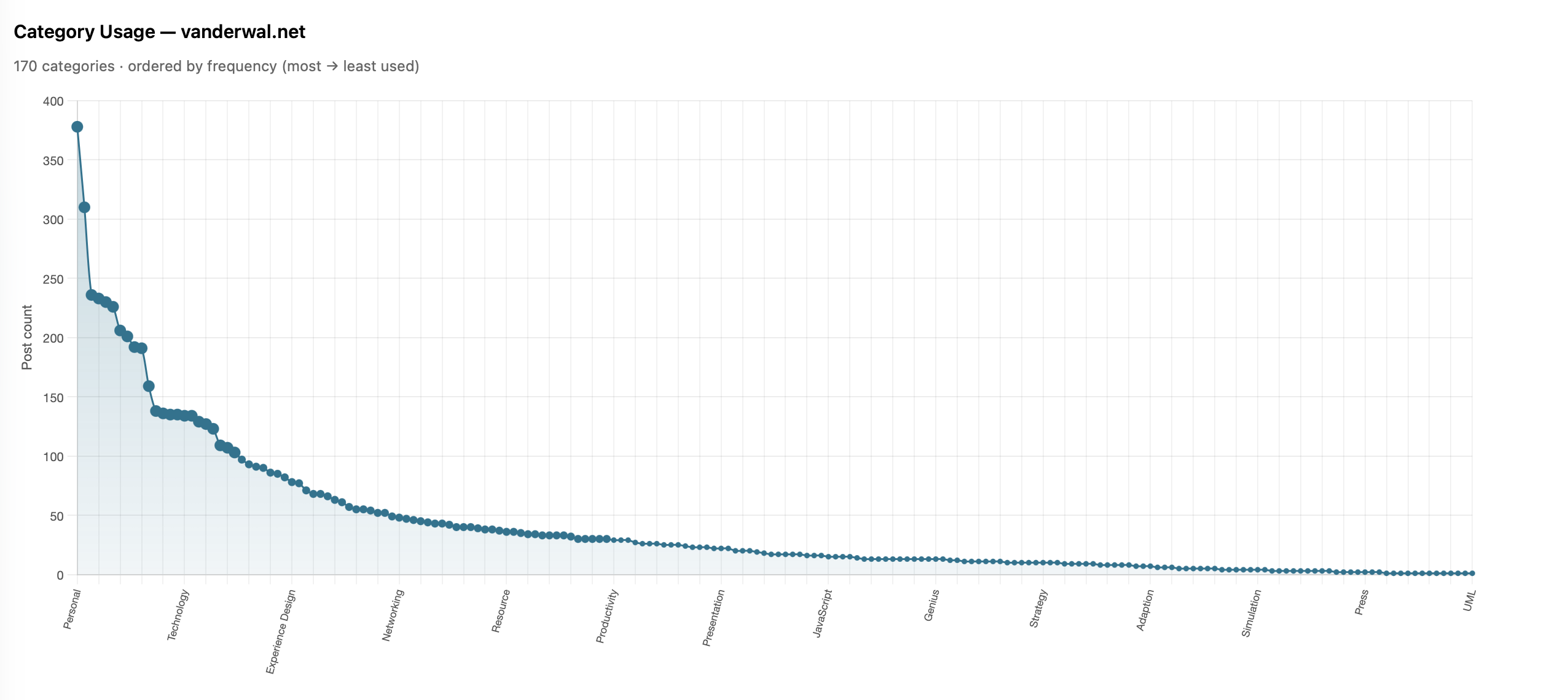
Category Long Tail

I done a very quick capture of category usage to look at the distribution of use. A question from James about whether my category distribution looked like a long tail distribution and I thought it may, but also looking at the numbers and not having a visualization I wasn’t sure. Charting the use, it really was a very long tail / power law distribution.

this chart is described in the test that follows

I shared it with James and he also ran his and ended up with much the same (Is there a power law of category use? - James’ Coffee Blog). There have been a few discussions of late around category use and some lean into having just a few categories. I have just over 200 categories now as most of my blog post have more than one subject and I use the categories to have an way to jump to related posts that cover the same subject. When I built my site’s CMS I wanted to have the capability to have multiple categories on each post. I have multiple categories for my own purposes, but also I’m cognizant that readers may have other terms.

With the long tail use of categories I know readers may stumble across a post through web search or a link from else where and having a category term that is familiar can get them to other things I may have posted. I view the web as being able to connect with others and blog posts are sharing things I have interests in or curiosity around and being able to connect with others in a similar mindset is the aim. So a handful of categories, particularly across 25 years and over 2,100 posts, doesn’t help build those connections.

More Analysis on Blog Posts and Categories

This distribution of categories really pushed my interest and curiosity of what the last 25 years of blogging looks like. I joke that Twitter ate my blog, but the sparklines sort of show that. I wanted to see the trends on my blog more closely (I have the archive of my Tweets and I’ll analyze them later and then bring the two analysis together).

To prep for the analysis I pulled my site’s database data local and put it into SQLite (it is already on Mac - Apple and quick) to connect locally with Jupyter Notebooks and use Plotly for interactive data visualizations in the notebook. I had a series of questions, somewhat common data analytics questions I’ve used since grad school looking at analysis over time.

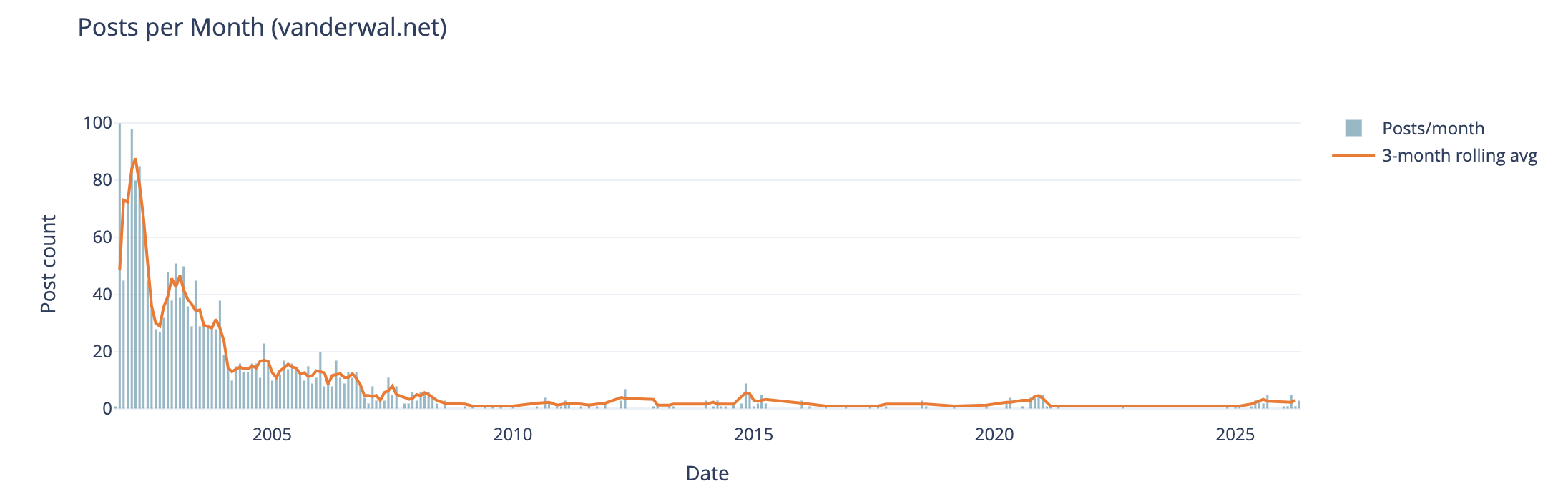
Posts per Month

this chart is described in the test that follows

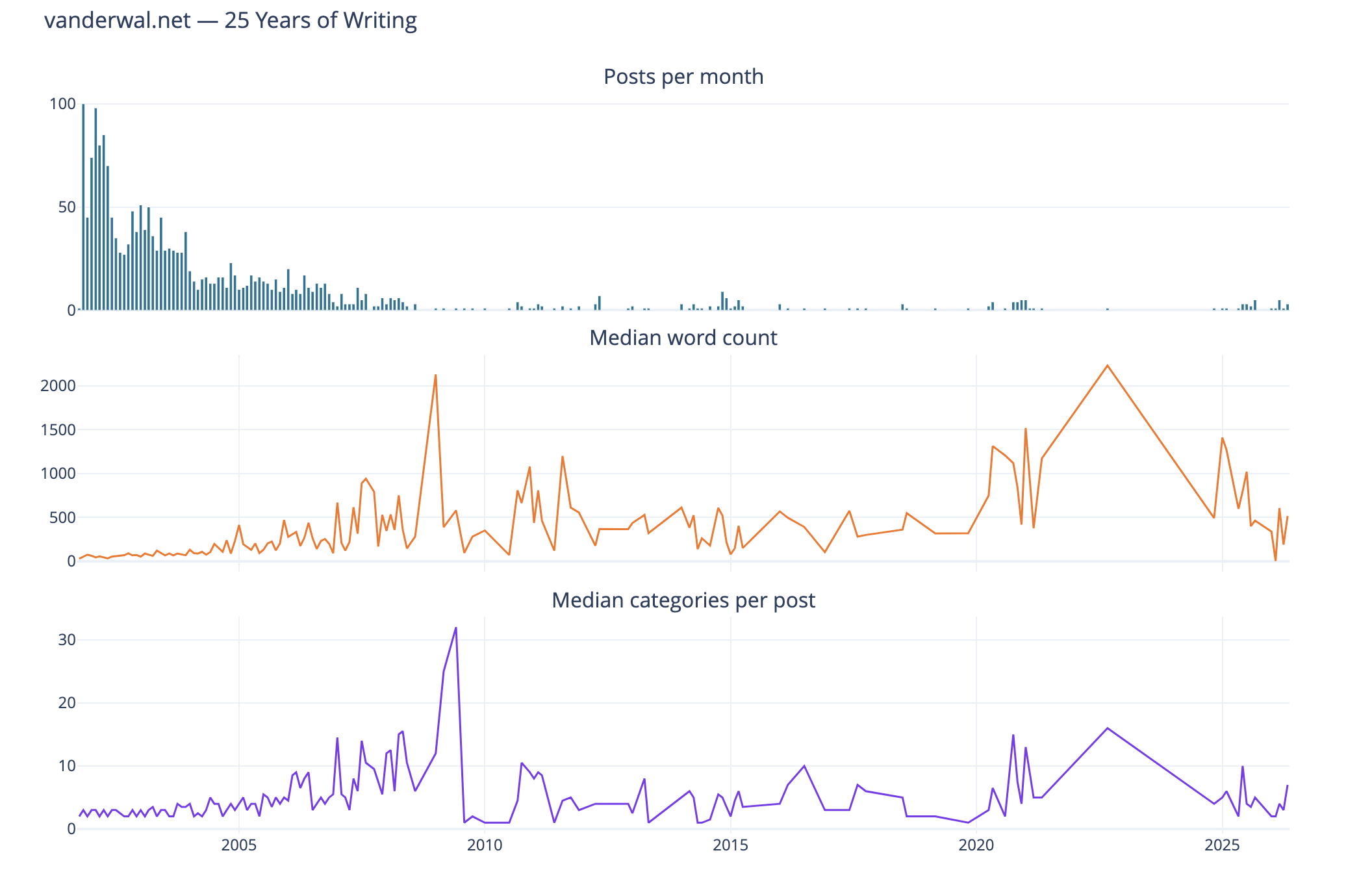
The first analysis is my blog posts by month over 25 years. In my early years I was posting frequently, often in shorter posts (but we will look at that next), and then around 2005 (when started engaging with Twitter) things dropped off. Also at this time I also started blogging more serious subjects at Personal InfoCloud, but those were not all that frequent (I’ll dig into this at some point later too).

My hunch that I posted much more early on and drop off around the time I engaged with Twitter, seem to hold up.

Post Length Over Time

this chart is described in the test that follows

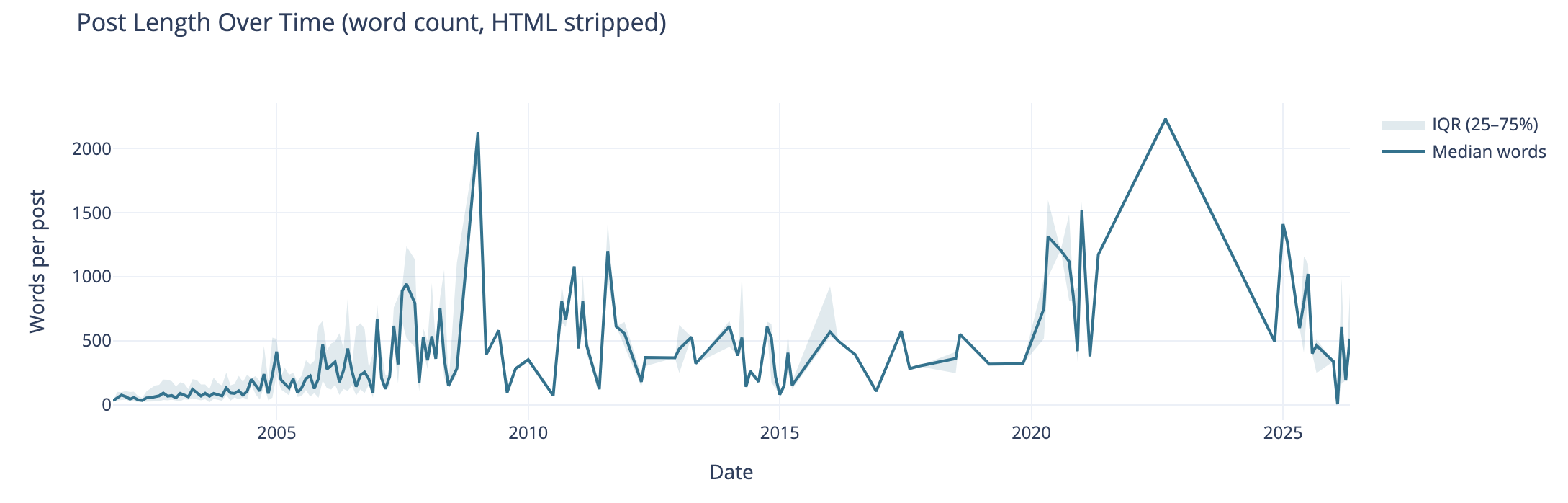
Post length over time also can tell the story of why post volume shifted. I wasn’t posting a lot of short post, but posting longer posts, but less frequently. I’m really curious what I posted in June of 2009 that caused the spike. The spike on the right end in 2020 and beyond are partly attributed to posting weeknotes, which tended to be longer than normal.

I know that my writing muscles went from a few hundred words early on to posts being around 1k and more. I found my comfortable blog post writing length was around 1.2k words. I write to find out and capture what I think, but rarely edit for brevity or other editing benefit, at least on this blog.

Median Categories per Post

this chart is described in the test that follows

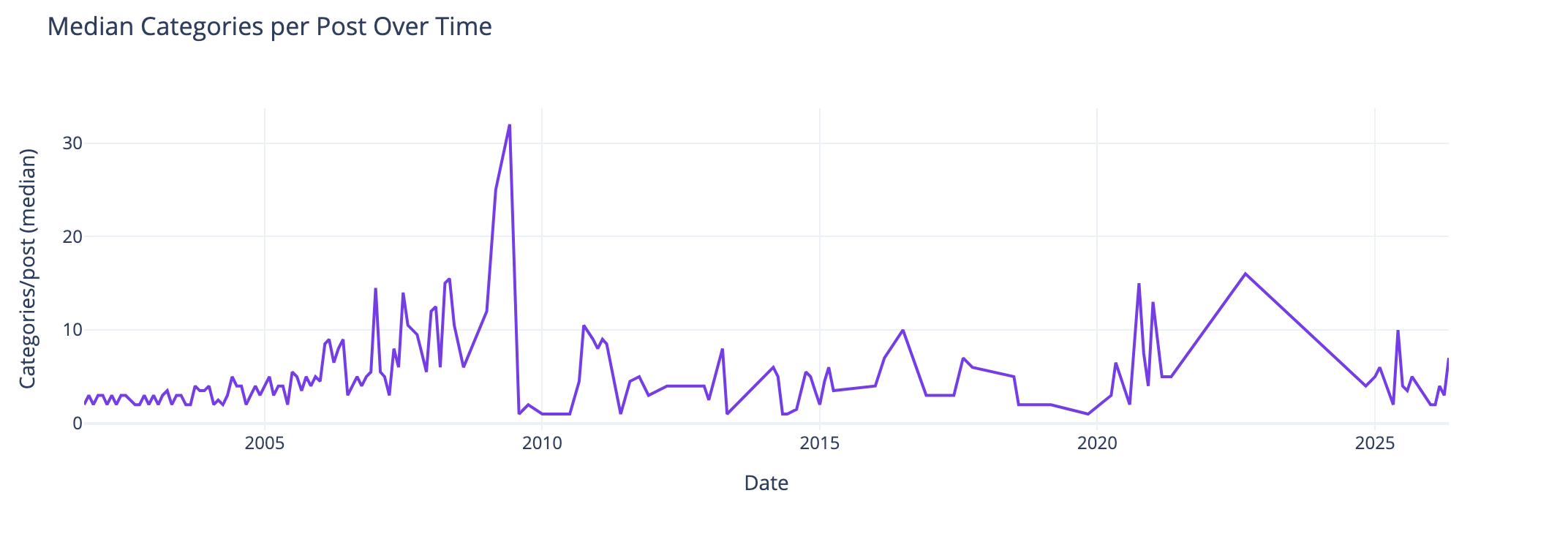
This view of the median number of categories per post over time I found interesting and I didn’t know what my expected outcome was going into this analysis. The numbers pretty much are in line with longer posts have more categories to cover slightly more breadth in a post. Again June 2009, not sure. The spike spike on the right aligns with weeknotes, which cover multiple subjects in one post.

Distribution of Categories per Post

this chart is described in the test that follows

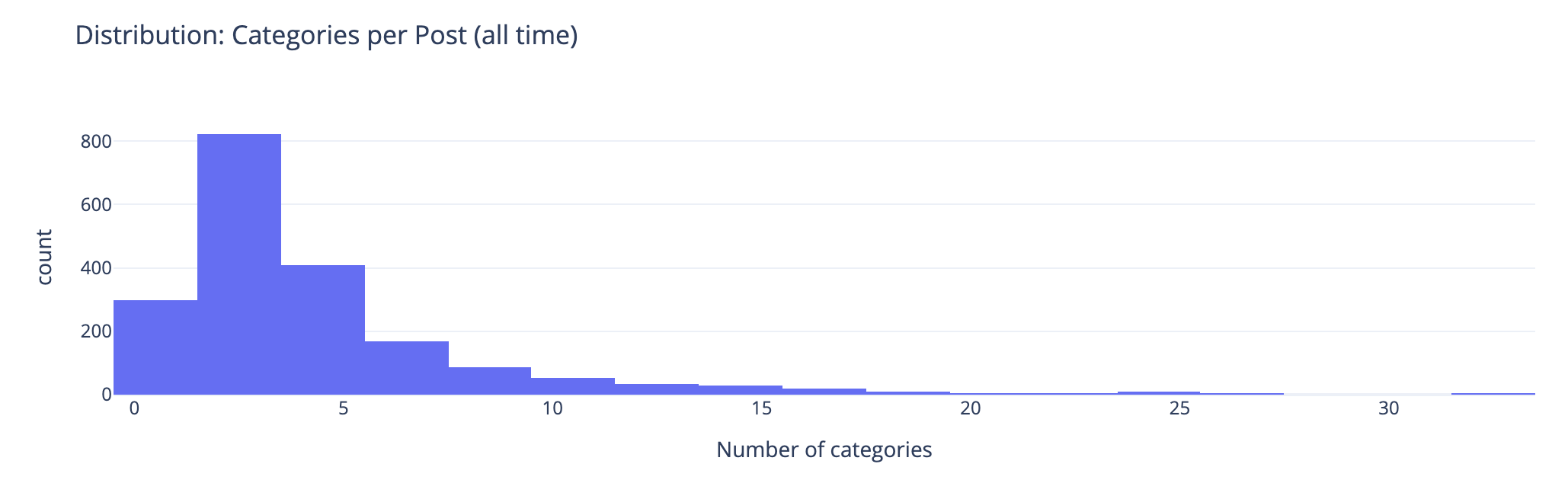
This chart groups number of categories on posts. This shows the second bar has the most number of posts (822 posts) have 2 or 3 categories on the posts. The third bar has 408 posts with 4 or 5 categories on them. This lines up well with the frequency and volume of posts early on which were shorter. Looking at the prior chart most posts had 10 or fewer categories on them.

Combined Timeline for Posts, Length, and median

this chart is described in the test that follows

I like this combined chart that reinforces early on with high volume of posts of shorter length and few categories on them. What I find interesting is the correlation of line trends for word count per post and categories per post. This ties closely with the longer posts have more categories.

Seasonal Patterns

this chart is described in the test that follows

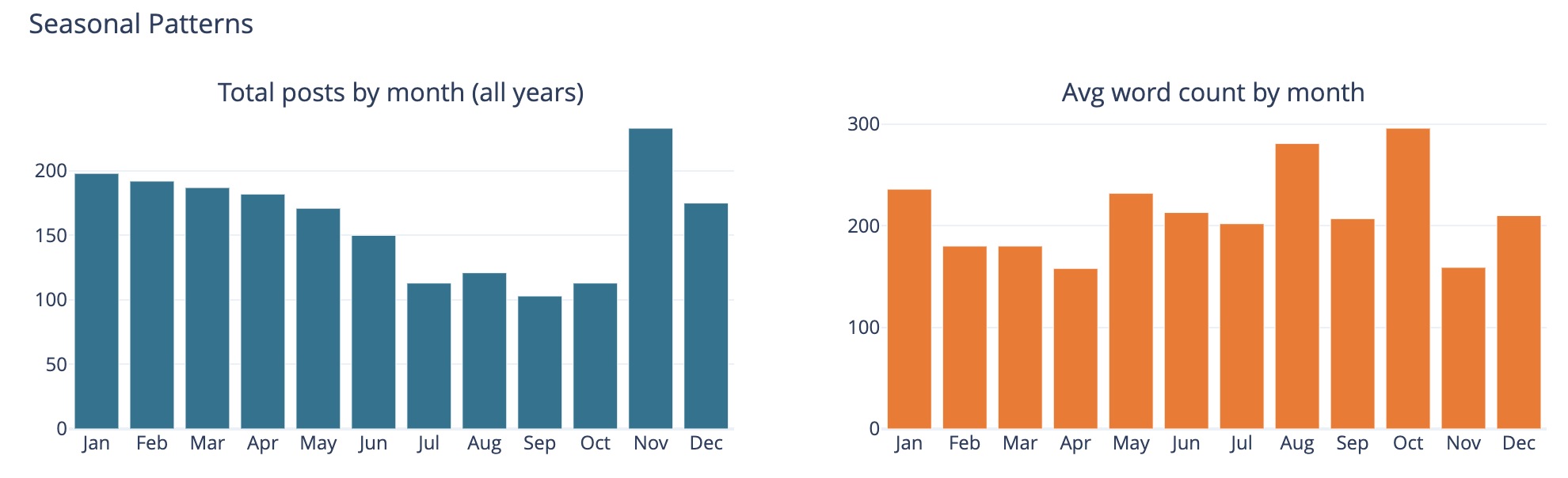
The bar chart on the left is total number of posts by month and on the left it is average word count on posts by month.

This was largely a curiosity to see what was there, but also a common analysis trend analysis to see if there are explanations of other trends looking at seasonal comparisons. The posts by month is not surprising to me as summer and early fall months have often been busy. I am not all that sure what the word count by month tells other than the correlation between more posts and shorter post length correlation showing up.

Top Category Activity Over Time

this chart is described in the test that follows

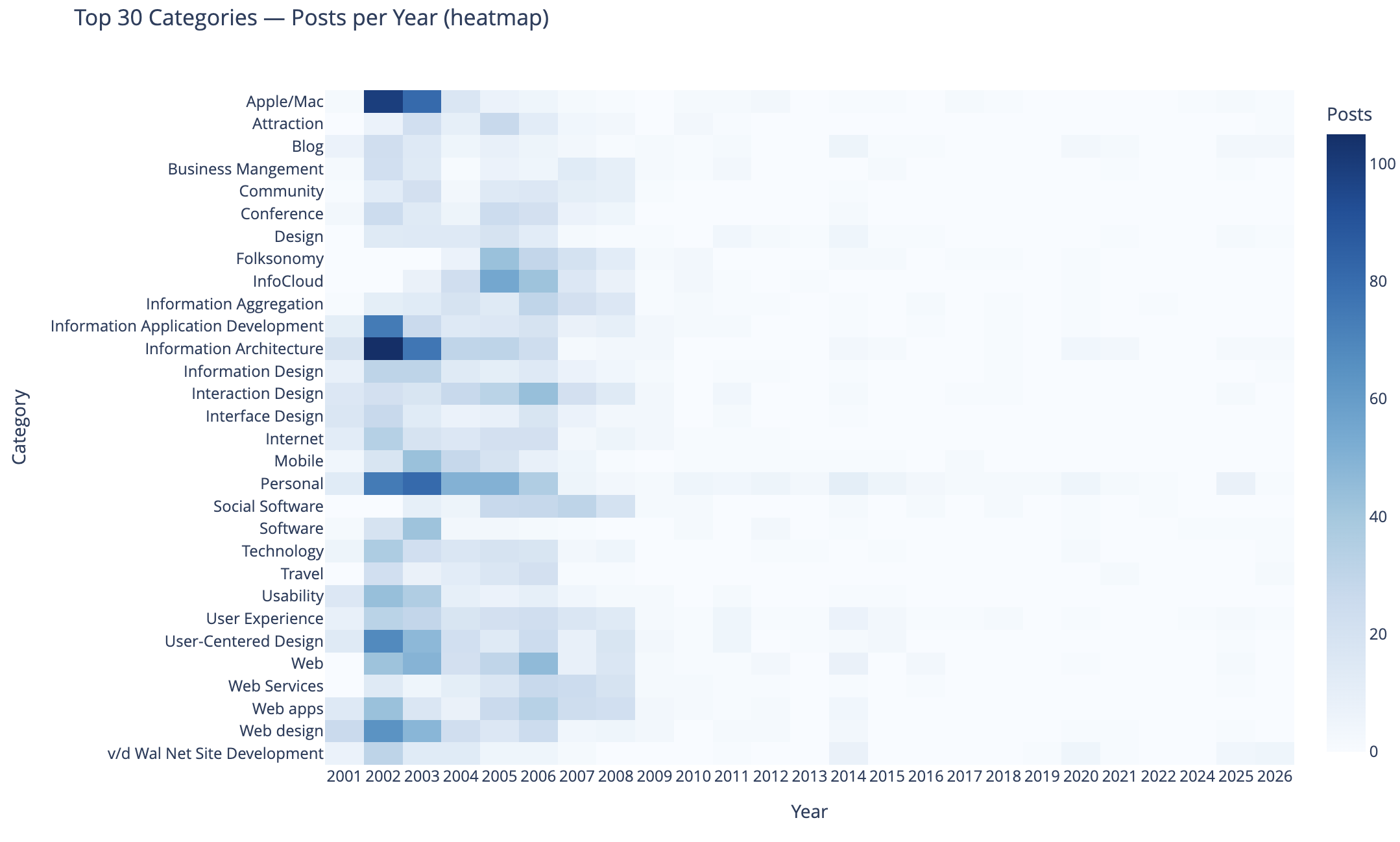
This chart shows the top 30 categories (by use) and their activity over time.

In this heat map Apple categorized posts were sure common, as well as Information Architecture, Information Application Development, Personal, User-Centered Design, and Web Design were also common. Personal and this site’s development.

The heat map being far more dense on the left in early years is skewed by volume of posts and makes activity in the middle and right (more recent years) difficult to see. I need to spend more time on this analysis and chart to separate out the early years and segment things so time outside of the early years can have trends more easily seen. I may want to select a different visualization, but if I can break things out by time that should help. Also running 3 time segements with the same top 30 categories across them and then the top 30 within each time segment could be interesting.

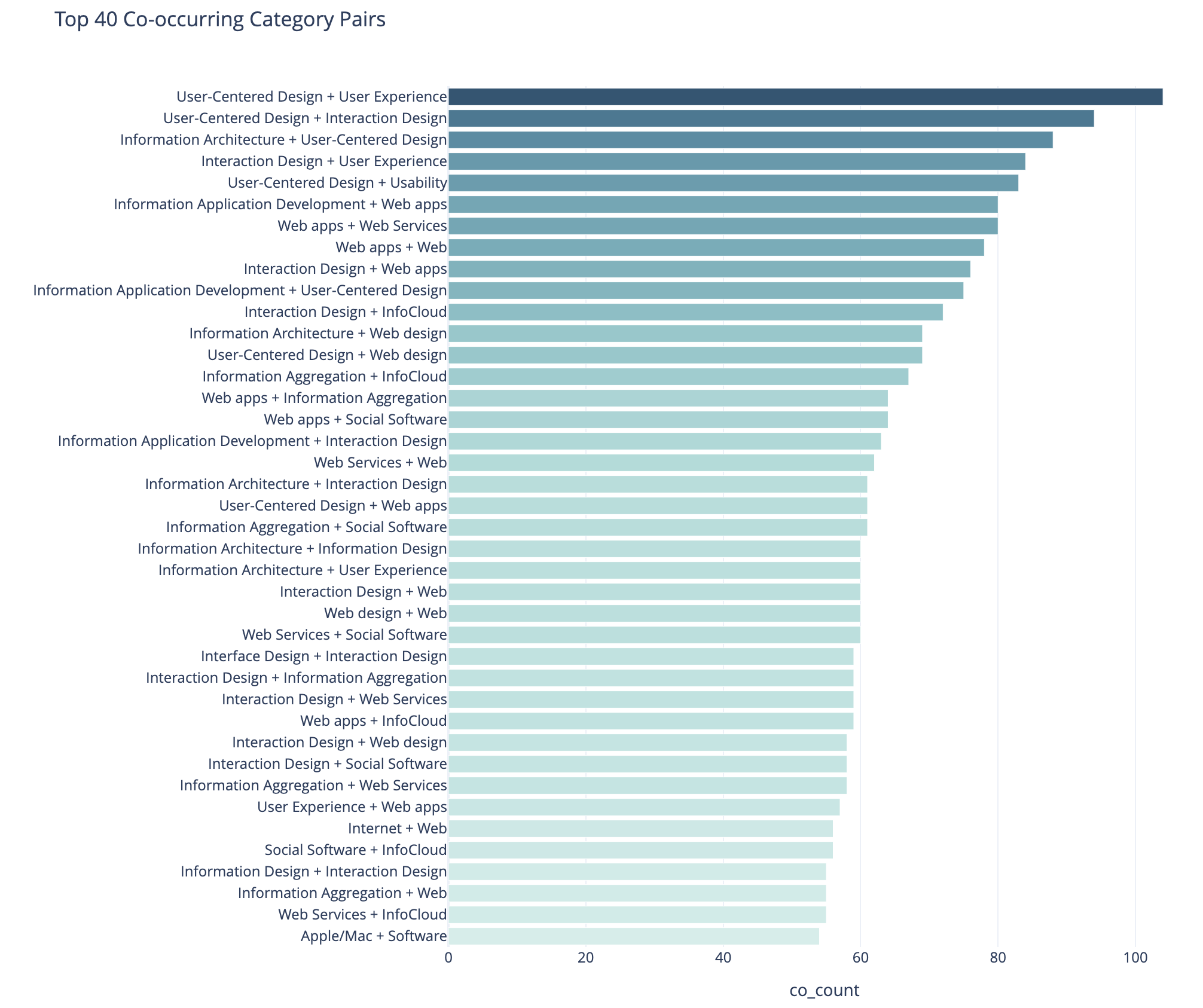
To 40 Co-Occuring Category Pairs

this chart is described in the test that follows

This cart of co-occurring category pairs is in part preparatory work for bringing concurrent tags into the category pages here for understanding and filtering needs for users.

The top 5 pairs are all related to UX, IA, and User-Centered Design and these being the type of concurrence isn’t a surprise to me. The broad UX community had rather divergent use of terms at times and one person’s IA was and other’s UX. For readers who think about these posts in one manner could find other similar content by the term they are familiar with using. Pretty much this whole list is application development, web design and development, web apps, and pan-UX related.

I don’t know how useful this is for broad insights. When I get to adding the concurrent categories on the category pages this will likely be more helpful on a category by category view.

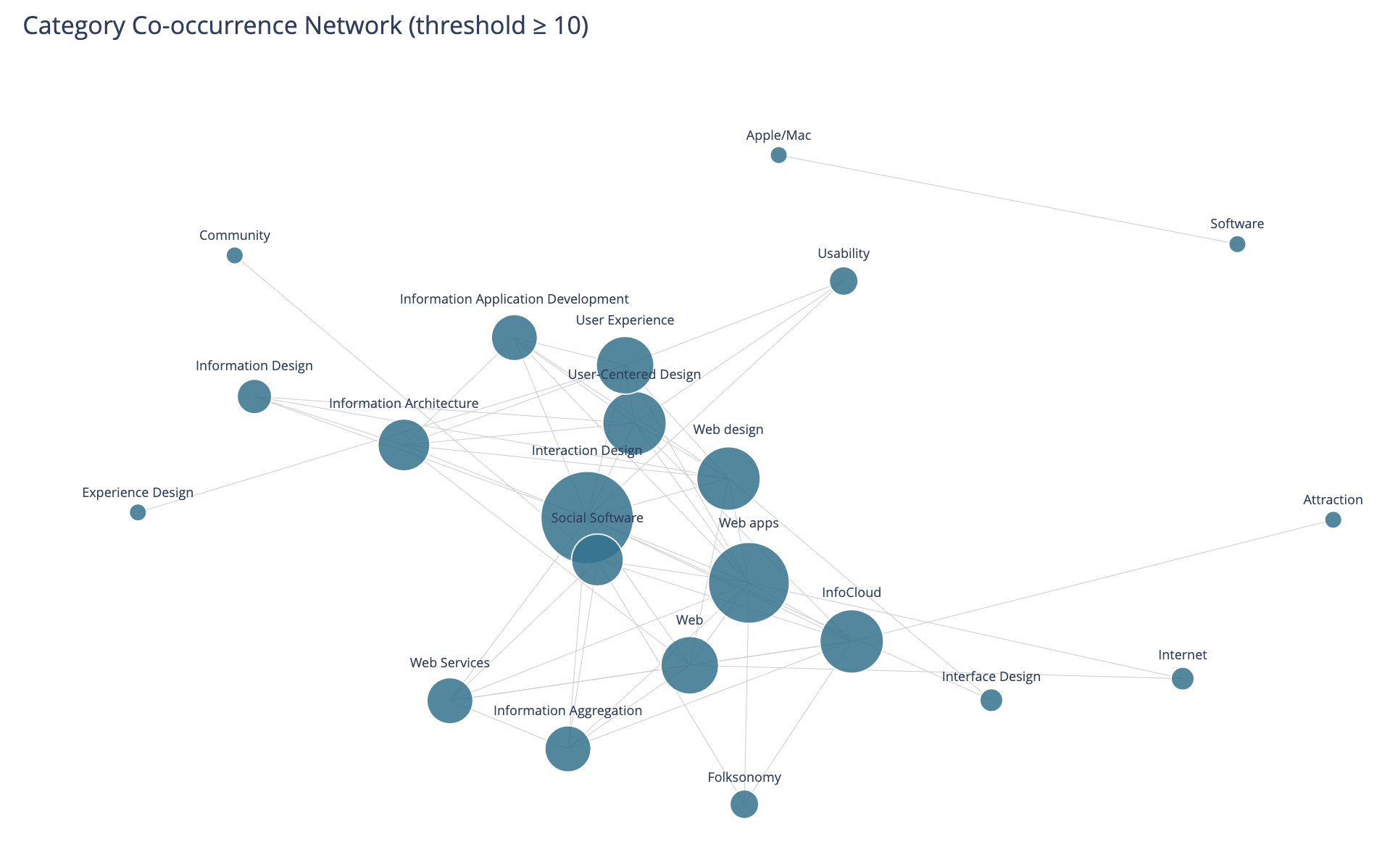
Category Co-occurence Network Graph

this chart is described in the test that follows

This chart looks at the top thirty categories that have 10 or more co-occurrence of categories.

This I find more interesting than the prior in that this has Social Software and Folksonomy showing up and showing its relationships. The largest category in this view is Interaction Design and its multiple connections. I am entertained by the standalone pairing of Apple and Software, that at the scale limited for the data these only connect to each other.

I need to rerun this with higher acceptance to get more included. But, also this graph isn’t interactive in Jupyter, and every time I went to zoom in it collapsed the graph and I couldn’t move a node out of the way was disappointing.

Helpful as a Good First Pass

This analysis and data visualizations were helpful to see into my 25 years of posts. There are some analysis sets and data visualizations that need more work. Most of these are more helpful with Plotly in Jupyter and the ability to interact with the visualizations.

I am really curious with what this will look like when I look at Twitter usage and notes. Obsidian on top of my notes make note making easier and far more helpful with backlinks / wiki links. I started using it on top of my directory with notes in June 2020 that had around 2k notes in it going back to 2003. Now there are around 6k to 7k and in the past about half of these notes would have been on one of my blogs.


30 May 2026

Updated Categories with Sparklines and Search is Now in Production

I made a couple of updates I have long wanted to make to this site. I’ve been wanting to see frequency of categories used on my blog for more than 15 years (or pretty much since I’ve had category list pages). I have also wanted to have blog search and the utter mess that Google Search has become in recent years, where my site isn’t showing at all at times has driven this. These additions will likely iterate and adapt a bit going forward.

Updates to Category Lists with Sparklines

I have basically had two category list pages for years: Category List (which is alphabetical sort) and Category List by Use. I have kept these two and added sparklines to them (Sparkline - Wikipedia). Each line now has a small line chart that covers the 25+ years and what periods had used the category and some sense of the volume of use over time. One category list view I wanted and was missing was one to show a view with the focus of most recently used categories, so there is now a Category Recently Used List that not only groups by most recently used (and in the same entry keeps the alphabetical sort) but also shows the date of the last use in the list. Personally, I have been finding this recently used list view the most helpful and interesting. Skimming through the list I know I have more recent posts that have covered or touched on a subject, but it didn’t include the category, and that becomes a quick task to fix that gap.

Sparklines?

I have been a big fan of sparklines to give quick understanding of data’s distributions at a glance, which I learned about in “recommended reading” of Edward Tufte’s book The Visual Display of Quantitative Information | Edward Tufte in grad school in social / policy quant classes. (There are are many Tufte essays and book annotations on sparklines at Edward Tufte Notebooks & Sketches | Art, Science and Sculpture).

Creating the Sparklines

In creating the sparklines for my category lists I looked initially (and have long looked at them) creating static images from the data and bringing the images in (this would mean updating the images and replacing the old with the new ones, which is relatively straight forward programmatically and something I’ve done in the past, but not optimal) and I also looked at JavaScript but it was a bit slow. I poked at using creating SVGs (which work well when printing or zooming in) and often are much quicker and less strain on a browser than JavaScript. I’ve had a few goes at SVG in the past and I get get my mind around simple shapes, but I would need a little help with sparklines. A couple years back on a sparkline spelunking I found Easy SVG sparklines | Alex Plescan which showed the how. But, I have SVGs somewhat in the same category as regex, which is I do it rarely and I’ll just use Claude Code | Anthropic’s agentic coding system \ Anthropic to assist with the creation.

Chunking the Data for a Sparkline

The other part of sparklines is they are intended to be small glimpses and I have 25+ years of posts and a monthly temporal segmentation would make for a long graphic. I played around with breaking things down to quarters, but in the end I went with two segments per year and roughly 50 data points to map out on a line chart. Running a test with the two data points a year was a reasonable enough glimpse to sort out if the category was used recently or what the variation of use was over time.

One of the interesting discoveries with the first lab run of the categories of sparklines was the rather “U shaped” distribution of the use of categories, which pretty much calls out the lull I had in blogging. This softening of blog post rhythm is something I call, “when Twitter ate my blog” (where the interesting things I would discover and want to share and interact around ended up on Twitter rather than my blog(s)). Other patterns that surfaced were limited use a category in a period when I was rather sure I had posted on the subject, some of this was I was not using the term in that way or I didn’t have the category in my system yet. One of the things that helped sort this out was using my blog search.

Search is Now Out of the Lab

One of the things I have been working on and using my my Lab at vanderwal.net is blog search. But, the modifications I made to the Category pages I found I was leaning on my blog search a fair amount to investigate things. But, the categories and blog search are both in the blog section of this site, so making the change from the lab to the production side made sense. One of the things holding back moving search over, was I had an SVG of a magnifying class in the menu bar with “Blog Search”, but no matter how small I made the image it still was messing with the vertical layout of the menubar. In removing the magnifying glass and just using text things kept to the same layout.

Bringing in Search

The search in the menu in the pages in the blog section with “Off the Top” or “random” in the URL which is where there are currently menubar links to Blog Search. I have the menu bar link to a search page to search from rather than a JavaScript drop down or other menu bar convention (again layout of the menu bar was part of the considerations).

When I was working on search in the Lab section I found I needed to make some modifications to the database to have quicker search and I needed to modify the database engine so I could have search include 3 letter terms as a minimum rather than 4 letter words. In working on search I found many of my early posts didn’t (and still don’t) have titles and I was using the title as the link. I initially thought I would just add titles, but there are around 300 posts that don’t have titles (I’m adding some as I touch the posts for other clean-up issues), but I ended up coding the search results to have the results just fill in “Blog Post #…” as a proxy for a proper title.

The initial 170 or so posts are not in the database and are therefore not in the search.

Bringing Search and Categories In

As I went to move the category list pages out of the lab and into the production side I needed to modify a few other templates and pages to add the updated links. In doing this I realized I could also easily update the menu bar to include “Blog Search”. So, I took a little bit of time and made both changes at the same time.

Not all of the links are in yet. If you see something a little off with category lists or missing blog search links let me know.


10 March 2026

Adding a Museum Category

A couple of things hit a confluence around museums in the past couple weeks. One is I was searching for a post (which I hadn’t written and therefore not posted) about the Musée d’Orsay and one of my favorite set of artworks. I also was searching for Marmottan – Monet Museum — Musée Marmottan Monet on my site to see if I had captured it somewhere (I hadn’t).

IndieWeb Carnival for March is Museums

The other force (it turns out) is the https://indieweb.org/IndieWeb_Carnival for March, that James’ Coffee Blog is running is focused on museums (IndieWeb Carnival March 2026: Museum memories | James’ Coffee Blog). I thought this would be a great way to capture the handful of museums I have strong fond memories of.

It turns out, I think I have strong fond memories or most museums and I have been to quite a few. I thought I may have a quick rundown, but then it turned into a list. If (more like when) I post them it will likely be a series. But, I also realized I don’t have a museum category, so that has been added. Doing a search I’ve added it to older posts where it is appropriate.

Museums are Part of the Social Fabric for Me

When James first mentioned his Carnival subject of museums I really liked it. I was initially only thinking of art museums, but quickly got to all the other museums I’ve gone to and enjoy. Museums are like fully immersive and in person non-fiction books. You can see (sometimes touch) and experience being in the presence with an object, but also find out background and context.

Cities that have and respect their history are much akin to museums. In Lyon I’d walk up a road most days and touch the stone wall built by the Romans in 300AD. In that quiet walk my mind would wander and think of all of those that had walked that road and touched that stone on their walks over 1700 years prior.

In Oxford a pub I’d occasionally go to to meet friend and have a pint was set up against the city wall built in 1000 to 1100AD. Who else had leaned against that wall while talking with friends and colleagues and what were they talking about.

My son over the past couple years as he has travelled will text and ask, “Dad, what is the oldest thing you’ve touched?” The wall in Lyon was the oldest thing I’ve touched, I would tell him. Then he would tell me a building or wall he touched and how old it was. When he was in Istanbul his first day he took a picture of an obelisk in the middle of a small traffic circle that was quiet when he took the picture. I sorted out where he was and what it was and it was from 3000BCE and originally from Egypt, but he said he didn’t touch it. We chatted about The ruins on the Asian side of Istanbul and many of the very old buildings and artifacts all around him (he was staying pretty much right on the old Hippodrome). But, he popped up with a picture of something from 5000BCE that he touched.

The city and culture cares about its past and broad and mixed past. A city, much like a museum can provide living moments of context and cultural understanding. It shares what a culture and society cares about.

Museums, whether art or artifacts provide a living fabric of what ties and weaves us all together.


This work is licensed under the Creative Commons Attribution-NonCommercial-ShareAlike License.