Off the Top: Community Entries

Showing posts: 1-15 of 94 total posts


15 August 2026

Summer Cinema and Art House Films

This morning on my coffee walk I was thinking I hadn’t seen either the new Spiderman block buster that is out, nor The Odessey. But, big summer block busters are something I do, but my deep enjoyment is the late summer art house films.

Thamara today posted about cinema (Cinema - Thamara Kandabada ) and frames the local cinema really well. Growing up I went to see films with my parents and saw many I was way too young to see. But, there was an art house theater in Portland that we went to a few times and the theater was small and not like the big chain theaters. When we moved to Pacific Palisades we were a few blocks from the Palisades movie theater with two screens and it was just under a dollar to go. The movies were second run or small films, but often going in I’d see a director or actors I knew who were catching an afternoon showing. If there was something of interest I may head their after school (once football season was over) to see one or two movies, and often meet a friend to join along.

Summer Cinema Kicks In

I always enjoyed going to the cinema. But, it wasn’t until I was in college that I really kicked in. I had a great course on Media Criticism and we watched a lot of movies and learned to critique them (many Hitchcock films, The Killing Fields, All the President’s Men, Three Days of Condor and so much more).

The college paper had a regular reviewer who focused on two-sentence reviews of the big movies that were out (which he got reviewed comped tickets to). I knew the editor of the paper and the local small cinema in Lafayette had called and asked if the paper wanted to send someone to review the Spike Lee film She’s Gotta Have It and I was offered the free ticket and some small cash payment. I loved the film and I was hooked not only on Spike Lee, but art house films from then on. I wrote a four to six paragraph review and the local theater liked it and my professors enjoyed it and how I approached the review.

That prior summer I was living in Berkeley and working a couple jobs (one at the college doing odd construction projects around campus (one was reinforcing one of the freshman men’s dorm hallway walls so they wouldn’t try to put their heads through it - ¾ inch plywood and ½ inch sheetrock made it quieter, stronger, and if you slammed a door the walls wouldn’t wobble for 40 to 60 feet) and running room service at the Oakland Airport Hilton). So, I had a little cash for movies and I saw a lot. Ferris Bueller, Top Gun, Aliens, Stand by Me, Ruthless People, Short Circuit, Running Scared, About Last Night, and in a art house retrospective theater A Room with a View (which I would see many times over the next couple years). A Room with a View had me hooked on the small art house theaters with good films that ran in them. This set me up for She’s Gotta Have it.

I regularly kept my eye on the small art house theaters for what was on in Lafayette, Berkeley, and San Francisco. When I moved to Oxford for a term (plus), the Penultimate Picture Palace (PPP) just over the Cowley bridge was a members cinema and would have a nights of double and triple features of films a couple years old or more with a theme for the night. I paid the member ship fee (which I believe included access or discounts at Not the Moulin Rouge up the hill in Headington). One of the first films I caught at the PPP was A Room with a View, but with the audience there it wasn’t a romantic period piece is was a comedy with a lot of hard laughter and many sprinkled in chuckles. A couple months later it played again elsewhere in Oxford and by this point I understood enough of the culture and found it really was a comedy and it made it even more of a wonderful movie for me.

Post College the Small Cinema Enchantment Continues

Post-college, San Francisco had an abundance of small cinemas and retrospective cinema houses with their own quirks. But, summer art house gems with the walking in from a warm sunny day for a treat of a film and walking out to chilly damp fog, which was perfect for conversation, coffee, and shared introspection.

Moving to the DC area, it too had an abundance of small art house cinemas. But, somewhere in the late 1990s or early 2000s, they started to close and get converted to other businesses. Georgetown had three or four, Foggy Bottom had a couple, and DuPont Circle had a couple or more. The summers in grad school were a great time to catch a good film at a small cinema.

Today the Options are Sparce

There are a few places around, but the business models went chasing more money. There is a community cinema a few miles away and a little farther away is the American Film Institute theater, but I haven’t been to that much. Walking distance there is a small multi-screen theater that used to only run art house and independent films on its four screens, but now it is one or two movies of six or seven playing that get a showing here or there on the schedule.

I still try to track down the summer independent small movies, but now mostly watch at home. I do watch the same to movies every summer on disks I own, Spike Lee’s Do the Right Thing and Bring on the Night, which is the Michael Apted film about Sting putting together his first band after The Police. Both scream summer to me and the enjoyment of films that to me have a lot of things to consider within them.


A Book Encompasses More than the Pages and What is on Them

Last evening I went down an odd rabbit hole. I’ve been doing two conflicting tasks with my bookshelves: 1) Taking pictures of them and converting that into markdown for titles and author lists of what is on what shelf and capture what I own; 2) Culling books that are vastly out of date, I didn’t find interesting nor helpful, or poorly written (or produced).

In doing this I ran across a book I picked up (or was gifted) in college during one summer. The book is Habits of the Heart - Google Books, which is academics and research writing a popularly approachable version (think of it as the precursor to Bowling Alone - Wikipedia). The book is a mixed social studies and sociology research look at patterns in America as of the 1980s. My paperback copy binding is a little brittle, but still doing alright. I remember reading the first half and then moved through reading what was of interest and new to me as it was covering familiar ground. I don’t remember much of the book, but I remember I did have a few long discussions about it. I thought I’d see what I highlighted and annotated to job my memory, but some of the notes and cues weren’t mine and I remembered two friends borrowed it (one for class and one also out of curiosity). My own highlights and marginalia are a mystery over time to myself, but now having mine combined with two other’s it is really muddled.

I had two “bookmarks”, one from Kepler’s Books in the first third and in the second third a airplane ticket sleeve for AirCal - Wikipedia with the paper ticket in it typed out for a $59 round trip from Oakland to San Diego. The ticket was from the travel agency connected to the college.

This had memories of college fresh in my head and thinking of great conversations with professors, classes that drastically changed and expanded my understanding of the world (in class and the many office hour visits to discuss something for class or say “hey” and then have an amazing couple hour conversation), and conversations with the president of the college, Brother Mel Anderson (there were a lot of these conversations).

The Habits of the Heart was largely calling out a pattern in the US of embracing individualism and going it alone. My college experience and beyond has all been heavily social and personal individual curiosity and drive, but those two have blended. I have long blogged to connect with others with similar curiosities. But, many years of focus on social software and its multiple patterns and scales with the differences as things scale. But in these, folksonomy / folksonomy - category is individuals tagging in their own vocabulary and out of their multiple deep contexts that are unique and this tagging is primarily for their own retrieval. But, in this tagging it is also social (public or semi-private) and others who have one or a few similar contexts and vocabularies using similar terminology sets use the tags to find the resources as well. This individual and social participant interweaving is key and essential. I don’t know how much I would agree with Habits of the Heart today. I may gut it to refresh it for me.

I wasn’t expecting so much to be wrapped in picking the book up off the shelf (it sat behind a stack of other books) and having the cover bring back memories before opening it and having so many more flood out along with a myriad of contexts colliding.


2 August 2026

BBC Global Focus on Lina Ghotmeh and Her Architecture

This morning I woke too early to head to the farmer’s market so I hit YouTube (as one does) and found this gem from BBC Global, Lina Ghotmeh: How to design buildings that remember the past. It is about Lina Ghotmeh, whom I didn’t know about before.

The video is wonderful, but the work of Ghotmeh is stunning. It has been a while since I’ve run into a new (to me) architect who is refreshing to hear discuss their work and perspectives, but also sees things differently and that difference make a fantastic outcome. The beauty of flow and space in her work, but also deeply considered understanding of history and cultural context is magnificent.

It has been a while since I’ve heard good architecture discussions, from basics to really good quotable insights.

Architecture has to talk about the environment, it has to talk about context, and to do that, we have to understand that environment in the large sense of what an environment is.

There was a great quote regarding her winning the work to be the architect for the Estonian museum - Lina Ghotmeh — Architecture | Estonian National Museum - and she said the blind review panel thought they were Estonian with how well they understood the culture, history, and environment. That is the sign of good design and development, where the needs and concerns are understood and perceived as those doing the work are “one of us”.

The competition itself was opened in 2005. It was an anonymous competition, so they didn’t know that we were foreigners — they thought we were Estonians.

The discussion of the Stone Garden work in Beirut, Lebanon provided really good insight and creativity to embrace the pained history while easing a means for inspiration for growth and recovery. (Lina Ghotmeh — Architecture | Stone Garden Housing - Beirut)

In 2020, August 4th, there was a huge explosion in the port of Beirut. Stone Garden was one of the first buildings that was hit. It actually resisted the explosion. It was designed to endure earthquakes because Lina did look back at the site, at history, at what was happening in Beirut. In itself, the building embodies resilience.

A term that Ghotmeh’s firm uses is, “archaeology of the future”, which I find to be a really good reflexive perspective while researching, designing, and building something informed for the near now and the future.

It’s about always digging in the place, understanding the context, understanding the client — that takes the form of different research elements, images. Every time you build something, you’re actually projecting into the future. And that’s why it’s an archaeology of the future.

The video wraps with her presentation to the British Museum for the redevelopment of the Western Range - Lina Ghotmeh — Architecture | Stone Garden Housing - Beirut and the outcome of that pitch and review process.

Looking at the Corpus of Work for Lina Ghotmeh

This video has had me digging into the architecture firm, Lina Ghotmeh — Architecture | Paris and going through the volume of work she and her firm have already done. There is so much wonderful work and many insights, that I know I will be returning to it.


8 November 2014

KM World 2014 Wrap

I spent much of this week at KM World 2014 in Washington, DC and the past few days I was working on notes and blog posts for here, but time to get them in readable form and posted wasn’t quite there, so today they became a Personal InfoCloud post, KM World 2014 is a Real Gem.

I had a great time with fantastic people whom I’ve known and people new to me. I spent a lot of time talking about work projects and being back on the consulting side again, but also getting content out and what makes sense with prioritization. I had a lot of great meetings and less formal chats about the state of things as well as trying out some metaphors for framing some things to gage how well they hold up.

I have a lot of snippets to explore and post that have come out of this past week, but I’m digging out of email, notes, snippets, and other things tucked away from this past week.


27 June 2009

Social Design for the Enterprise Workshop in Washington, DC Area

I am finally bringing workshop to my home base, the Washington, DC area. I am putting on a my "Social Design for the Enterprise" half-day workshop on the afternoon of July 17th at Viget Labs (register from this prior link).

Yes, it is a Friday in the Summer in Washington, DC area. This is the filter to sort out who really wants to improve what they offer and how successful they want their products and solutions to be.

Past Attendees have Said...

"A few hours and a few hundred dollar saved us tens of thousands, if not well into six figures dollars of value through improving our understanding" (Global insurance company intranet director)

From an in-house workshop:
"We are only an hour in, can we stop? We need to get many more people here to hear this as we have been on the wrong path as an organization" (National consumer service provider)

"Can you let us know when you give this again as we need our [big consulting firm] here, they need to hear that this is the path and focus we need" (Fortune 100 company senior manager for collaboration platforms)

"In the last 15 minutes what you walked us through helped us understand a problem we have had for 2 years and a provided manner to think about it in a way we can finally move forward and solve it" (CEO social tool product company)

Is the Workshop Only for Designers?

No, the workshop is aimed at a broad audience. The focus of the workshop gets beyond the tools' features and functionality to provide understanding of the other elements that make a giant difference in adoption, use, and value derived by people using and the system owners.

The workshop is for user experience designers (information architects, interaction designers, social interaction designers, etc.), developers, product managers, buyers, implementers, and those with social tools running already running.

Not Only for Enterprise

This workshop with address problems for designing social tools for much better adoption in the enterprise (in-house use in business, government, & non-profit), but web facing social tools.

The Workshop will Address:

Designing for social comfort requires understanding how people interact in a non-mediated environment and what realities that we know from that understanding must we include in our design and development for use and adoption of our digital social tools if we want optimal adoption and use.

  • Tools do not need to be constrained by accepting the 1-9-90 myth.
  • Understanding the social build order and how to use that to identify gaps that need design solutions
  • Social comfort as a key component
  • Matrix of Perception to better understanding who the use types are and how deeply the use the tool so to build to their needs and delivering much greater value for them, which leads to improved use and adoption
  • Using the for elements for enterprise social tool success (as well as web facing) to better understand where and how to focus understanding gaps and needs for improvement.
  • Ways user experience design can be implemented to increase adoption, use, and value
  • How social design needs are different from Web 2.0 and what Web 2.0 could improve with this understanding

More info...

For more information and registration to to Viget Lab's Social Design for the Enterprise page.

I look forward to seeing you there.


7 May 2008

Enterprise Social Tools: Components for Success

One of the things I continually run across talking with organizations deploying social tools inside their organization is the difficultly getting all the components to mesh. Nearly everybody is having or had a tough time with getting employees and partners to engage with the services, but everybody is finding out it is much more than just the tools that are needed to consider. The tools provide the foundation, but once service types and features are sorted out, it get much tougher. I get frustrated (as do many organizations whom I talk with lately) that social tools and services that make up enterprise 2.0, or whatever people want to call it, are far from the end of the need for getting it right. There is great value in these tools and the cost of the tools is much less than previous generations of enterprise (large organization) offerings.

Social tools require much more than just the tools for their implementation to be successful. Tool selection is tough as no tool is doing everything well and they all are focussing on niche areas. But, as difficult as the tool selection can be, there are three more elements that make up what the a successful deployment of the tools and can be considered part of the tools.

Four Rings of Enterprise Social Tools
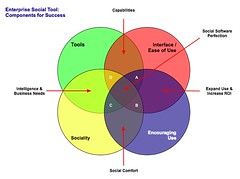
Enterprise Social Tool: Components for Success The four elements really have to work together to make for a successful services that people will use and continue to use over time. Yes, I am using a venn diagram for the four rings as it helps point out the overlaps and gaps where the implementations can fall short. The overlaps in the diagram is where the interesting things are happening. A year ago I was running into organizations with self proclaimed success with deployments of social tools (blogs, wikis, social bookmarking, forums, etc.), but as the desire for more than a simple set of blogs (or whichever tool or set of tools was selected) in-house there is a desire for greater use beyond some internal early adopters. This requires paying close attention to the four rings.

Tools

The first ring is rather obvious, it is the tools. The tools come down to functionality and features that are offered, how they are run (OS, rack mount, other software needed, skills needed to keep them running, etc.), how the tools are integrated into the organization (authentication, back-up, etc.), external data services, and the rest of the the usual IT department checklist. The tools get a lot of attention from many analysts and tech evangelists. There is an incredible amount of attention on widgets, feeds, APIs, and elements for user generated contribution. But, the tools do not get you all of the way to a successful implementation. The tools are not a mix and match proposition.

Interface & Ease of Use

One thing that the social software tools from the consumer web have brought is ease of use and simple to understand interfaces. The tools basically get out of the way and bring in more advanced features and functionality as needed. The interface also needs to conform to expectations and understandings inside an organization to handle the flow of interaction. What works for one organization may be difficult for another organization, largely due to the tools and training, and exposure to services outside their organization. Many traditional enterprise tools have been trying to improve the usability and ease of use for their tools over the last 4 to 5 years or so, but those efforts still require massive training and large binders that walk people through the tools. If the people using the tools (not administering the tools need massive amounts of training or large binders for social software the wrong tool has been purchased).

Sociality

Sociality is the area where people manage their sharing of information and their connections to others. Many people make the assumption that social tools focus on everything being shared with everybody, but that is not the reality in organizations. Most organizations have tight boundaries on who can share what with whom, but most of those boundaries get in the way. One of the things I do to help organizations is help them realize what really needs to be private and not shared is often much less than what they regulate. Most people are not really comfortable sharing information with people they do not know, so having comfortable spaces for people to share things is important, but these spaces need to have permeable walls that encourage sharing and opening up when people are sure they are correct with their findings.

Sociality also includes the selective groups people belong to in organizations for project work, research, support, etc. that are normal inside organizations to optimize efficiency. But, where things get really difficult is when groups are working on similar tasks that will benefit from horizontal connections and sharing of information. This horizontal sharing (as well as diagonal sharing) is where the real power of social tools come into play as the vertical channels of traditional organization structures largely serve to make organizations inefficient and lacking intelligence. The real challenge for the tools is the capability to surface the information of relevance from selective groups to other selective groups (or share information more easily out) along the way. Most tools are not to this point yet, largely because customers have not been asking for this (it is a need that comes from use over time) and it can be a difficult problem to solve.

One prime ingredient for social tool use by people is providing a focus on the people using the tools and their needs for managing the information they share and the information from others that flow through the tool. Far too often the tools focus on the value the user generated content has on the system and information, which lacks the focus of why people use the tools over time. People use tools that provide value to them. The personal sociality elements of whom are they following and sharing things with, managing all contributions and activities they personally made in a tool, ease of tracking information they have interest in, and making modifications are all valuable elements for the tools to incorporate. The social tools are not in place just to serve the organization, they must also serve the people using the tools if adoption and long term use important.

Encouraging Use

Encouraging use and engagement with the tools is an area that all organizations find they have a need for at some point and time. Use of these tools and engagement by people in an organization often does not happen easily. Why? Normally, most of the people in the organization do not have a conceptual framework for what the tools do and the value the individuals will derive. The value they people using the tools will derive needs to be brought to the forefront. People also usually need to have it explained that the tools are as simple as they seem. People also need to be reassured that their voice matters and they are encouraged to share what they know (problems, solutions, and observations).

While the egregious actions that happen out on the open web are very rare inside an organization (transparency of who a person is keeps this from happening) there is a need for a community manager and social tool leader. This role highlights how the tools can be used. They are there to help people find value in the tools and provide comfort around understanding how the information is used and how sharing with others is beneficial. Encouraging use takes understanding the tools, interface, sociality, and the organization with its traditions and ways of working.

The Overlaps

The overlaps in the graphic are where things really start to surface with the value and the need for a holistic view. Where two rings over lap the value is easy to see, but where three rings overlap the missing element or element that is deficient is easier to understand its value.

Tools and Interface

Traditional enterprise offerings have focussed on the tools and interface through usability and personalization. But the tools have always been cumbersome and the interfaces are not easy to use. The combination of the tools and interface are the core capabilities that traditionally get considered. The interface is often quite flexible for modification to meet an organizations needs and desires, but the capabilities for the interface need to be there to be flexible. The interface design and interaction needs people who have depth in understanding the broad social and information needs the new tools require, which is going to be different than the consumer web offerings (many of them are not well thought through and do not warrant copying).

Tools and Sociality

Intelligence and business needs are what surface out of the tools capabilities and sociality. Having proper sociality that provides personal tools for managing information flows and sharing with groups as well as everybody as it makes sense to an individual is important. Opening up the sharing as early as possible will help an organization get smarter about itself and within itself. Sociality also include personal use and information management, which far few tools consider. This overlap of tools and sociality is where many tools are needing improvement today.

Interface and Encouraging Use

Good interfaces with easy interaction and general ease of use as well as support for encouraging use are where expanding use of the tools takes place, which in turn improves the return on investment. The ease of use and simple interfaces on combined with guidance that provides conceptual understanding of what these tools do as well as providing understanding that eases fears around using the tools (often people are fearful that what they share will be used against them or their job will go away because they shared what they know, rather than they become more valuable to an organization by sharing as they exhibit expertise). Many people are also unsure of tools that are not overly cumbersome and that get out of the way of putting information in to the tools. This needs explanation and encouragement, which is different than in-depth training sessions.

Sociality and Encouraging Use

The real advantages of social tools come from the combination of getting sociality and encouraging use correct. The sociality component provides the means to interact (or not) as needed. This is provided by the capabilities of the product or products used. This coupled with a person or persons encouraging use that show the value, take away the fears, and provide a common framework for people to think about and use the tools is where social comfort is created. From social comfort people come to rely on the tools and services more as a means to share, connect, and engage with the organization as a whole. The richness of the tools is enabled when these two elements are done well.

The Missing Piece in Overlaps

This section focusses on the graphic and the three-way overlaps (listed by letter: A; B; C; and D). The element missing in the overlap or where that element is deficient is the focus.

Overlap A

This overlap has sociality missing. When the tool, interface, and engagement are solid, but sociality is not done well for an organization there may be strong initial use, but use will often stagnate. This happens because the sharing is not done in a manner that provides comfort or the services are missing a personal management space to hold on to a person's own actions. Tracking one's own actions and the relevant activities of others around the personal actions is essential to engaging socially with the tools, people, and organization. Providing comfortable spaces to work with others is essential. One element of comfort is built from know who the others are whom people are working with, see Elements of Social Software and Selective Sociality and Social Villages (particularly the build order of social software elements) to understand the importance.

Overlap B

This overlap has tools missing, but has sociality, interface, and encouraging use done well. The tools can be deficient as they may not provide needed functionality, features, or may not scale as needed. Often organizations can grow out of a tool as their needs expand or change as people use the tools need more functionality. I have talked with a few organizations that have used tools that provide simple functionality as blogs, wikis, or social bookmarking tools find that as the use of the tools grows the tools do not keep up with the needs. At times the tools have to be heavily modified to provide functionality or additional elements are needed from a different type of tool.

Overlap C

Interface and ease of use is missing, while sociality, tool, and encouraging use are covered well. This is an area where traditional enterprise tools have problems or tools that are built internally often stumble. This scenario often leads to a lot more training or encouraging use. Another downfall is enterprise tools are focussed on having their tools look and interact like consumer social web tools, which often are lacking in solid interaction design and user testing. The use of social tools in-house will often not have broad use of these consumer services so the normal conventions are not understood or are not comfortable. Often the interfaces inside organizations will need to be tested and there many need to be more than one interface and feature set provided for depth of use and match to use perceptions.

Also, what works for one organization, subset of an organization, or reviewer/analyst will not work for others. The understanding of an organization along with user testing and evaluation with a cross section of real people will provide the best understanding of compatibility with interface. Interfaces can also take time to take hold and makes sense. Interfaces that focus on ease of use with more advanced capabilities with in reach, as well as being easily modified for look and interactions that are familiar to an organization can help resolve this.

Overlap D

Encouraging use and providing people to help ease people's engagement is missing in many organizations. This is a task that is often overlooked. The tools, interface, and proper sociality can all be in place, but not having people to help provide a framework to show the value people get from using the tools, easing concerns, giving examples of uses for different roles and needs, and continually showing people success others in an organization have with the social tool offerings is where many organization find they get stuck. The early adopters in an organization may use the tools as will those with some familiarity with the consumer web social services, but that is often a small percentage of an organization.

Summary

All of this is still emergent and early, but these trends and highlights are things I am finding common. The two areas that are toughest to get things right are sociality and encouraging use. Sociality is largely dependent on the tools, finding the limitations in the tools takes a fair amount of testing often to find limitations. Encouraging use is more difficult at the moment as there are relatively few people who understand the tools and the context that organizations bring to the tools, which is quite different from the context of the consumer social web tools. I personally only know of a handful or so of people who really grasp this well enough to be hired. Knowing the "it depends moments" is essential and knowing that use is granular as are the needs of the people in the organization. Often there are more than 10 different use personas if not more that are needed for evaluating tools, interface, sociality, and encouraging use (in some organizations it can be over 20). The tools can be simple, but getting this mix right is not simple, yet.

[Comments are open and moderated at Enterprise Social Tools: Components for Success :: Personal InfoCloud


3 May 2008

Getting Info into the Field with Extension

This week I was down in Raleigh, North Carolina to speak at National Extension Technology Conference (NETC) 2008, which is for the people running the web and technology components for what used to be the agricultural extension of state universities, but now includes much more. This was a great conference to connect with people trying to bring education, information, and knowledge services to all communities, including those in rural areas where only have dial-up connectivity to get internet access. The subject matter presented is very familiar to many other conferences I attend and present at, but with a slightly different twist, they focus on ease of use and access to information for everybody and not just the relatively early adopters. The real values of light easy to use interfaces that are clear to understand, well structured, easy to load, and include affordance in the initial design consideration is essential.

I sat in on a few sessions, so to help tie my presentation to the audience, but also listen to interest and problems as they compare to the organizations I normally talk to and work with (mid-size member organizations up to very large global enterprise). I sat in on a MOSS discussion. This discussion about Sharepoint was indiscernible from any other type of organization around getting it to work well, licensing, and really clumsy as well as restrictive sociality. The discussion about the templates for different types of interface (blogs and wikis) were the same as they they do not really do or act like the template names. The group seemed to have less frustration with the wiki template, although admitted it was far less than perfect, it did work to some degree with the blog template was a failure (I normally hear both are less than useful and only resemble the tools in name not use). [This still has me thinking Sharepoint is like the entry drug for social software in organizations, it looks and sounds right and cool, but is lacking the desired kick.]

I also sat down with the project leads and developers of an eXtension wide tool that is really interesting to me. It serves the eXtension community and they are really uncoupling the guts of the web tools to ease greater access to relevant information. This flattening of the structures and new ways of accessing information is already proving beneficial to them, but it also has brought up the potential to improve ease some of the transition for those new to the tools. I was able to provide feedback that should provide a good next step. I am looking forward to see that tool and the feedback in the next three to six months as it has incredible potential to ease information use into the hands that really need it. It will also be a good example for how other organizations can benefit from similar approaches.

Comments are open (with usual moderation) at this post at Getting Info into the Field with Extension :: Personal InfoCloud.


16 April 2008

Social Tools for Mergers and Acquisitions

The announcement yesterday of Delta and Northwest airlines merging triggered a couple thoughts. One of the thoughts was sadness as I love the unusually wonderful customer service I get with Northwest, and loathe the now expected poor and often nasty treatment by Delta staff. Northwest does not have all the perks of in seat entertainment, but I will go with great customer service and bags that once in nearly 50 flights did not arrive with me.

But, there is a second thing. It is something that all mergers and large organization changes trigger...

Social Tools Are Great Aids for Change

Stewart Mader brought this to mind again in his post Onboarding: getting your new employees cleared for takeoff, which focusses on using wikis (he works for Atlassian and has been a strong proponent of wikis for years and has a great book on Wiki Patterns) as a means to share and update the information that is needed for transitions and the joining of two organizations.

I really like his write-up and have been pushing the social tools approach for a few years. The wiki is one means of gathering and sharing information. It is a good match with social bookmarking, which allows organizations that are coming together have their people find and tag things in their own context and perspective. This provides finding common objects that exist, but also sharing and learning what things are called from the different perspectives.

Communication Build Common Ground

Communication is a key cornerstone to any organization working with, merging with, or becoming a part of another. Communication needs common ground and social bookmarking that allows for all context and perspectives to be captured is essential to making this a success.

This is something I have presented on and provided advice in the past and really think and have seen that social tools are essentials in these times of transition. It is really rewarding when I see this working as I have been through organization mergers, going public, and major transitions in the days before these tools existed. I can not imaging thinking of transitioning with out these tools and service today. I have talked to many organizations after the fact that wished they had social bookmarking, blogs, and wikis to find and annotate items, provide the means to get messages out efficiently (e-mail is becoming a poor means of sharing valuable information), and working toward common understanding.

One large pain point in mergers and other transitions is the cultural change that brings new terms, new processes, new workflow, and disruption to patterns of understanding that became natural to the people in the organization. The ability to map what something was called and the way it was done to what it is now called and the new processes and flows is essential to success. This is exactly what the social tools provide. Social bookmarking is great for capturing terms, context, and perspectives and providing the ability to refind these new items using prior understanding with low cognitive costs. Blogs help communicate people's understanding as they are going through the process as well as explain the way forward. Wikis help map these individual elements that have been collectively provided and pull them together in one central understanding (while still pointing out to the various individual contributions to hold on to that context) in a collaborative (working together with one common goal) environment.

Increasing Speed and Lowering Cost of Transition

Another attribute of the social tools is the speed and cost at which the information is shared, identified, and aggregated. In the past the large consulting firms and the slow and expensive models for working were have been the common way forward for these times of change. Seeing social tools along with a few smart and nimble experts on solid deployments and social engagement will see similar results in days and a handful of weeks compared to many weeks and months of expensive change management plodding. The key is the people in the organizations know their concerns and needs, while providing them the tools to map their understanding and finding information and objects empowers the individuals while giving them knowledge and the means to share with others. This also helps the individuals grasp that are essential to the success and speed to the change. Most people resent being pushed and prodded into change and new environments, giving them the tools to understand and guide their own change management is incredibly helpful. This decreases the time for transition (for processes and emotionally) while also keeping the costs lower.

[Comments are open and moderated as always in the post at: Social Tools to Efficiently Build Common Ground :: Personal InfoCloud]


10 April 2008

Denning and Yaholkovsky on Real Collaboration

The latest edition of the Communications of the ACM (Volume 51, Issue 4 - April 2008) includes an article on Getting to "we", which starts off by pointing out the misuse and mis-understanding of the term collaboration as well as the over use of the practice of collaboration when it is not proper for the need. The authors Peter Denning and Peter Yaholkovsky break down the tools needed for various knowledge needs into four categories: 1) Information sharing; 2) Coordination; 3) Cooperation; and Collaboration. The authors define collaboration as:

Collaboration generally means working together synergistically. If your work requires support and agreement of others before you can take action, you are collaborating.

The article continues on to point out that collaboration is often not the first choice of tools we should reach for, as gathering information, understanding, and working through options is really needed in order to get to the stages of agreement. Their article digs deeply into the resolving "messy problems" through proper collaboration methods. To note, the wiki - the usual darling of collaboration - is included in their "cooperation" examples and not Collaboration. Most of the tools many businesses consider in collaboration tools are in the lowest level, which is "information sharing". But, workflow managment falls into the coordination bucket.

This is one of the better breakdowns of tool sets I have seen. The groupings make a lot of sense and their framing of collaboration to take care of the messiest problems is rather good, but most of the tools and services that are considered to be collaborations tools do not even come close to that description or to the capabilities required.

[Comments are open at Denning and Yaholkovsky on Real Collaboration :: Personal InfoCloud]


6 April 2008

Selective Sociality and Social Villages

The web provides wonderful serendipity on many fronts, but in this case it brought together two ideas I have been thinking about, working around, and writing about quite a bit lately. The ideas intersect at the junction of the pattern of building social bonds with people and comfort of know interactions that selective sociality brings.

The piece that struck me regarding building and identifying a common bond with another person came out of Robert Paterson's "Mystery of Attraction" post (it is a real gem). Robert describes his introduction and phases of getting to know and appreciate Luis Suarez (who I am a huge fan of and deeply appreciate the conversations I have with him). What Robert lays out in his introduction (through a common friend on-line) is a following of each other's posts and digital trail that is shared out with others. This builds an understanding of each others reputation in their own minds and the shared interest. Upon this listening to the other and joint following they built a relationship of friendship and mutual appreciation (it is not always mutual) and they began to converse and realized they had a lot more in common.

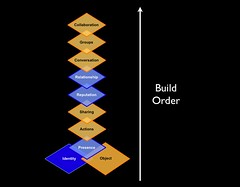
Elements of Social Software Build Order What Robert echos is the Elements in Social Software and its build order. This build order is common in human relationships, but quite often social software leaves out steps or expects conversations, groups, and collaboration to happen with out accounting for the human elements needed to get to this stage. Quite often the interest, ideas, and object (all social objects) are the stimulus for social interaction as they are the hooks that connect us. This is what makes the web so valuable as it brings together those who are near in thought and provides a means to connect, share, and listen to each other. I really like Robert's analogy of the web being like university.

Selective Sociality of Villages

The piece that resonated along similar threads to Robert's post is Susan Mernit's "Twitter & Friend Feed: The Pleasure of Permissions". Susan's post brings to light the value of knowing who you are sharing information with and likes the private or permission-based options that both Twitter and FriendFeed offer. This selective sociality as known Local InfoCloud of people and resources that are trusted and known, which we use as resources. In this case it is not only those with whom we listen to and query, but those with whom we share. This knowing who somebody is (to some degree) adds comfort, which is very much like Robert Patterson and Luis Suarez#039; villages where people know each other and there is a lot of transparency. Having pockets where our social armor is down and we can be free to share and participate in our lives with others we know and are familiar to us is valuable.

I am found these two pieces quite comforting as they reflect much of what I see in the physical community around me as well as the work environments I interact with of clients and collaborators. The one social web service I have kept rather private is Twitter and I really want to know who someone is before I will accept them as a connection. This has given me much freedom to share silly (down right stupid - in a humorous way) observations and statements. This is something I hear from other adults around kids playgrounds and practices of having more select social interactions on line in the services and really wanting to connect with people whom they share interests and most often have known (or followed/listened to) for sometime before formally connecting. Most often these people want to connect with the same people on various services they are trying out, based on recommendation (and often are leaving a service as their friends are no longer there or the service does not meet their needs) of people whom they trust. This is the core of the masses who have access and are not early adopters, but have some comfort with the web and computers and likely make up 80 to 90 percent of web users.

[Comments are open (with moderation as always) on this post at Selective Sociality and Social Villages :: Personal InfoCloud]


22 February 2008

Remote Presentation and Perception Matrix for Social Tools

This post is also found at: Remote Presentation and Perceptions Matrix for Social Tools :: Personal InfoCloud with moderated comments turned on.]

Today I did something I had never done before (actually a few things) I sat in my office in my home and gave a live web video presentation to a conference elsewhere on the globe. I presented my nearly all new presentation, Keeping Up With Social Tagging to the Expert Workshop in: Social Tagging and Knowledge Organization - Perspectives and Potential that was put on by the Knowledge Media Research Center in Tübingen, Germany.

Remote Presentation Feelings

While the remote video presentation is normal for many people inside their large organizations and I have presented at meetings and conferences where my presentation was provided to other location on live video feed (my recent Ann Arbor trip to present at STIET was HD broadcast to Wayne State in Detroit), this home office to conference presentation was new to me. The presentation and video link used Adobe Connect, which allowed me to see whom I was talking to, manage my slides, text chat, and see myself. This worked quite well, much better than I expected. I did have my full slide presentation in lightroom view set up in Keynote on my external monitor on the side and used Awaken on the side monitor as well to help with timing.

The ability to get feedback and watch the attendees body language and non-verbal responses was insanely helpful. I have given webinars and done phone presentations where I had not visual cues to the audience responses, which I find to be a horrible way to present (I often will expand on subjects or shorten explanations based on non-verbal feedback from the audience). Adobe Connect allowed this non-verbal feedback to be streamed back to me, which completely allows me to adjust the presentation as I normally do.

One thing that was a wee bit difficult was having to change focus (I suppose that comes with use and experience), but I would watch audience feedback while presenting, peek to the side to see where I was with time and slides (to work in the transitions), but would then try to look at the camera to "connect". Watching myself on the video feedback the moments I would try to connect through the camera I would open my eyes wide as if trying to see through my iSight and boy does that come across looking strange on a close range camera. I also (unknown to myself until recently watching a video of another presentation I had done) use a similar facial expression to add emphasis, I am realizing with a camera as close as it is for web presentation also really looks odd. I am sort of used to listening to myself (normally to write out new analogies I use or responses to questions), but watching myself in playback from that close of a range is really uncomfortable.

One thing I really missed in doing this web video presentation was extended interaction with the attendees. I rather enjoy conferences, particularly ones with this focussed a gathering as it makes for great socializing with people passionate about the same subjects I am passionate about. I like comparing note, perceptions, and widely differing views. It helps me grow my knowledge and understandings as well as helps change my perceptions. Live face-to-face conversation and sharing of interests is an incredibly value part of learning, experiencing, and shaping views and it is something I greatly enjoy attending conferences in person. I am not a fan of arriving at a conference just prior to a presentation, giving the presentation, and then leaving. The personal social interaction is valuable. The video presentation does not provide that and I really missed it, particularly with the people who are so closely tied to my deep interest areas as this workshop was focused.

New Content in Presentation

This presentation included a lot of new content, ideas, and concepts that I have not really presented or written about in as open of a forum. I have received really strong positive feedback from the Faces of Perception, Depth of Perception, and Perception Matrix when I have talked about it with people and companies. I have included this content in the book on social bookmarking and folksonomy I am writing for O&Reilly and pieces have been in public and private workshops I have given, but it was long past time to let the ideas out into the open.

The components of perception came about through reading formal analysis and research from others as well as not having a good models myself to lean on to explain a lot of what I find from social computing service providers (web tools in the Web 2.0 genre as well as inside the firewall Enterprise 2.0 tools) as tool makers or service owners. The understandings that are brought to the table on a lot of research and analysis is far too thin and far too often badly confuses the roles and faces of the tool that are being reviewed or analyzed. In my working with tool makers and organizations implementing social tools the analysis and research is less than helpful and often makes building products that meet the user needs and desires really difficult. I am not saying that this conceptual model fixes it, but from those who have considered what it shows almost all have had realizations they have had a less than perfect grasp and have lacked the granularity they have needed to build, analyze, or research these social tools.

I am hoping to write these perspectives up in more depth at some point in the not too distant future, but the video and slides start getting the ideas out there. As I have been walking people through how to use the tools I have been realizing the content needed to best us the model and matrix may take more than a day of a workshop of even a few days to get the most complete value from it. These tools have helped me drastically increase my value in consulting and training in the very short time I have used them. Some are finding that their copying of features and functionality in other social services has not helped them really understand what is best for their user needs and are less than optimal for the type of service they are offering or believe they are offering.


5 February 2008

Social Computing Summit in Miami, Florida in April, 2008

ASIS&T has a new event they are putting on this year, the Social Computing Summit in Miami, Florida on April 10-11, 2008 (a reminder page is up at Yahoo's Upcoming - Social Computing Summit). The event is a single-track event on both days with keynote presentations, panels, and discussion.

The opening keynote is by Nancy Baym. I have been helping assist with organization of the Social Computing Summit and was asked by the other organizers to speak, which I am doing on the second day. The conference is a mix of academic, consumer, and business perspectives across social networking, politics, mobile, developing world, research, enterprise, open social networks (social graph and portable social networks) as well as other subjects. The Summit will be a broad view of the digital social world and the current state of understanding from various leaders in social computing.

There is an open call for posters for the event that closes on February 25, 2008. Please submit as this is looking to be a great event and more perspectives and expertise will only make this event more fantastic.


16 January 2008

DataPortability Video is Place to Start Understanding

Marchall Kirkpatrick at ReadWriteWeb has posted a good background about New Video Explains the Basics of Data Portability. The DataPortability - Connect, Control, Share, Remix video is under 2 minutes in length and explains the reasons why the DataPoratbility.org group is important. It aims to ease the pain many are experiencing as they use more social media, social web services, social networks, and/or social computing services in their personal and work life.

Control

The biggest piece in this for me is control with translates to services respecting privacy wishes among other desires around trust and control of sharing. As Tom Raftery points out With the rising interest in, and use of Social Networks (FaceBook, Plaxo et al) there is growing unease in what those sites are doing with your data, never mind the inconvenience of uploading all your data every time you join a new site. The DataPortability.org aims to include in its focus data that is "shared between our chosen (and trusted) tools and vendors".

I have been working around the edges on a project whose aim is to respect these privacy wishes. This is one of the things that really needs to be at the core of all services entering into this market segment.


14 January 2008

Ma.gnolia Goes Mobile

On Friday Ma.gnolia rolled out a mobile version of their site, M.gnolia - Mobile Ma.gnolia. This had me really excited as I now have access to my bookmarks in my pocket on my mobile. Ma.gnolia gives a quick preview in their blog post Ma.gnolia Blog: Flowers on the Go.

What Mobile Ma.gnolia Does and Does Not Do

First, off the mobile Ma.gnolia does not have easy bookmarking, which is not surprising given the state things in mobile browsers. I really do not see this as a huge downside. What I am head over heals happy about is access to my bookmarks (all 2800 plus). The mobile version allows searching through your own tags (if you are logged in). It currently has easy access to see that is newly bookmarked in Ma.gnolia groups you follow, your contact's bookmarks, popular bookmarks, your own tags, and your profile.

Mobile Site Bookmarks

One thing that is helpful for those that use mobile web browsing is having easy access to mobile versions of web sites. Yes, the iPhone and many smartphone users (I am in the Nokia camp with my well liked E61i) can easily browse and read regular web pages, but mobile optimized pages are quicker to load and have less clutter on a smaller screen. The iPhone, WebKit-based browsers (Nokia), Opera Mini, and other decent mobile web browsers all have eased mobile browsing use of regular webpages, but having a list of mobile versions is really nice.

Yesterday, Saturday, I created a Ma.gnolia Mobile Version Group so people can share web pages optimized for mobile devices (quicker/smaler downloads, smaller screens, less rich ads, etc.). One of the ways I was thinking people could use this is to find sites in this group then bookmark them for their own use with tags and organization that makes sense for themself. The aim is just to collect and share with others what you find helpful and valuable for yourself. This group will be monitored for spam as the rest of Ma.gnolia is (Ma.gnolia uses "rel="no-follow"" so there really is little value to spammers).

Ways You Can Use Mobile Ma.gnolia

This means if you tagged a store, restaurant, bar, transit site, or other item that has value when out walking around it is really nice to have quick access to it. It can also be a great way to read those items you have tagged "to read" (if you are a person that tags things in that manner) so you can read what you want in the doctor's office, bus, train, or wherever.

I have a lot of content I have bookmarked for locations I am work, live, and visit. When I come across something I want to remember (places to eat, drink, learn, hang, be entertained, etc.) I often dump them into the bookmarks. But, getting to this information has been painful from a mobile in the past. I am now starting to go back to things I have tagged with locations and add a "togo" tag so they are easier for me to find and use in the Ma.gnolia mobile interface. I have already added a bookmark for an museum exhibit that I really want to see that is not far from where I am. When a meeting is dropped, postponed, or runs short near the museum I can make a trip over and see it. There is so much information flowing through my devices and it is nice to be able to better use this info across my Personal InfoCloud in my trusted devices I have with me and use the information in context it is well suited for, when have stepped away from my desk or laptop.

I am looking forward to see where this goes. Bravo and deep thanks to the Larry and others at Ma.gnolia that made this happen!


10 January 2008

Posting Elements of the Social Software Stack

I have been working for quite on finding a good way to explain the elements in the social software stack (or most of the important ones). I have blogged the result of the work as The Elements in the Social Software Stack (comments are open there).

In my public and in-house workshops I have worked through various graphics from others and my own to work as a foundation for talking to and through the subject. In November I finally sat down (in a hallway open space) the day before my workshop at the IA Konferenz in Stuttgart, Germany. It had all the elements that are part of a solid foundation, in progressive order:

  1. Identity
  2. Object (social object)
  3. Presence
  4. Actions
  5. Sharing
  6. Reputation
  7. Relationships
  8. Conversation
  9. Groups
  10. Collaboration

This and one other post that is in the works are becoming the corner stones for my work helping start-ups and enterprise work through social software (social computing) to properly solve their problems and address the issues at hand. It has also been the foundation for rethinking (mostly more clearly thinking about) social bookmarking and folksonomy. I am rewriting the work I have done toward the book based on these two pieces as it is making the communication of concepts clearer.

Who Does This Help?

People looking at the social software services should have a solid idea of the central elements, identity and the social object. After that it is a building process to account for the other elements leading up to the services full offerings. Social bookmarking (folksonomy related services) should get up to or include conversation. Tools like Ma.gnolia go up to groups for their social bookmarking service and they cover the elements leading up to that end point.

There is more that can be fleshed out in this, but it is a foundation and a starting point. The next piece will build on this posting and should be a good foundation for understanding.

Still here? Go read The Elements in the Social Software Stack :: Personal InfoCloud and offer constructive feedback. Thank you.


This work is licensed under the Creative Commons Attribution-NonCommercial-ShareAlike License.