Off the Top: Collaboration Entries

Showing posts: 1-15 of 37 total posts


19 August 2026

A Painting Exchange with Words about Hobbema's Wooded Landscape

This is a painting swap and collaboration that James proposed the other day where he gives me a painting to write about and I give him one. He had done this last year and wanted to do it again. Last year’s, Painting impressions with Zachary - with words, wonder.

I Gave James the Tower of Babylon

I gave James Pieter Bruegel‘s The Tower of Babel - Wikipedia. I have tried to see the actual work twice and was foiled both times. I’ve studied it formally and have a deep fascination for the breadth and detail in the work. You can read James’ words on the piece in his site: James’ words on the Tower of Babel Painting.

Meindert Hobbema’s Wooded Landscape

To me, James offered up a painting hanging in the National Galleries Scotland by Meindert Hobbema, Wooded Landscape.
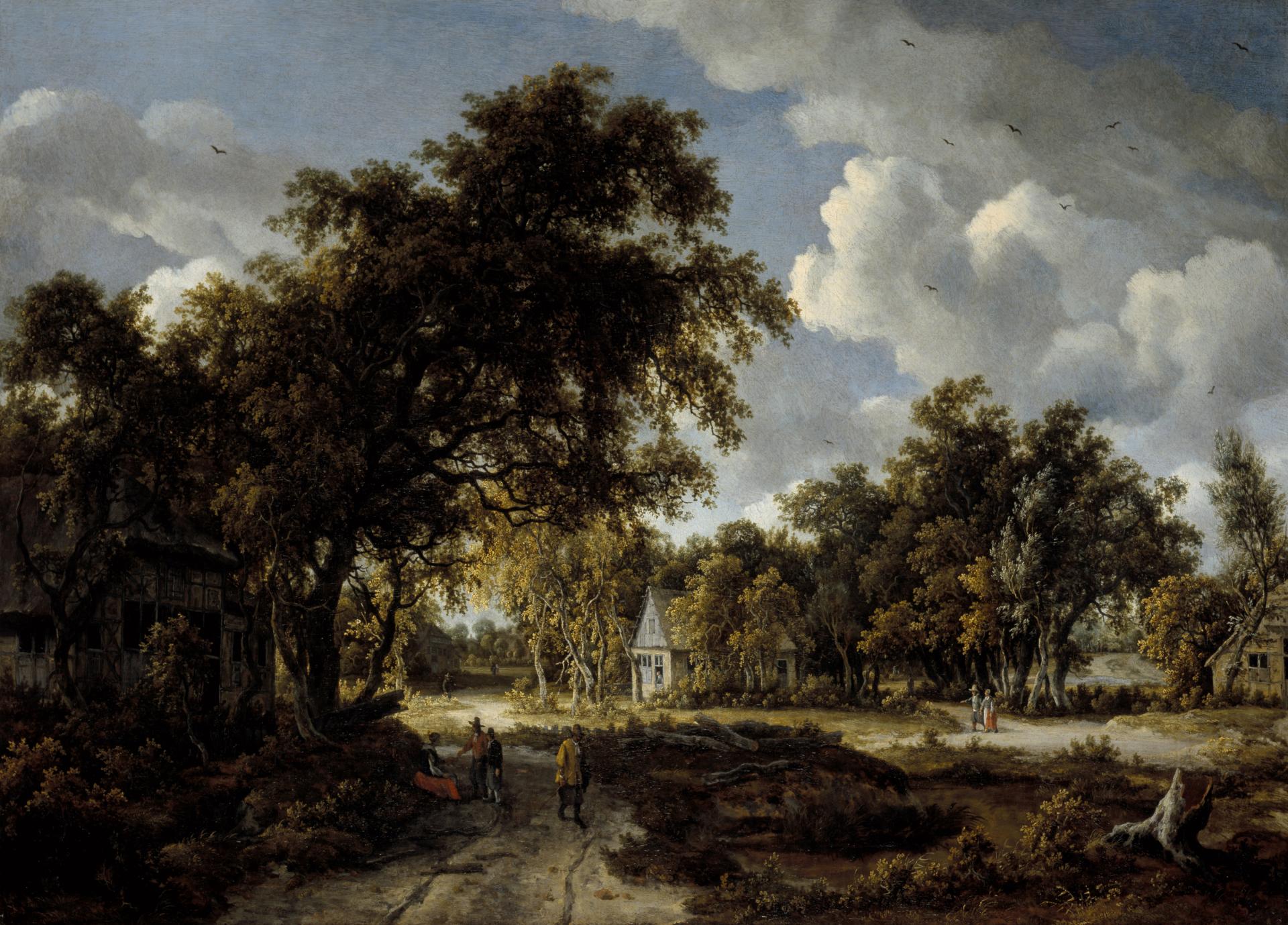
This is a painting of open paths through woods with buildings surrounded by trees and people walking on the paths, through the trees there are large billowing clouds in the sky

When first looked at Meindert Hobbema’s Wooded Landscape my eye quickly saw the people, the path, the woods, and boldly clouded sky. The people in action, as if captured in a photo, are very reminiscent of Pieter Bruegel the Elder paintings of towns people in a mix of action, but this with with far few people and action. It has that life captured and people living their lives in the painting of Early Northern Renaissance painters like the works of those who came out of a Bruegel (elder or younger) or Bosch studio.

Looking at the people they seem to be wearing the dress of the English pilgrims who came to the US in the early to mid–1600s. Many of these pilgrims spent time in or near Leiden, Netherlands before heading off to the Americas. The men in their tall hats with sizable brims and wide band fits that pilgrim dress quite closely. The women’s modest dress and the men’s cut of their coats is very much akin to the paintings of pilgrims that Americans know.

But, the woodsy nature setting is a little different from Dutch paintings and are something I more often associate with English or German paintings. The sky framed by the trees seems like it is snippets of the long sky so common in the Netherlands, but also like it was dropped into England as well.

Staring at the painting for a while I kept trying to get it to tell me where it was.

The skies fit the long sky paintings of Dutch pastoral scenes or the vast paintings of Dutch fleet under sail or in combat on the North Sea. The large clouds billowing is common in both Dutch and British paintings, and very much a John Constable focus years later where the clouded skies are prominent and a focus.

But, in this painting the clouds are there, but occluded by the woods. The woods are a bit dark and provide shadows and cover for the people and buildings. But, as we back out a bit and pay attention to where the light shines it is on the blue grey building with a woman looking out, as if she is in anticipation of someone arriving or returning. With the one of the paths moving somewhat through the middle of the painting and out and away, that is mostly darkened, so not the focus. But, the light is favorable to the path to the right mid-ground with a man and woman walking toward the meeting of the paths near the front of the house with the woman looking out. Is the couple walking the awaited arrival? Or are they just walking through like the others.

In the foreground in the shadow of the trees on the left there are a couple of people talking to a woman and possibly touching hands or one handing something to the other, as the woman sits in front of a rather dark house. Across from her is a tree that has been toppled some time ago and weathered. There are rough piles of large tree trunks somewhat piles, was there a storm in the not too distant past? Are the clouds a new storm coming (but isn’t there always a storm brewing)?

One interesting element missing is a patron and person clearly in focus in the painting. It isn’t the people, nor their built environment that is the focus, which 100 to 200 years prior van Eyck, Memling, and others would have leaned into in their painting. Hobbema’s painting is more organic and not as structured as artist from earlier years. But, Hobbema is a contemporary of Vermeer and there is some rhyming of pale Northern light in this piece somewhat akin to what is found in a Vermeer. In the look across time the rough details in the distance of the couple walking past the house a ways ahead, but the leaves and foregrounds have soft details and rough shapes and not the pristine details of prior generations of Netherlandish painters.

The Gallery Painting Annotation

I tried to steer clear of the gallery’s annotation for the painting at the start, but reading it and mention that this is likely a imaginary place, makes a bit of sense as the mix of Dutch / Netherlandish styles, but the woods were something I couldn’t place (but I’m mostly thinking of flying over the Netherlands today with the vast swathes of farms, flat, and mostly a lack of woods). There are many tells that this is a Dutch painter, but there are pieces that seem to come from elsewhere, or a time in a place I am not quite familiar.

The gallery note of a made up place would make sense of the billowing clouds of darkening long sky, but paired with wonderful sun dappled woods and a potential village are added to a more pastoral and flat scene-scape. With Hobbema known for their wooded landscapes, I think of Thomas Kinkade’s cozy town cottages and paintings of the 1980s to early 2000s and the request and offers of payment to add more warmly lit candles and touches of light. But, with Hobbema was the request, “add more woods”?

Where Do I Land?

The painting has entertained me with the exercise of trying to sort out where this would be, what is the story being told (or what myriad of stories can come out of the painting), or is the painting just a painting to be a painting. Was this painted for a Dutch audience or a British one, as both around this time leaned toward large scenery and sky paintings. Constable is a half century or more yet to arrive.

This is now a painting I would like to see. I could also craft stories from this painted scene, with each visit to view and craft some new tale, much like sitting in a cafe with a street view and many tables of customers and telling the stories of the table guests and passers by.


15 August 2026

A Book Encompasses More than the Pages and What is on Them

Last evening I went down an odd rabbit hole. I’ve been doing two conflicting tasks with my bookshelves: 1) Taking pictures of them and converting that into markdown for titles and author lists of what is on what shelf and capture what I own; 2) Culling books that are vastly out of date, I didn’t find interesting nor helpful, or poorly written (or produced).

In doing this I ran across a book I picked up (or was gifted) in college during one summer. The book is Habits of the Heart - Google Books, which is academics and research writing a popularly approachable version (think of it as the precursor to Bowling Alone - Wikipedia). The book is a mixed social studies and sociology research look at patterns in America as of the 1980s. My paperback copy binding is a little brittle, but still doing alright. I remember reading the first half and then moved through reading what was of interest and new to me as it was covering familiar ground. I don’t remember much of the book, but I remember I did have a few long discussions about it. I thought I’d see what I highlighted and annotated to job my memory, but some of the notes and cues weren’t mine and I remembered two friends borrowed it (one for class and one also out of curiosity). My own highlights and marginalia are a mystery over time to myself, but now having mine combined with two other’s it is really muddled.

I had two “bookmarks”, one from Kepler’s Books in the first third and in the second third a airplane ticket sleeve for AirCal - Wikipedia with the paper ticket in it typed out for a $59 round trip from Oakland to San Diego. The ticket was from the travel agency connected to the college.

This had memories of college fresh in my head and thinking of great conversations with professors, classes that drastically changed and expanded my understanding of the world (in class and the many office hour visits to discuss something for class or say “hey” and then have an amazing couple hour conversation), and conversations with the president of the college, Brother Mel Anderson (there were a lot of these conversations).

The Habits of the Heart was largely calling out a pattern in the US of embracing individualism and going it alone. My college experience and beyond has all been heavily social and personal individual curiosity and drive, but those two have blended. I have long blogged to connect with others with similar curiosities. But, many years of focus on social software and its multiple patterns and scales with the differences as things scale. But in these, folksonomy / folksonomy - category is individuals tagging in their own vocabulary and out of their multiple deep contexts that are unique and this tagging is primarily for their own retrieval. But, in this tagging it is also social (public or semi-private) and others who have one or a few similar contexts and vocabularies using similar terminology sets use the tags to find the resources as well. This individual and social participant interweaving is key and essential. I don’t know how much I would agree with Habits of the Heart today. I may gut it to refresh it for me.

I wasn’t expecting so much to be wrapped in picking the book up off the shelf (it sat behind a stack of other books) and having the cover bring back memories before opening it and having so many more flood out along with a myriad of contexts colliding.


2 August 2026

BBC Global Focus on Lina Ghotmeh and Her Architecture

This morning I woke too early to head to the farmer’s market so I hit YouTube (as one does) and found this gem from BBC Global, Lina Ghotmeh: How to design buildings that remember the past. It is about Lina Ghotmeh, whom I didn’t know about before.

The video is wonderful, but the work of Ghotmeh is stunning. It has been a while since I’ve run into a new (to me) architect who is refreshing to hear discuss their work and perspectives, but also sees things differently and that difference make a fantastic outcome. The beauty of flow and space in her work, but also deeply considered understanding of history and cultural context is magnificent.

It has been a while since I’ve heard good architecture discussions, from basics to really good quotable insights.

Architecture has to talk about the environment, it has to talk about context, and to do that, we have to understand that environment in the large sense of what an environment is.

There was a great quote regarding her winning the work to be the architect for the Estonian museum - Lina Ghotmeh — Architecture | Estonian National Museum - and she said the blind review panel thought they were Estonian with how well they understood the culture, history, and environment. That is the sign of good design and development, where the needs and concerns are understood and perceived as those doing the work are “one of us”.

The competition itself was opened in 2005. It was an anonymous competition, so they didn’t know that we were foreigners — they thought we were Estonians.

The discussion of the Stone Garden work in Beirut, Lebanon provided really good insight and creativity to embrace the pained history while easing a means for inspiration for growth and recovery. (Lina Ghotmeh — Architecture | Stone Garden Housing - Beirut)

In 2020, August 4th, there was a huge explosion in the port of Beirut. Stone Garden was one of the first buildings that was hit. It actually resisted the explosion. It was designed to endure earthquakes because Lina did look back at the site, at history, at what was happening in Beirut. In itself, the building embodies resilience.

A term that Ghotmeh’s firm uses is, “archaeology of the future”, which I find to be a really good reflexive perspective while researching, designing, and building something informed for the near now and the future.

It’s about always digging in the place, understanding the context, understanding the client — that takes the form of different research elements, images. Every time you build something, you’re actually projecting into the future. And that’s why it’s an archaeology of the future.

The video wraps with her presentation to the British Museum for the redevelopment of the Western Range - Lina Ghotmeh — Architecture | Stone Garden Housing - Beirut and the outcome of that pitch and review process.

Looking at the Corpus of Work for Lina Ghotmeh

This video has had me digging into the architecture firm, Lina Ghotmeh — Architecture | Paris and going through the volume of work she and her firm have already done. There is so much wonderful work and many insights, that I know I will be returning to it.


3 October 2020

Rebuilding My Note Taking and Management System and Model

The past many weeks I have been digging into a better note taking and management method, while also embracing what I have and my core underlying principles. A continual genre in YouTube I watch is around productivity, particularly around personal knowledge management methods and tools. A couple years back I ran into Zettelkasten Method, that comes from Niklas Luhmann, which focuses on his prolific reading and his card catalogue and related note taking system. Then a few months back I heard Jorge Arango’s interview with Beck Tench it drew Zettelkasten back into focus. The interview with Beck focussed on Tinderbox, which I love, but I also want mobile access to my notes from phone and tablet.

Early Exploration

I have been using Notion a little bit, but my only use the last few months is as an interstitial capture for YouTube and some other rich media. [I like Notion and it seems like a modern take on Podio and has a similar downfall of not sorting out an adaptive data structure for interoperability and consistency.] But, the communities that are interested in Notion became obsessed with Roam Research, so I looked at Roam. Roam and Notion are two vastly different approaches, which can complement each other but in to way replace each other. But, each has a similar faults, no API, no standard export for structured information, and fully cloud based. That is too many common failure points wrapped into one product (Notion is working on and API, which is really good). Roam bugged me most because it relies on an outline format but has no clue about OPML exporting, but worse has no good export model. The cloud based, which requires being connected and online is a model I really don’t like as, particularly if their isn’t a local sync nor standard data format model. What I really like about Roam is its block focussed format, that is akin to purple numbers model of small chunks that are addressable and reusable.

In this time of looking what a next generation of quick note taking would look like, but long used tool, NValt failed spectacularly, in that it would not find my directory where my 1,200+ notes were stored, nor could I add new notes. Fortunately all of my notes are in plain markdown text files, so all I was missing was my tagging of the files in NValt (Brett Terpstra who created NValt has been working on a new tool that can replace NValt but has been taking forever to show up and my need became immediate). This is one of the common reasons for owning my own notes and having them locally and not using somebody else’s model and framework. But, also using the [small apps loosely joined] model where many tools pointing at well formatted / structured data / information can function to their best ability and can use their strengths without breaking anything with the information / data.

Seriously Looking at Note Taking and Management Tools

I started looking at about five or six different note taking tools. I was building out a rough attribute model of tools to help see what each offered or didn’t. I am needing to write this up, but it started with watching Mike and Matty’s, Notion vs Roam vs Obsidian vs Remnote - How to best fit note taking app for you and using their criteria as a base, then building on it. Obsidian and Remnote were already on my list, but also included Zettelnote, Zettlr, and a couple that extended Tidlywiki for a Zettelkasten type model. I also included OmniOutliner as that has been (and will be) my core outlining tool that interplays well with OPML and I can back and forth with good mind mapping tools that also output and import OPML data standard. I also included DevonThink Pro as it is my long used (since 2005) note and information storage and smart search tool (it already was indexing my notes directories) that there is no chance I’m going to give up, but also knew it didn’t have the core functionality I was seeking, wiki-style back linking.

I did a quick test or Roam and ruled it out as it broke rules I try not to break, and it broke many of them (biggest one is know now you are going to exit before you enter anything and a lack of any structure nor API made it a giant risk I’ve been burned by too many times, but the developers have a lot of arrogance about their approach that far too often leads to disasters - sometimes the kindest, smartest, and solid planning people end up with disasters that I feel very badly about but arrogance and ignorant I don’t).

Zettlr and Remnote were next. But the setup took a bit more of me managing and building things and I know when I lose focus those may not be best choices for myself (my past self 15 years ago or more would have loved it and done well with it, but those days are not now).

Obsidian Ticks the Right Boxes and Adapts to My Existing Model

Obsidian is where I put some time. I pointed its “Vault” to my notes directory (and sub-directory) where I had my 1,200 markdown notes already (some of them were .txt extensions, which I did bulk extension swap on) and it could read everything perfectly. One of my first tests was adding backlinks to some of my social lenses and social scaling notes, which worked really well by making related elements connected. I started capturing my notes about what I was doing in Obsidian and the ease of not only connecting things with backlinks, but having the ability to set empty node wiki links (many notes with the same link to a note / page that doesn’t exist yet, but have the same link to it) and then being able to use backlink following from that non-existent notes link list of things pointing to it was insanely valuable.

I have quite a few book list and book note pages already and I started linking them and linking authors and making author pages. I also found I was wanting note page templates for simple book pages in a Zettelkasten model, a book notes template, author / creator template, and a few others. I created these from existing structured notes I’ve used for years and put the outlines in TextExpander using a simple input line or two to label all of the headers with author name or other name.

I started typing out my notes and highlights from books I’ve read and annotated over the years and after the first three or so books I was deeply hooked.

The Use Where Obsidian Showed I was Hooked

Where I knew I was sold was this last weekend I went back to one of Matt Webb’s blog posts on Small Groups that is dense and has links out to great resources. I captured my initial notes on Matt’s post, and annotated relating to his sections. But, I also quickly dug through the linked materials and created and filled out structured note pages for those as well. The James Mullholland post on Small Groups was fantastic and it spidered out to more related resources, so I followed those and took notes. All of this was cross-linked and back-linked and fleshed out small group notes that I have been building as part of social scaling I’ve been writing on and presenting (talks and workshops) for years. The small group size they focus on is roughly team size, but not a team. Both of these are cooperative social models, which scale from teams, groups (small to large groups with similar social interaction models, but the dynamics shift quite a bit around 75 people and break fully about 300 to 500 people), community (everybody inside a firewall or inside an walled off construct), and network (inside and outside a firewall - so for business it is customers, contractors, consultants, vendors, etc. where there needs to be a safe model for sharing information with shared goals as different roles with their purpose come together for back and forth exchange) - more can be found in my related write-up 5 Core Insights for Community Platforms Today.

This note taking and contextualizing and cross linking to rip through and gut a series of related and interrelated pieces has been something I’ve long looked for and wanted. Many dog years ago in college I took reading notes on note cards with citations and context. When writing a paper / essay I would assemble the note cards in an order that could tell a story. Then I would build an outline in WordStar and type in the quotes. Then I would write the narrative and wrapper. Obsidian is starting to get at that, but ripping through a resource to pull out highlights, quotes, annotations, and notes is utterly fantastic. It gives me a solid resource to easily pull together ideas and supporting information.

Other Obsidian Capabilities

Obsidian can show two note pages at once so to easily copy book citation information from the structured book note file into the book note page. The multiple notes in panels also works well for copying quotes to quote pages and cross linking.

Using Obsidian and Still Working from Mobile and Tablet

The mobile use essential had been broken for a bit after Dropbox stopped supporting softlinks in Mac and requiring that to be native in Dropbox and doing the softlink from the Mac to Dropbox. I moved the directory to Dropbox, which leaves a copy locally usable should something happen to Dropbox and added a softlink for local backups. I pointed DevonThink to this directory to index and I was back running. Now I can use Drafts to take a quick note from my iOS devices and push it to the notes directory (later go back and fix the file name) and I have good inbound notes and can use backlinks (which I test later). This method also works for share sheet to Drafts from Overcast or YouTube and having the link to the media and the notes all pulled in.

Happiness with notes has been missing for a while, perhaps happiness has returned.

Resources


13 March 2016

PubPub from MIT Media Lab

I just stumbled into MIT Media Lab’s PubPub service that is an open platform for writing new research journals. It has some nice collaborative features, versioning, embraces markdown at its core, and inline discussions.

Social Circles

One of the pieces I really want to explore is how its social dimensions work. My my take on different things I write and have interest in have different social circles that I want to ping and get feedback from. But, there are subjects and groups / communities that I really would like to participate in as well. This is a more complicated and complex area that really needs work and focus. Google+ tried this but deeply flubbed it as their circles are based on individual’s perspectives and not socially constructed realities (knowing the boundaries of who is involved in a circle and having really solid social interaction design around that is a basic requirement, something nobody at Google seemed to consider nor have basic foundations in social sciences to understand this basic need). For PubPub, getting these constructs right would be really helpful and make it a really powerful service and platform.

Other than PubPub

PubPub is fairly close to what I was hoping Poetica would become and Draft app. I’ve been thinking about this for The Lenses and its subset, Social Lenses writings. Also just being able to write blogs and get knowledgeable sanity checks on them from others before posting. This is something I was trying to do with Draft app and had some success with people who are familiar with markdown (which is most people I interact with), but alerting people or subsets of groups that there is something I would really like early looks at and feedback is where it falls a bit short. It also seems like Nate Kontny is now more focussed on Highrise (light CRM service that he took over and now is CEO) than Draft. Also with the purchase of Poetica and its imminent shuttering, I’m looking at other options.

Some of what I have interest in can be found in Medium, but I’d rather just syndicate there, given their use policy. Medium is a really nice content creation platform, with some okay drafting with feedback capabilities, but I’m looking for a bit more. I also really prefer Markdown approach these days as it keeps things really light and I can edit and work on writing from most any platform I have with me or at my access, even if I’m lacking a network connection (which is something that is really helpful for focus for me actually).

One PubPub Wish

The one thing I wish PubPub had was an open source version where I owned the platform and could run it on a server of my choosing. But, it looks like this is in the plans (a few bugs need to be squashed on their way to this), as the PubPub About page states.


30 April 2015

The Humanity of it All

This morning started with my early morning reading and I found Om Malik Interviews Brunello Cucinelli after a more somber stretch of reading.

Om’s interview is a breath of fresh air for me. There is so much in this piece that resonates with understanding not only quality of product, but quality of life and living. There is so much wisdom and understanding the humanity of life and living. Not only are many of our social platforms missing this, but our work and the environments where we live.

There is so much that is fantastic in this piece, but the focus on sane work life and real balance is great to see. Also the focus on ensuring the whole ecosystem is sustainable and thriving is essential. But, the slice of this where Bruello says, “We need a new form of capitalism, a contemporary form of capitalism. I would like to add “humanistic” to that equation” is key. The article mentions “human” 15 times and to me bringing humanity into our work focus and life focus is essential.

There are so many good things in this it may be the best thing I have read in a while, but also highly likely to reread a few times.

Thank you Om


8 November 2014

KM World 2014 Wrap

I spent much of this week at KM World 2014 in Washington, DC and the past few days I was working on notes and blog posts for here, but time to get them in readable form and posted wasn’t quite there, so today they became a Personal InfoCloud post, KM World 2014 is a Real Gem.

I had a great time with fantastic people whom I’ve known and people new to me. I spent a lot of time talking about work projects and being back on the consulting side again, but also getting content out and what makes sense with prioritization. I had a lot of great meetings and less formal chats about the state of things as well as trying out some metaphors for framing some things to gage how well they hold up.

I have a lot of snippets to explore and post that have come out of this past week, but I’m digging out of email, notes, snippets, and other things tucked away from this past week.


27 June 2009

Social Design for the Enterprise Workshop in Washington, DC Area

I am finally bringing workshop to my home base, the Washington, DC area. I am putting on a my "Social Design for the Enterprise" half-day workshop on the afternoon of July 17th at Viget Labs (register from this prior link).

Yes, it is a Friday in the Summer in Washington, DC area. This is the filter to sort out who really wants to improve what they offer and how successful they want their products and solutions to be.

Past Attendees have Said...

"A few hours and a few hundred dollar saved us tens of thousands, if not well into six figures dollars of value through improving our understanding" (Global insurance company intranet director)

From an in-house workshop:
"We are only an hour in, can we stop? We need to get many more people here to hear this as we have been on the wrong path as an organization" (National consumer service provider)

"Can you let us know when you give this again as we need our [big consulting firm] here, they need to hear that this is the path and focus we need" (Fortune 100 company senior manager for collaboration platforms)

"In the last 15 minutes what you walked us through helped us understand a problem we have had for 2 years and a provided manner to think about it in a way we can finally move forward and solve it" (CEO social tool product company)

Is the Workshop Only for Designers?

No, the workshop is aimed at a broad audience. The focus of the workshop gets beyond the tools' features and functionality to provide understanding of the other elements that make a giant difference in adoption, use, and value derived by people using and the system owners.

The workshop is for user experience designers (information architects, interaction designers, social interaction designers, etc.), developers, product managers, buyers, implementers, and those with social tools running already running.

Not Only for Enterprise

This workshop with address problems for designing social tools for much better adoption in the enterprise (in-house use in business, government, & non-profit), but web facing social tools.

The Workshop will Address:

Designing for social comfort requires understanding how people interact in a non-mediated environment and what realities that we know from that understanding must we include in our design and development for use and adoption of our digital social tools if we want optimal adoption and use.

  • Tools do not need to be constrained by accepting the 1-9-90 myth.
  • Understanding the social build order and how to use that to identify gaps that need design solutions
  • Social comfort as a key component
  • Matrix of Perception to better understanding who the use types are and how deeply the use the tool so to build to their needs and delivering much greater value for them, which leads to improved use and adoption
  • Using the for elements for enterprise social tool success (as well as web facing) to better understand where and how to focus understanding gaps and needs for improvement.
  • Ways user experience design can be implemented to increase adoption, use, and value
  • How social design needs are different from Web 2.0 and what Web 2.0 could improve with this understanding

More info...

For more information and registration to to Viget Lab's Social Design for the Enterprise page.

I look forward to seeing you there.


19 August 2008

Stewart Mader is Now Solo and One to Watch and Hire

There seems to be many people that are joining the ranks of solo service providers around social tools. Fortunately there are some that are insanely great people taking these steps. Stewart Mader is one of these insanely great people now fully out on his own. Stewart Mader's Wiki Adoption Services are the place to start for not only initial stages of thinking through and planning successful wiki projects, but also for working through the different needs and perspectives that come with the 6 month and one year realizations.

Those of you not familiar with Stewart, he wrote the best book on understanding wikis and adoption, Wikipatterns and is my personal favorite speaker on the subject of wikis. Others may have more broadly known names, but can not come close to touching his breadth nor depth of knowledge on the subject. His understandings of wikis and their intersection with other forms and types of social tools is unsurpassed.

I welcome Stewart to the realm of social tool soloists experts. I look forward to one day working on a project with Stewart.


3 May 2008

Getting Info into the Field with Extension

This week I was down in Raleigh, North Carolina to speak at National Extension Technology Conference (NETC) 2008, which is for the people running the web and technology components for what used to be the agricultural extension of state universities, but now includes much more. This was a great conference to connect with people trying to bring education, information, and knowledge services to all communities, including those in rural areas where only have dial-up connectivity to get internet access. The subject matter presented is very familiar to many other conferences I attend and present at, but with a slightly different twist, they focus on ease of use and access to information for everybody and not just the relatively early adopters. The real values of light easy to use interfaces that are clear to understand, well structured, easy to load, and include affordance in the initial design consideration is essential.

I sat in on a few sessions, so to help tie my presentation to the audience, but also listen to interest and problems as they compare to the organizations I normally talk to and work with (mid-size member organizations up to very large global enterprise). I sat in on a MOSS discussion. This discussion about Sharepoint was indiscernible from any other type of organization around getting it to work well, licensing, and really clumsy as well as restrictive sociality. The discussion about the templates for different types of interface (blogs and wikis) were the same as they they do not really do or act like the template names. The group seemed to have less frustration with the wiki template, although admitted it was far less than perfect, it did work to some degree with the blog template was a failure (I normally hear both are less than useful and only resemble the tools in name not use). [This still has me thinking Sharepoint is like the entry drug for social software in organizations, it looks and sounds right and cool, but is lacking the desired kick.]

I also sat down with the project leads and developers of an eXtension wide tool that is really interesting to me. It serves the eXtension community and they are really uncoupling the guts of the web tools to ease greater access to relevant information. This flattening of the structures and new ways of accessing information is already proving beneficial to them, but it also has brought up the potential to improve ease some of the transition for those new to the tools. I was able to provide feedback that should provide a good next step. I am looking forward to see that tool and the feedback in the next three to six months as it has incredible potential to ease information use into the hands that really need it. It will also be a good example for how other organizations can benefit from similar approaches.

Comments are open (with usual moderation) at this post at Getting Info into the Field with Extension :: Personal InfoCloud.


16 April 2008

Explaining the Granular Social Network

This post on Granular Social Networks has been years in the making and is a follow-up to one I previously made in January 2005 on Granular Social Networks as a concept I had been presenting and talking about for quite some time at that point. In the past few years it has floated in and out of my presentations, but is quite often mentioned when the problems of much of the current social networking ideology comes up. Most of the social networking tools and services assume we are broadline friends with people we connect to, even when we are just "contacts" or other less than "friend" labels. The interest we have in others (and others in us) is rarely 100 percent and even rarer is that this 100 percent interest and appreciation is equal in both directions (I have yet to run across this in any pairing of people, but I am open to the option that it exists somewhere).

Social Tools Need to Embrace Granularity

What we have is partial likes in others and their interests and offerings. Our social tools have yet to grasp this and the few that do have only taken small steps to get there (I am rather impressed with Jaiku and their granular listening capability for their feed aggregation, which should be the starting point for all feed aggregators). Part of grasping the problem is a lack of quickly understanding the complexity, which leads to deconstructing and getting to two variables: 1) people (their identities online and their personas on various services) and 2) interests. These two elements and their combinations can (hopefully) be seen in the quick annotated video of one of my slides I have been using in presentations and workshops lately.

Showing Granular Social Network


Granular Social Network from Thomas Vander Wal on Vimeo.

The Granular Social Network begins with one person, lets take the self, and the various interest we have. In the example I am using just five elements of interest (work, music, movies, food, and biking). These are interest we have and share information about that we create or find. This sharing may be on one service or across many services and digital environments. The interests are taken as a whole as they make up our interests (most of us have more interests than five and we have various degrees of interest, but I am leaving that out for the sake of simplicity).

Connections with Others

Our digital social lives contain our interests, but as it is social it contains other people who are our contacts (friends is presumptive and gets in the way of understanding). These contacts have and share some interests in common with us. But, rarely do the share all of the same interest, let alone share the same perspective on these interests.

Mapping Interests with Contacts

But, we see when we map the interests across just six contacts that this lack of fully compatible interests makes things a wee bit more complicated than just a simple broadline friend. Even Facebook and their touted social graph does not come close to grasping this granularity as it is still a clumsy tool for sharing, finding, claiming, and capturing this granularity. If we think about trying a new service that we enjoy around music we can not easily group and capture then try to identify the people we are connected to on that new service from a service like Facebook, but using another service focussed on that interest area it could be a little easier.

When we start mapping our own interest back to the interest that other have quickly see that it is even more complicated. We may not have the same reciprocal interest in the same thing or same perception or context as the people we connect to. I illustrate with the first contact in yellow that we have interest in what they share about work or their interest in work, even though they are not stating or sharing that information publicly or even in selective social means. We may e-mail, chat in IM or talk face to face about work and would like to work with them in some manner. We want to follow what they share and share with them in a closer manner and that is what this visual relationship intends to mean. As we move across the connections we see that the reciprocal relationships are not always consistent. We do not always want to listen to all those who are sharing things, with use or the social collective in a service or even across services.

Focus On One Interest

Taking the complexity and noise out of the visualization the focus is placed on just music. We can easily see that there are four of our six contacts that have interest in music and are sharing their interest out. But, for various reasons we only have interests in what two of the four contacts share out. This relationship is not capturing what interest our contacts have in what we are sharing, it only captures what they share out.

Moving Social Connections Forward

Grasping this as a relatively simple representation of Granular Social Networks allows for us to begin to think about the social tools we are building. They need to start accounting for our granular interests. The Facebook groups as well as listserves and other group lists need to grasp the nature of individuals interests and provide the means to explicitly or implicitly start to understand and use these as filter options over time. When we are discussing portable social networks this understanding has be understood and the move toward embracing this understanding taken forward and enabled in the tools we build. The portable social network as well as social graph begin to have a really good value when the who is tied with what and why of interest. We are not there yet and I have rarely seen or heard these elements mentioned in the discussions.

One area of social tools where I see this value beginning to surface in through tagging for individuals to start to state (personally I see this as a private or closed declaration that only the person tagging see with the option of sharing with the person being tagged, or at least have this capability) the reasons for interest. But, when I look at tools like Last.fm I am not seeing this really taking off and I hear people talking about not fully understanding tagging as as it sometimes narrows the interest too narrowly. It is all an area for exploration and growth in understanding, but digital social tools, for them to have more value for following and filtering the flows in more manageable ways need to more in grasping this more granular understanding of social interaction between people in a digital space.


10 April 2008

Denning and Yaholkovsky on Real Collaboration

The latest edition of the Communications of the ACM (Volume 51, Issue 4 - April 2008) includes an article on Getting to "we", which starts off by pointing out the misuse and mis-understanding of the term collaboration as well as the over use of the practice of collaboration when it is not proper for the need. The authors Peter Denning and Peter Yaholkovsky break down the tools needed for various knowledge needs into four categories: 1) Information sharing; 2) Coordination; 3) Cooperation; and Collaboration. The authors define collaboration as:

Collaboration generally means working together synergistically. If your work requires support and agreement of others before you can take action, you are collaborating.

The article continues on to point out that collaboration is often not the first choice of tools we should reach for, as gathering information, understanding, and working through options is really needed in order to get to the stages of agreement. Their article digs deeply into the resolving "messy problems" through proper collaboration methods. To note, the wiki - the usual darling of collaboration - is included in their "cooperation" examples and not Collaboration. Most of the tools many businesses consider in collaboration tools are in the lowest level, which is "information sharing". But, workflow managment falls into the coordination bucket.

This is one of the better breakdowns of tool sets I have seen. The groupings make a lot of sense and their framing of collaboration to take care of the messiest problems is rather good, but most of the tools and services that are considered to be collaborations tools do not even come close to that description or to the capabilities required.

[Comments are open at Denning and Yaholkovsky on Real Collaboration :: Personal InfoCloud]


22 February 2008

Remote Presentation and Perception Matrix for Social Tools

This post is also found at: Remote Presentation and Perceptions Matrix for Social Tools :: Personal InfoCloud with moderated comments turned on.]

Today I did something I had never done before (actually a few things) I sat in my office in my home and gave a live web video presentation to a conference elsewhere on the globe. I presented my nearly all new presentation, Keeping Up With Social Tagging to the Expert Workshop in: Social Tagging and Knowledge Organization - Perspectives and Potential that was put on by the Knowledge Media Research Center in Tübingen, Germany.

Remote Presentation Feelings

While the remote video presentation is normal for many people inside their large organizations and I have presented at meetings and conferences where my presentation was provided to other location on live video feed (my recent Ann Arbor trip to present at STIET was HD broadcast to Wayne State in Detroit), this home office to conference presentation was new to me. The presentation and video link used Adobe Connect, which allowed me to see whom I was talking to, manage my slides, text chat, and see myself. This worked quite well, much better than I expected. I did have my full slide presentation in lightroom view set up in Keynote on my external monitor on the side and used Awaken on the side monitor as well to help with timing.

The ability to get feedback and watch the attendees body language and non-verbal responses was insanely helpful. I have given webinars and done phone presentations where I had not visual cues to the audience responses, which I find to be a horrible way to present (I often will expand on subjects or shorten explanations based on non-verbal feedback from the audience). Adobe Connect allowed this non-verbal feedback to be streamed back to me, which completely allows me to adjust the presentation as I normally do.

One thing that was a wee bit difficult was having to change focus (I suppose that comes with use and experience), but I would watch audience feedback while presenting, peek to the side to see where I was with time and slides (to work in the transitions), but would then try to look at the camera to "connect". Watching myself on the video feedback the moments I would try to connect through the camera I would open my eyes wide as if trying to see through my iSight and boy does that come across looking strange on a close range camera. I also (unknown to myself until recently watching a video of another presentation I had done) use a similar facial expression to add emphasis, I am realizing with a camera as close as it is for web presentation also really looks odd. I am sort of used to listening to myself (normally to write out new analogies I use or responses to questions), but watching myself in playback from that close of a range is really uncomfortable.

One thing I really missed in doing this web video presentation was extended interaction with the attendees. I rather enjoy conferences, particularly ones with this focussed a gathering as it makes for great socializing with people passionate about the same subjects I am passionate about. I like comparing note, perceptions, and widely differing views. It helps me grow my knowledge and understandings as well as helps change my perceptions. Live face-to-face conversation and sharing of interests is an incredibly value part of learning, experiencing, and shaping views and it is something I greatly enjoy attending conferences in person. I am not a fan of arriving at a conference just prior to a presentation, giving the presentation, and then leaving. The personal social interaction is valuable. The video presentation does not provide that and I really missed it, particularly with the people who are so closely tied to my deep interest areas as this workshop was focused.

New Content in Presentation

This presentation included a lot of new content, ideas, and concepts that I have not really presented or written about in as open of a forum. I have received really strong positive feedback from the Faces of Perception, Depth of Perception, and Perception Matrix when I have talked about it with people and companies. I have included this content in the book on social bookmarking and folksonomy I am writing for O&Reilly and pieces have been in public and private workshops I have given, but it was long past time to let the ideas out into the open.

The components of perception came about through reading formal analysis and research from others as well as not having a good models myself to lean on to explain a lot of what I find from social computing service providers (web tools in the Web 2.0 genre as well as inside the firewall Enterprise 2.0 tools) as tool makers or service owners. The understandings that are brought to the table on a lot of research and analysis is far too thin and far too often badly confuses the roles and faces of the tool that are being reviewed or analyzed. In my working with tool makers and organizations implementing social tools the analysis and research is less than helpful and often makes building products that meet the user needs and desires really difficult. I am not saying that this conceptual model fixes it, but from those who have considered what it shows almost all have had realizations they have had a less than perfect grasp and have lacked the granularity they have needed to build, analyze, or research these social tools.

I am hoping to write these perspectives up in more depth at some point in the not too distant future, but the video and slides start getting the ideas out there. As I have been walking people through how to use the tools I have been realizing the content needed to best us the model and matrix may take more than a day of a workshop of even a few days to get the most complete value from it. These tools have helped me drastically increase my value in consulting and training in the very short time I have used them. Some are finding that their copying of features and functionality in other social services has not helped them really understand what is best for their user needs and are less than optimal for the type of service they are offering or believe they are offering.


11 February 2008

Yahoo! Makes Good Call on Microsoft Purchase

The Wall Street Journal article about Yahoo! Rejecting Microsoft Bid (many more stories on TechMeme) was one that restored my faith in Yahoo! (not that it was really lost). I am proud of the Yahoo! board, but not for the reasons most are talking about. Since hearing about the Microsoft bid to take over Yahoo! I thought it was a really poor idea, well horrible idea. I really like Yahoo! and a lot of the things they are doing. I also really do like Microsoft (it is just some of their products that frustrate me to no end), in particular I think the MS Live group has come up with some great ideas out of research and that pleases e to know end. I am a giant fan of Ray Ozzie (oh, where have you gone Ray?).

Merger Would be a Giant Culture Clash

Yes, there are the technology concerns with some of the best open and shared technology development and augmentation coming out of Yahoo!, which is counter to the Microsoft focus on using their own tools (most of the web is built on open tools and Yahoo! helps make that a great platform to develop upon). This is not my big concern.

Where I see a giant problem is the management and employee culture. I know and have known a lot of employees and managers (mid-level and upper-level) at both organizations. Microsoft is a tough business culture with keeping the top percentage of employees and contributers on a project and moving others off to find a spot on other projects. In talking with many Microsoft employees (most were in the top performer group) this is often seen as horribly disruptive to the team when the changes occur. This management model also discourages sharing collectively and building collaboratively, which is also stated as a huge problem. These disruptions and metrics that are counter to strong development for the web and quick iterative cycles (not that Yahoo! seems to iterate quickly other than Flickr and a handful of other products) are quite counter to an open shared development process at Yahoo!. The clash of management cultures on this front, unless Microsoft did the unthinkable and adopted the Yahoo! approach, which could fix a lot of what has been holding Microsoft back (well, from current and former employees perspectives).

Related to the performance of employees the management teams go through similar reviews. But, many employees I have talked with (at conferences, networking events, airports and airplanes (there is always one within 10 seats of me it seams), and chat) have been really frustrated with management changes that can occur after 6 to 9 months. Having a new manager often changes focus and direction, which breaks momentum and continuity. Talking with great people Microsoft has lost over the past couple years, this management change was their biggest reason for leaving. The changes in management also often lead to conflicting measurement goals, which would make a great product or team look as if they were not working up to the standards. This is not management, but business process failure. This is not saying Microsoft has poor managers, quite the opposite in fact as many are some of the best I have run across in the business. But, the structure, processes, and measurement that the top management of Microsoft has established seems to be what has inhibited Microsoft from really top performance. What may work for some parts of Microsoft does not seem to work for other areas (actually, of all the Microsoft employees I have talked with from all across the organization the model does not work outside of sales).

The Yahoo! management has had more than their share of restructuring, but the disruptions this has made to product development and progress have been minimal. The goals, direction, and means to get the job done do not change for the most part (from what I have heard). Employees are flustered, but not demoralized. Yahoo! seems to have much greater continuity and central focus. Their products are well known, well used, and they iterate (over time). Many discussions with Yahoo! employees and managers outside the walls of Yahoo! are more frustrated by the silos and inability to work across the silos, but some the restructuring in the past couple of years has helped move to alleviate these problems. The cross platform team that works to help research, understand, and develop best of class solutions is a great step in this direction (from the perspective of many within Yahoo!). Yahoo! has known what has been holding back its efforts (Panama ate focus and resources) and has taken steps to alleviate the problems and move in a new positive direction. There are many things in Yahoo! that were more transparent two years ago than they are now (part of that may be those talking about things openly have been insanely busy). One of the things that seems to be problematic (from an outsider's perspective) is blinder focus and lack of concurrent development within groups.

Sum of Parts are Not Positive

When looking at the two cultures of the companies they are incredibly polar. One of the first steps in looking at a purchase or merger must be to look at compatibility of the cultures. Sure the products and services look like they may be a good fit by some at Microsoft, but those products and services are built by people with in a culture that propagates an environment to build wonderful things. Breaking that culture (Microsoft repeatedly iterated the vast savings the combination of MS and Y! would make) through integration of polar cultures has the high probability of destroying the value of what you believe will help. In this case a one plus one could equal less than one.

Partnering Not Combining

Yahoo! and Microsoft could have increased value partnering and working together though a Microsoft investment. What and how I do not know, but Microsoft needs positive outcomes and Yahoo! could use some financial boosts. Microsoft could also use a culture change, but that does not seem to be with in their vision as of yet and it is a huge organization to move in a new direction.

Yahoo! could improve its lot with partnerships, be it Microsoft, Ebay, Murdoch, Time Warner (AOL), and Google. I really do not want to see the Yahoo! search engine go away as the competition is good and provides alternatives should something go wrong with a one player or few player marketplace (oligopoly).


5 February 2008

Social Computing Summit in Miami, Florida in April, 2008

ASIS&T has a new event they are putting on this year, the Social Computing Summit in Miami, Florida on April 10-11, 2008 (a reminder page is up at Yahoo's Upcoming - Social Computing Summit). The event is a single-track event on both days with keynote presentations, panels, and discussion.

The opening keynote is by Nancy Baym. I have been helping assist with organization of the Social Computing Summit and was asked by the other organizers to speak, which I am doing on the second day. The conference is a mix of academic, consumer, and business perspectives across social networking, politics, mobile, developing world, research, enterprise, open social networks (social graph and portable social networks) as well as other subjects. The Summit will be a broad view of the digital social world and the current state of understanding from various leaders in social computing.

There is an open call for posters for the event that closes on February 25, 2008. Please submit as this is looking to be a great event and more perspectives and expertise will only make this event more fantastic.


This work is licensed under the Creative Commons Attribution-NonCommercial-ShareAlike License.