Off the Top: v/d Wal Net Site Development Entries

Showing posts: 1-15 of 107 total posts


19 August 2026

Feeds with More Elements

I had a callout that my RSS / XML feed is lacking links. It has been a long time since I looked at my feed other than to ensure content was in it. I haven’t really touched it much over the last 25 years, other than when I do a PHP update or take security steps.

I looked at my feed reader and the raw XML output file and there were no links. I looked at my create RSS code that I run manually after reviewing what comes out of the CMS. I realized that I was stripping out a lot of HTML elements and links were one.

Now with Links and More

For the same price you have been paying for the feed, you are now getting live links in your feed reader, along with blockquote, lists, code, and more elements.

Ping me in Mastodon or use the contact link above to let me know if the feed or something else needs a little attention.


16 August 2026

Halfway Through Blaugust

At the halfway point of Blaugust following my saying I was in on Blaugust and aiming for 31 post in August, it is time for a check-in. On the 16th of August I have 22 posts (counting this post), which is more than I expected. I had two personal goals for the Blaugust endeavor: 1) Get back in the habit of posting and comfortable with the workflow; 2) Make a dent on my long list of blogfodder.

Back Comfortable with My Workflow

Not only am I comfortable with my workflow, but I’ve made tweaks to it. I have a lot of Daily Dump notes with things written out in the sections that could easily turn into a blog post. Now I have a smoother flow taking those notes and quickly extracting them to their own note, immediately having it transcluded back in, add the blog note framings, as well as blogfodder tracking, which makes it very quick to extract, wrap it for a post, and run through the edit and posting steps.

I am not only more comfortable with my process, but I’m feeling like I’m back living in my site again. I am using my blog search as I prep a note to potentially post to see what I have that may be similar or nice to add to a post as a reference. I also have been finding quite a few small UI gaffs that needed fixing and knocking them out. All pages in the blog area should have “Blog Search” in the navigation. There were layout twitches in layout switching between blog main page and individual post pages, which has been there a long time. This twitch isn’t fully gone, but far less noticeable.

Another thing I did was add some categories to accommodate creative and fiction posts, which I have been trying to sort out what to do with them. I may have another option at some point, but for now I have a decent option.

Making a Dent In Blogfodder List?

Uh… On this front I have knocked out a few items on the blogfodder list, cleaned up the list a little, but the list got a bit longer. Many of the posts for Blaugust have been new ideas and not coming out of the blogfodder list. Many of the items on the list are longer pieces and need more work, but they are likely going to be posted on Personal InfoCloud, but I will note here that I’ve posted there (just like the old days).

Some of those longer pieces will cover: “folksonomy and LLMs” (this question comes up a lot and helping quite a few understand the realities and frame their needs); “My working with AI since 2008”; “My AI policy for my sites (in short nothing read was created or edited by AI)”; “AI and Social Computing (particularly around teams and organizations)”; and other topic. I have quite a few others I swore I have posted over the years, but nope, so I’ve queued those up as well.


12 August 2026

Thinking in Tools has a Category, Sort of

Posting more of what I’ve been only writing as notes for myself, but also things that start as intended posts, I’ve been updating and adding some categories. One category I thought I have had for a long time is Thinking Tools, which is for tools I think in. I have a regular set of tools I write, think, and research in and many have remained the same over many years.

Prior Thinking Tools Posts

Recently I posted about My Browser Family and I definitely think and work in Safari and Zen in different ways, which I outlined. Also in the Podcast Interviews and Presentations the Last Few Years I mention a little bit about my use of OmniGraffle by The Omni Group and OmniOutliner by The Omni Group. I have brought up Obsidian a fair amount since moving to use it as my regular note making app in June 2020, I got to the point of adding a category for it, Obsidian. But, my writing workflow has at least two markdown apps (including Obsidian) as I edit and work on longer writing pieces in iA Writer as it handles all the markdown I regularly use when writing and it is an interface that gets out of the way and lets me focus on words.

Some Tools I Write to Think In

My thinking tools also focus on adaptability so I can bounce between different markdown apps (adding in MarkEdit, Drafts, Marked, and BBEdit), but also can take outlines in OmniOutliner where I’m framing out ideas and export to OPML and import that OPML into a MindMapping app (my favorite is mostly gone (iThoughts), but mostly use MindNode that sort of fits the bill of need, but not as well). With MindMapping I can see the dimensions and gaps more easily and can relatively easily and rearrange the nodes. Sometimes I go back to OmniOutlines with that output, but either way it eventually makes it into markdown as an outline or headings and subheadings (and or export to Keynote as very rough slides).

See It to Think It More Clearly

When I need to see systems and map out flows and interaction points I often turn to OmniGraffle at some point as I know it like the back of my hand I can get it to do many things quickly. With layers and canvases I can turn things off and on to tell stories as needed or get a solid focus of people in a meeting of lawyers and leaders to get actual understanding and focus on decision points to get the best answers to move forward. Early on I’ll use Apple’s Freeform to roughly sketch things and capture rough ideas, as well as use it as a whiteboard or sticky board wall (I really wish there was a better means to bring the pencil and iPad into Vision Pro with Freeform as it is really close with the pencil shadows and bevel tip orientations, but it needs two more essentials). I also use Obsidian Canvas to lay out elements and components of plans and ideas to group them and understand and see flows and interconnections. Obsidian Canvas (Obsidian Canvas) is now its own Open Source offering, JSON Canvas. Canvas is something I’ll often throw on Vision Pro to work through large systems or flows using the Mac Extended monitor mode an ultra wide screen setup and reference materials on the same screen.

I have a couple others I dip into for visual thinking as well. Keynote is always close and often my Master Deck of 600+ slides is open to quickly reference something. I have nearly 600 keynote desks and I’ve been working on getting outlines of them to see what slides I used in which presentation or deck, but also the Master Deck has gaps and doesn’t have the fully fleshed out versions of idea sets. When I had 200 to 300 presentations the Mac search was quite good at finding presentations that would have a phrase in it, but now it finds a lot and I need to map the uses of a slide and the 25 minute version of explaining a concept or the 2 minute version.

More Thinking in Tools Posts to Come

I have many more categories that are regular parts of my thinking tools and framings that let me go broad and deep, as well as pull on my own work from across the years.

I’m thinking I may do deep dive posts on one tool and/or a set of tools / apps. Also layout my app use that map to long standing concepts like the The Elements in the Social Software Stack, which has a build order that helps social tools for use in organizations, but also personal tools that follow the same pattern are vastly more helpful than those that have some things out of order. The “Action” and then “Share” is essential and the Drafts app became a great example of this process order. Action is capturing an idea or writing and framing something out fully. Then figure out what you want to do with what you just created and captured. This allows you to think and capture fully with out thinking about the social context of where it can go. You can push the full content to your working notes and ideas and then create sub-notes from copying paragraphs into new notes and send those as text messages, post to Mastodon (or Twitter), as well as share in Slack and/or a text message and so much more.

Having this category of Thinking Tools gives me a wrapper to post this and some may also cross post to Personal InfoCloud as well.


9 August 2026

Search Pages Brought Up to Our Standards

As I’ve been searching my site a fair amount before starting to blog, the small type (compared to the rest of the page and site) in the search form and search button were bugging me. So thinking of you, well from my perspective, I’ve updated the Search page and Search Results.

I also noticed the navigation for the search related pages the navigation still had “Lab” and it was selected. Fixed that. Now the pages are up to your (well my) standards.


22 June 2026

Does the Internet Make My Type Look Small

Early in the week I was “doing a thing” that is part of future improvement to the back catalog of 25 plus years of posts and I looking at my site a lot, as well as other sites and my type looked small when comparing to most. To me my site was quite readable and keeping comfortable line lengths, but there was a size difference that I really hadn’t noticed as much.

I checked with a few fellow bloggers, whom I swore recently had type around the same rendered size mine has, but they nearly all said they hadn’t touched their type size in years (a couple had adjusted it in recent months). Their type sizes were larger.

Adjusting Type Size

The last visual adjustments I made were in 2020 and it was a bumping up of the default type size and making the page size wider, as screens were larger and could accommodate the size increase of the type (today I found my original draft of the Model of Attraction is still in the older page size - Model of Attraction - First Draft).

I still set the default font size in pixels and call Helvetica Neue to be displayed. I started working with the modifying the CSS in the Lab - vanderwal.net, as there are enough page types in there to test many of the layouts and furniture with the adjustments.

I bumped up the font size two pixels and that needed a lot of adjustments for the header, nav bar, margins, and padding. I was about halfway through the adjustments of sizing for other CSS elements when I realized the line lengths for body text were tight, like a cheap suit that “stretches”. I backed down the font size one pixel and that improved the type size nicely and kept good line lengths and reading more comfortable. One thing I needed to do was add height to the heading to let the “highly creative” heading set more clearly again. This meant adjusting the height of the heading background image (there is plenty of width).

I completed adjusting the margins and padding and the body text was breathing well. I opened a few other pages from other sites I regularly visit for blogs and new and informative sites. The type on vanderwal.net felt like it fit on the web.

Moving the CSS Out of the Lab

On Friday I took the steps to move the CSS over to this side of things.Because there are some things that are a little different on the Lab side I needed to use diff to compare the two CSS files and update this side. I turned to my trusty BBEdit to do the task (I hadn’t used the compare in BBEdit in years) and it reminded me why I like using BBEdit for the, “I wish I had something that could…” type tasks.

After about a half an hour things were sorted and most things looked as I had hoped. There are a handful of alignments that need fussing with. There is a margin and / or padding issue that has been around from the last size tweaking a few years back.

Side Benefit

There are some small benefits that have come from these adjustments. One is related to the links page and improved ease clicking Vision Pro and on iPad. I have kept the line height a bit tight as there are many links and on a laptop or desktop screen it is fine clicking. It has also improved clicking on mobile as the touch target is increase.


6 June 2026

Personal Blog Data Analysis - Looking at 25 Years

After adding sparklines to my category lists (Updated Categories with Sparklines and Search is Now in Production) I wanted to have a deeper dive looking at my categories and blog analytics over 25 years.

Category Long Tail

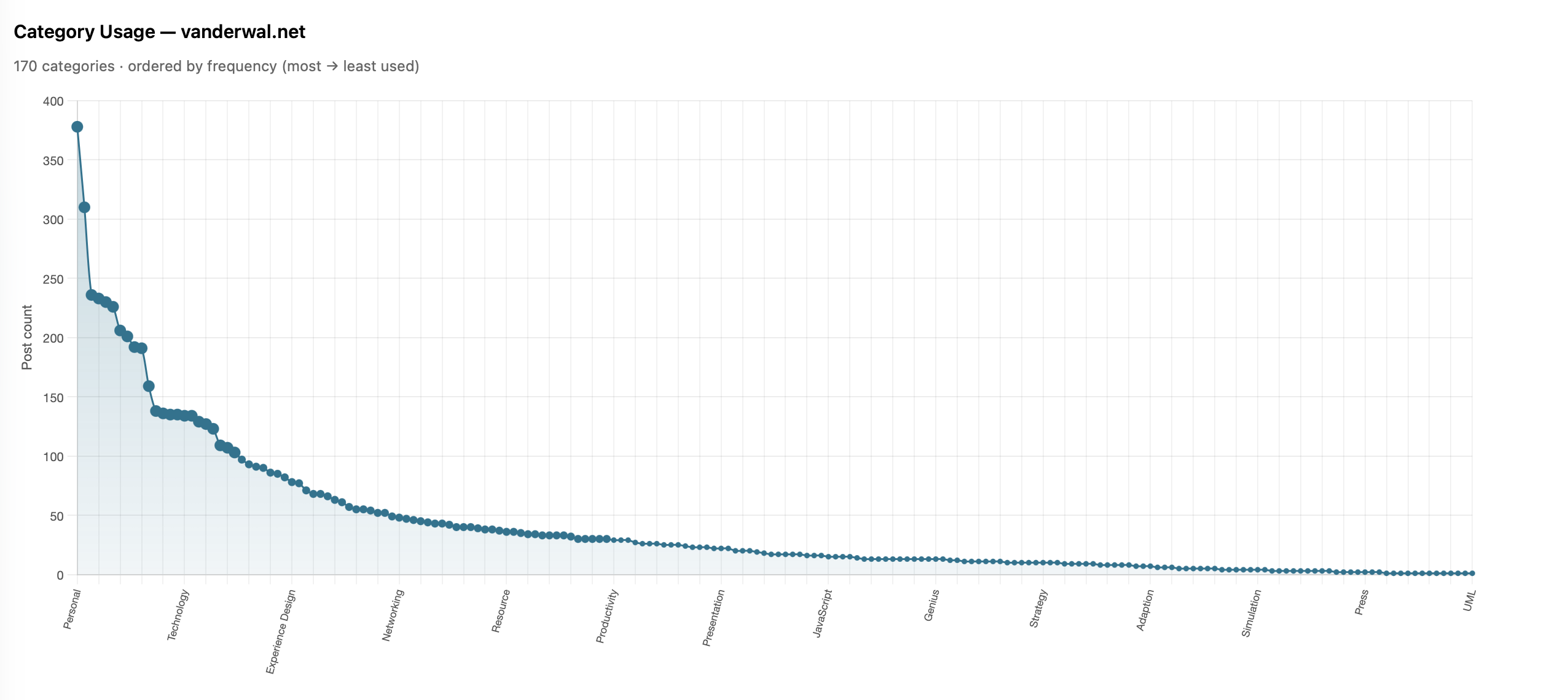
I done a very quick capture of category usage to look at the distribution of use. A question from James about whether my category distribution looked like a long tail distribution and I thought it may, but also looking at the numbers and not having a visualization I wasn’t sure. Charting the use, it really was a very long tail / power law distribution.
this chart is described in the test that follows

I shared it with James and he also ran his and ended up with much the same (Is there a power law of category use? - James’ Coffee Blog). There have been a few discussions of late around category use and some lean into having just a few categories. I have just over 200 categories now as most of my blog post have more than one subject and I use the categories to have an way to jump to related posts that cover the same subject. When I built my site’s CMS I wanted to have the capability to have multiple categories on each post. I have multiple categories for my own purposes, but also I’m cognizant that readers may have other terms.

With the long tail use of categories I know readers may stumble across a post through web search or a link from else where and having a category term that is familiar can get them to other things I may have posted. I view the web as being able to connect with others and blog posts are sharing things I have interests in or curiosity around and being able to connect with others in a similar mindset is the aim. So a handful of categories, particularly across 25 years and over 2,100 posts, doesn’t help build those connections.

More Analysis on Blog Posts and Categories

This distribution of categories really pushed my interest and curiosity of what the last 25 years of blogging looks like. I joke that Twitter ate my blog, but the sparklines sort of show that. I wanted to see the trends on my blog more closely (I have the archive of my Tweets and I’ll analyze them later and then bring the two analysis together).

To prep for the analysis I pulled my site’s database data local and put it into SQLite (it is already on Mac - Apple and quick) to connect locally with Jupyter Notebooks and use Plotly for interactive data visualizations in the notebook. I had a series of questions, somewhat common data analytics questions I’ve used since grad school looking at analysis over time.

Posts per Month
this chart is described in the test that follows

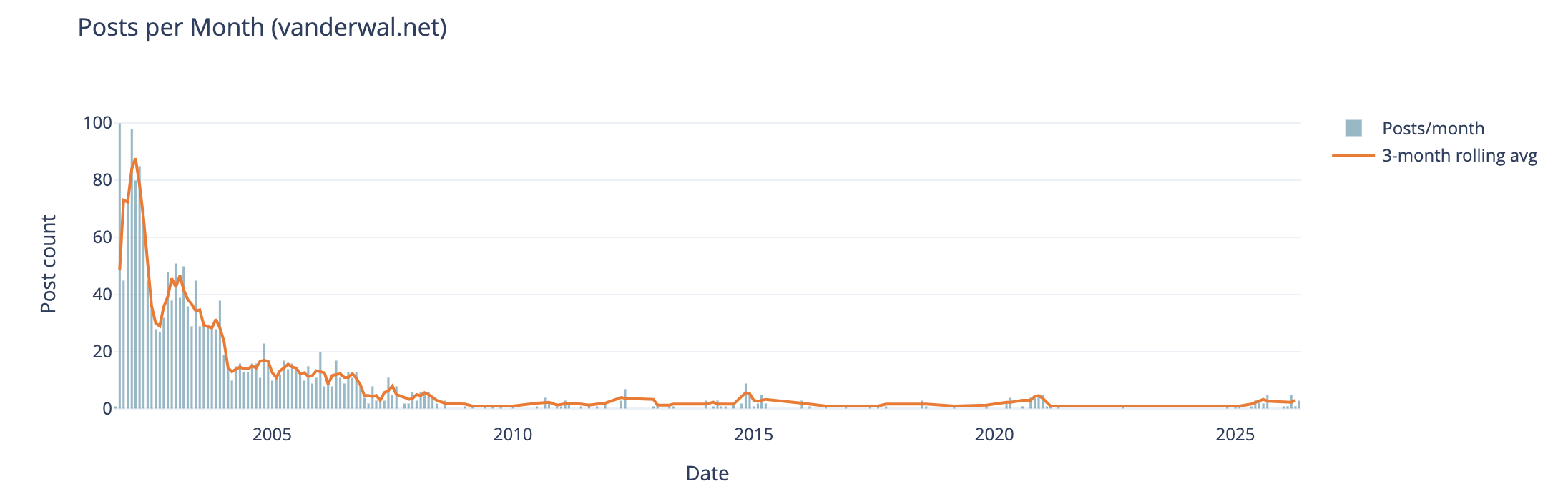
The first analysis is my blog posts by month over 25 years. In my early years I was posting frequently, often in shorter posts (but we will look at that next), and then around 2005 (when started engaging with Twitter) things dropped off. Also at this time I also started blogging more serious subjects at Personal InfoCloud, but those were not all that frequent (I’ll dig into this at some point later too).

My hunch that I posted much more early on and drop off around the time I engaged with Twitter, seem to hold up.

Post Length Over Time
this chart is described in the test that follows

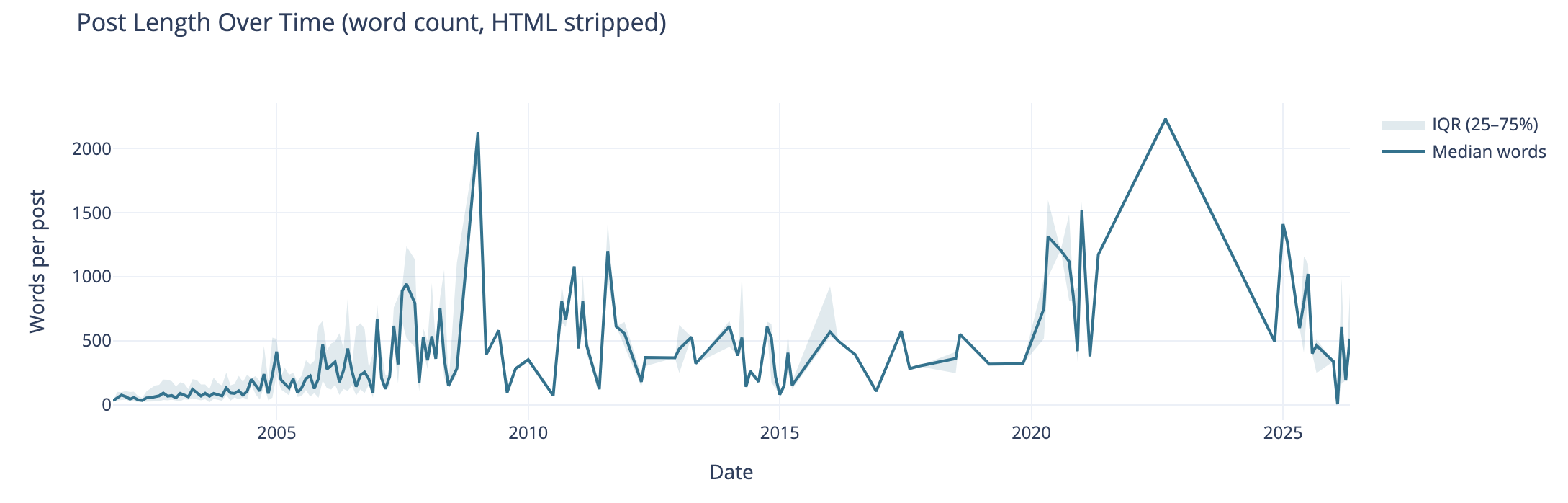
Post length over time also can tell the story of why post volume shifted. I wasn’t posting a lot of short post, but posting longer posts, but less frequently. I’m really curious what I posted in June of 2009 that caused the spike. The spike on the right end in 2020 and beyond are partly attributed to posting weeknotes, which tended to be longer than normal.

I know that my writing muscles went from a few hundred words early on to posts being around 1k and more. I found my comfortable blog post writing length was around 1.2k words. I write to find out and capture what I think, but rarely edit for brevity or other editing benefit, at least on this blog.

Median Categories per Post
this chart is described in the test that follows

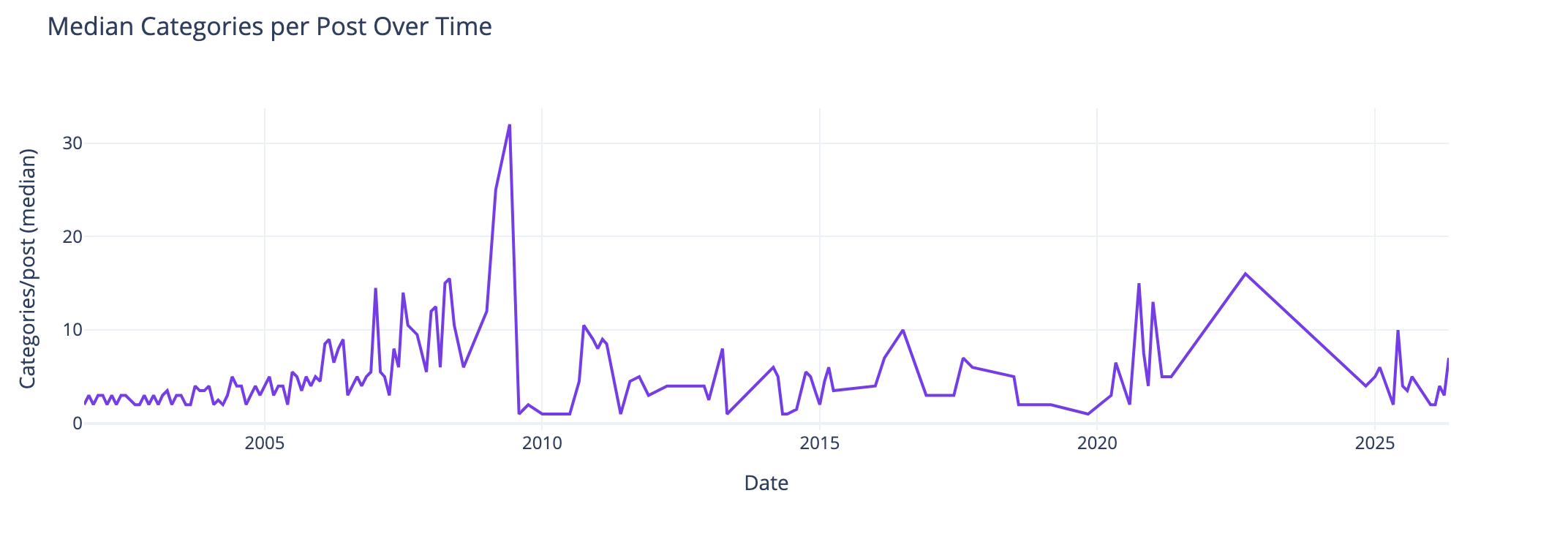
This view of the median number of categories per post over time I found interesting and I didn’t know what my expected outcome was going into this analysis. The numbers pretty much are in line with longer posts have more categories to cover slightly more breadth in a post. Again June 2009, not sure. The spike spike on the right aligns with weeknotes, which cover multiple subjects in one post.

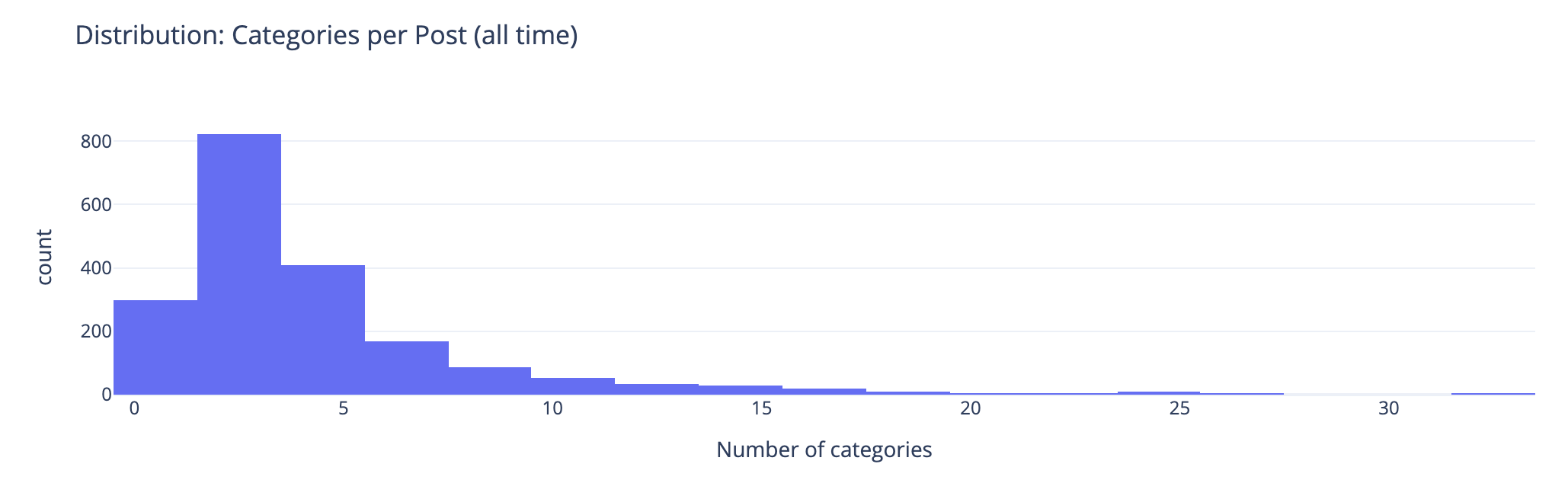
Distribution of Categories per Post
this chart is described in the test that follows

This chart groups number of categories on posts. This shows the second bar has the most number of posts (822 posts) have 2 or 3 categories on the posts. The third bar has 408 posts with 4 or 5 categories on them. This lines up well with the frequency and volume of posts early on which were shorter. Looking at the prior chart most posts had 10 or fewer categories on them.

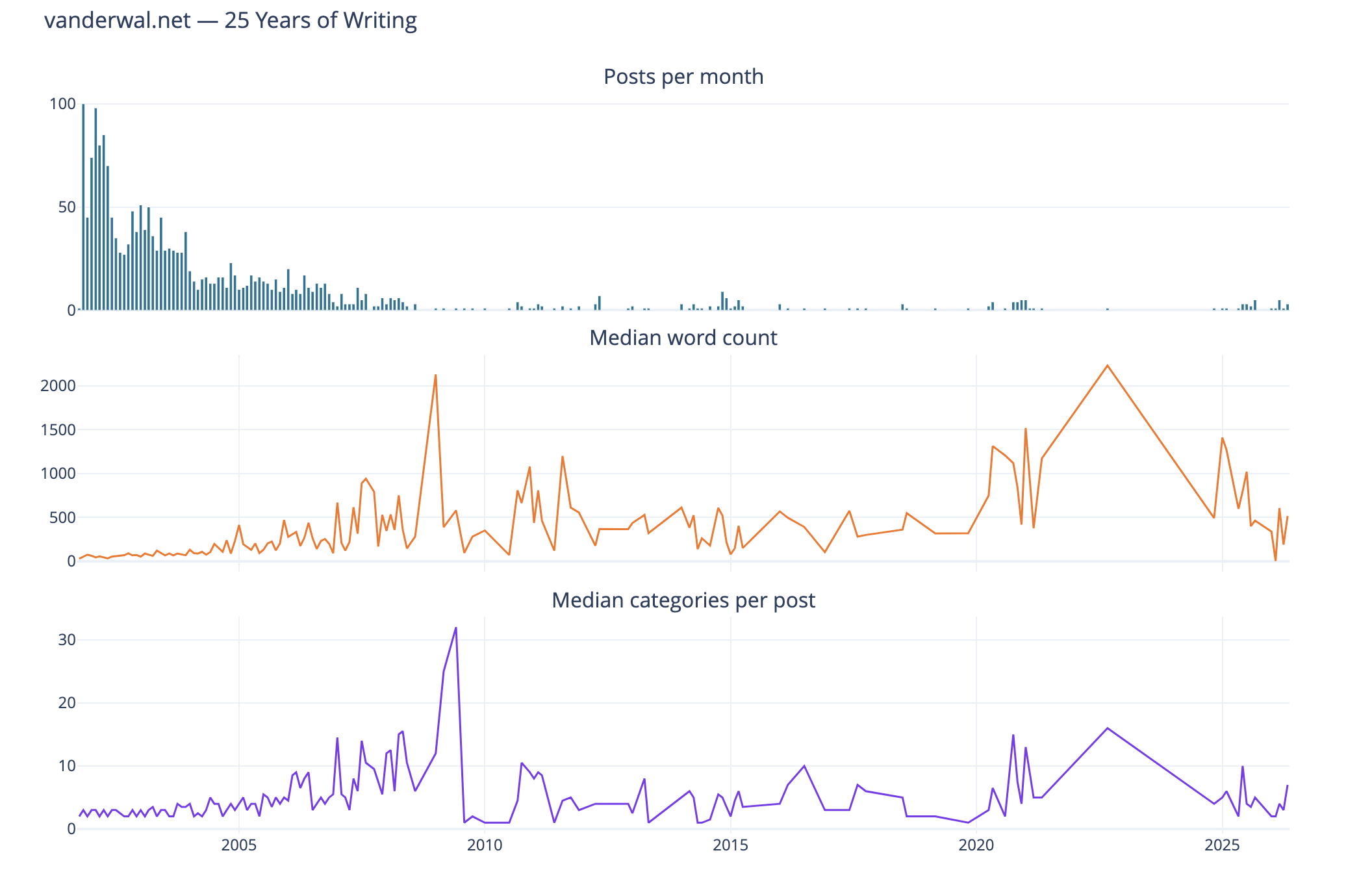
Combined Timeline for Posts, Length, and median
this chart is described in the test that follows

I like this combined chart that reinforces early on with high volume of posts of shorter length and few categories on them. What I find interesting is the correlation of line trends for word count per post and categories per post. This ties closely with the longer posts have more categories.

Seasonal Patterns
this chart is described in the test that follows

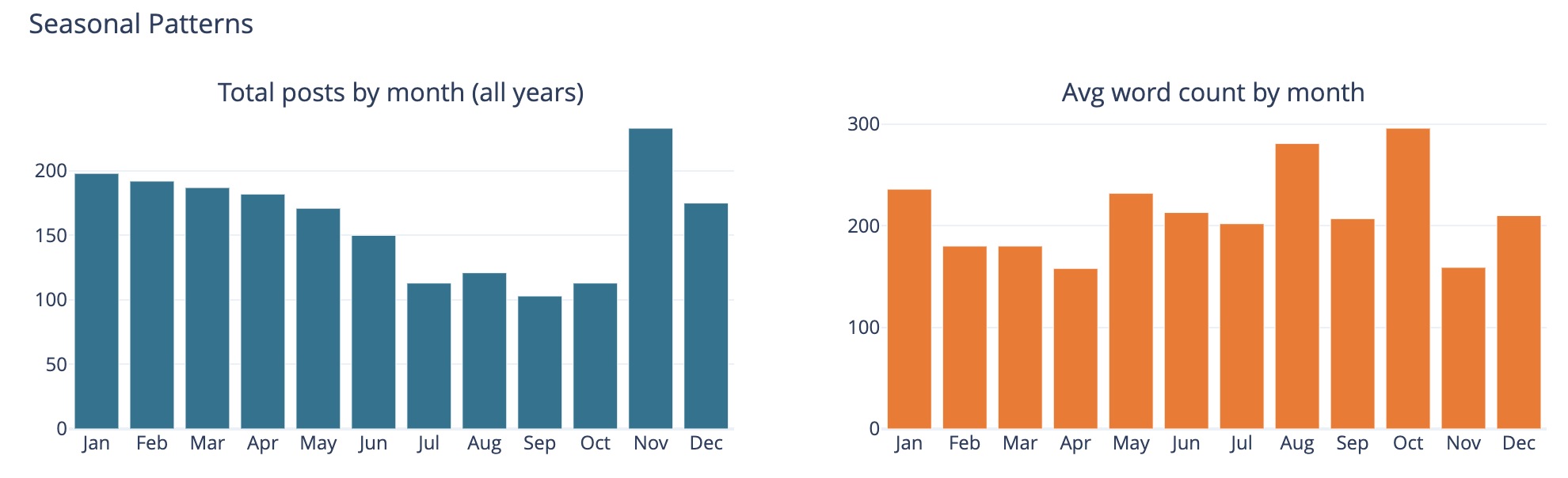
The bar chart on the left is total number of posts by month and on the left it is average word count on posts by month.

This was largely a curiosity to see what was there, but also a common analysis trend analysis to see if there are explanations of other trends looking at seasonal comparisons. The posts by month is not surprising to me as summer and early fall months have often been busy. I am not all that sure what the word count by month tells other than the correlation between more posts and shorter post length correlation showing up.

Top Category Activity Over Time
this chart is described in the test that follows

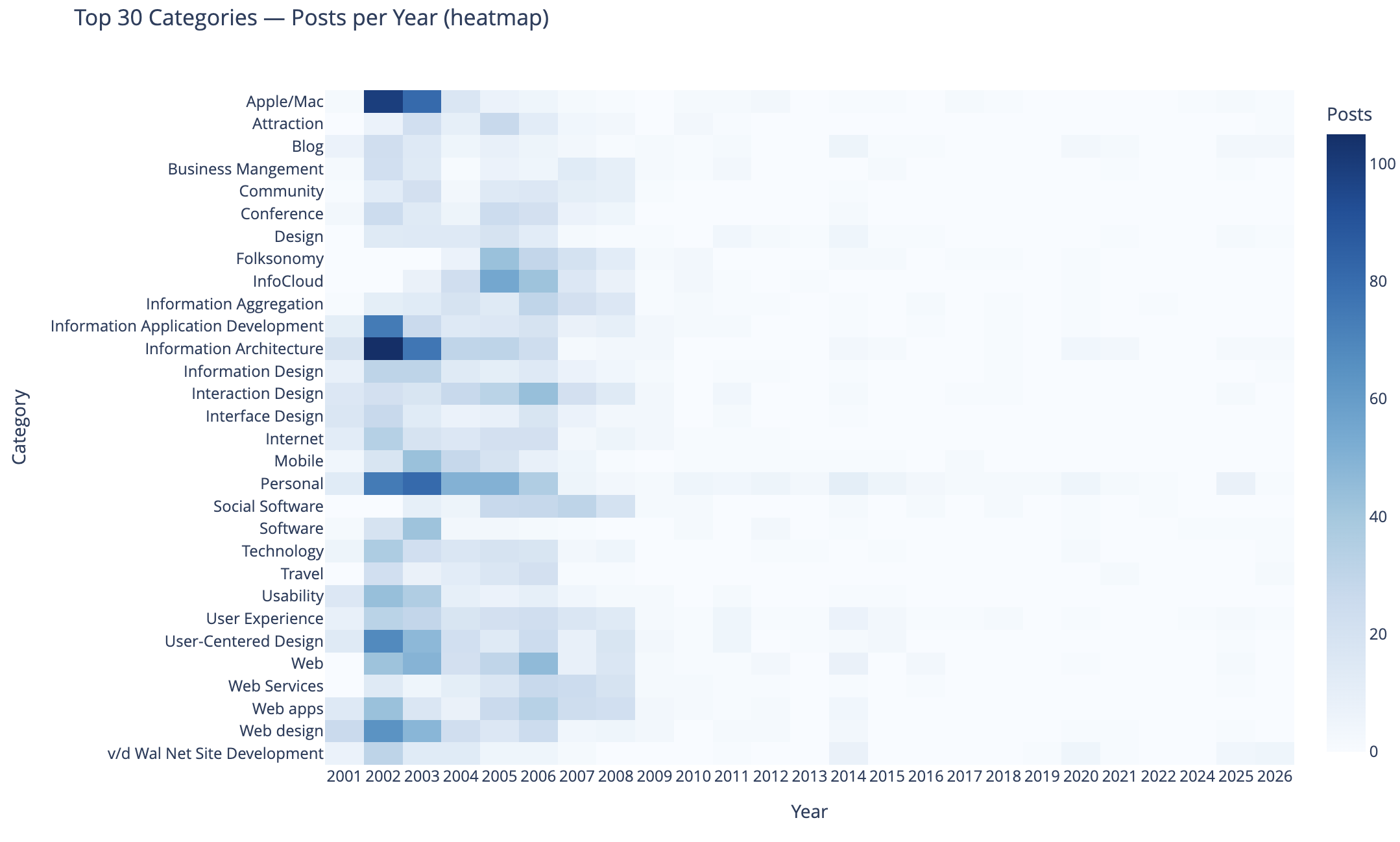
This chart shows the top 30 categories (by use) and their activity over time.

In this heat map Apple categorized posts were sure common, as well as Information Architecture, Information Application Development, Personal, User-Centered Design, and Web Design were also common. Personal and this site’s development.

The heat map being far more dense on the left in early years is skewed by volume of posts and makes activity in the middle and right (more recent years) difficult to see. I need to spend more time on this analysis and chart to separate out the early years and segment things so time outside of the early years can have trends more easily seen. I may want to select a different visualization, but if I can break things out by time that should help. Also running 3 time segements with the same top 30 categories across them and then the top 30 within each time segment could be interesting.

To 40 Co-Occuring Category Pairs
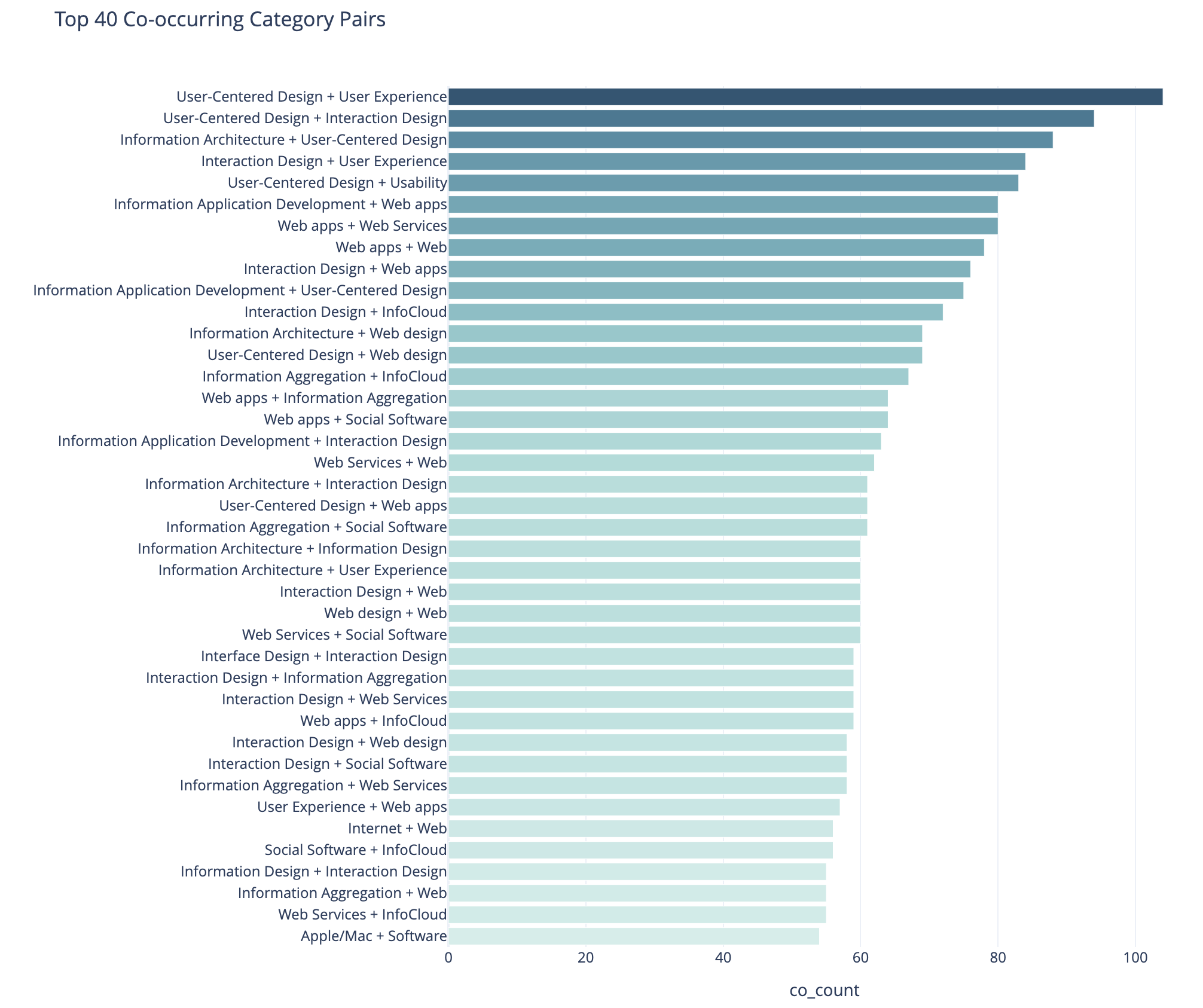
this chart is described in the test that follows

This cart of co-occurring category pairs is in part preparatory work for bringing concurrent tags into the category pages here for understanding and filtering needs for users.

The top 5 pairs are all related to UX, IA, and User-Centered Design and these being the type of concurrence isn’t a surprise to me. The broad UX community had rather divergent use of terms at times and one person’s IA was and other’s UX. For readers who think about these posts in one manner could find other similar content by the term they are familiar with using. Pretty much this whole list is application development, web design and development, web apps, and pan-UX related.

I don’t know how useful this is for broad insights. When I get to adding the concurrent categories on the category pages this will likely be more helpful on a category by category view.

Category Co-occurence Network Graph
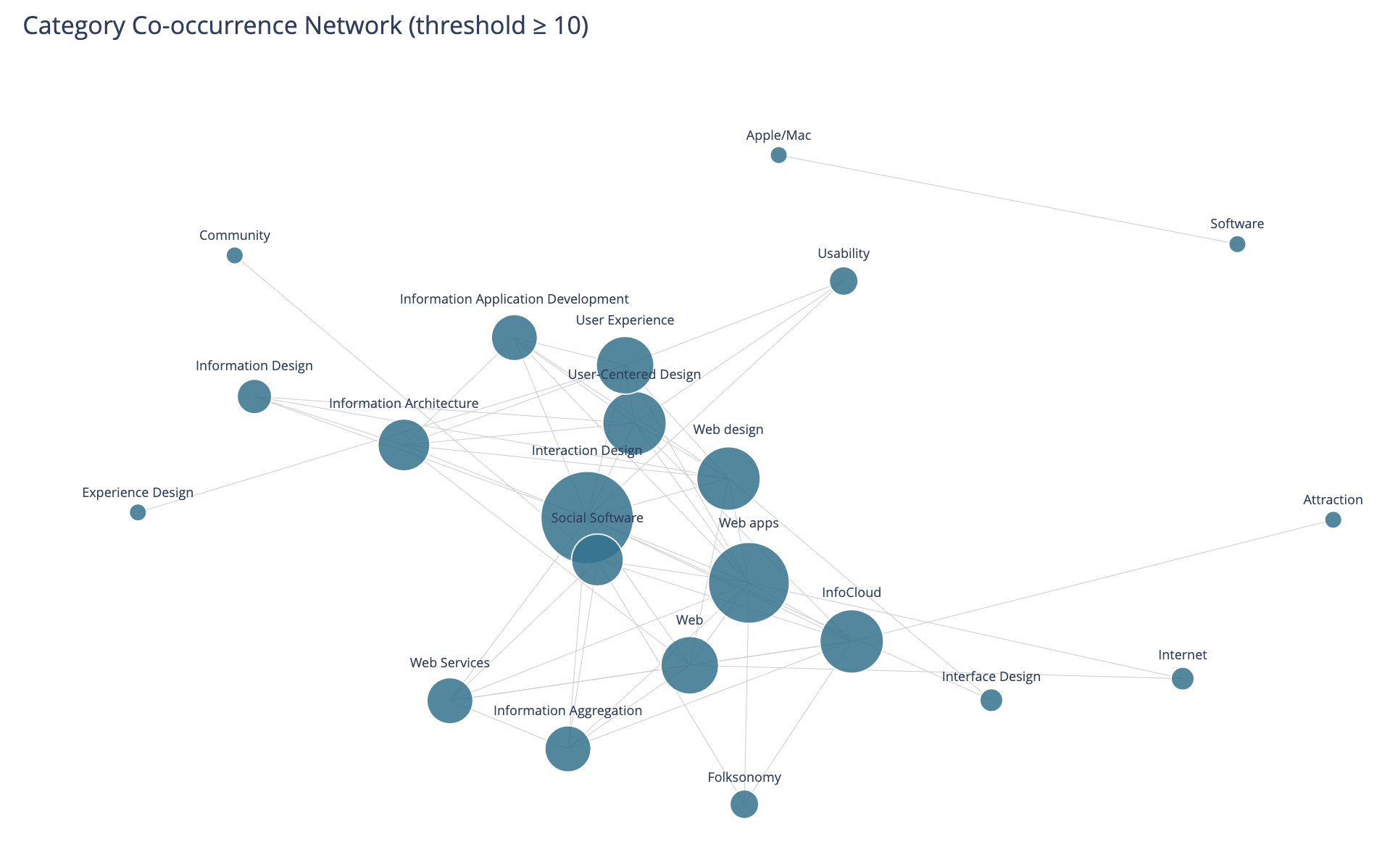
this chart is described in the test that follows

This chart looks at the top thirty categories that have 10 or more co-occurrence of categories.

This I find more interesting than the prior in that this has Social Software and Folksonomy showing up and showing its relationships. The largest category in this view is Interaction Design and its multiple connections. I am entertained by the standalone pairing of Apple and Software, that at the scale limited for the data these only connect to each other.

I need to rerun this with higher acceptance to get more included. But, also this graph isn’t interactive in Jupyter, and every time I went to zoom in it collapsed the graph and I couldn’t move a node out of the way was disappointing.

Helpful as a Good First Pass

This analysis and data visualizations were helpful to see into my 25 years of posts. There are some analysis sets and data visualizations that need more work. Most of these are more helpful with Plotly in Jupyter and the ability to interact with the visualizations.

I am really curious with what this will look like when I look at Twitter usage and notes. Obsidian on top of my notes make note making easier and far more helpful with backlinks / wiki links. I started using it on top of my directory with notes in June 2020 that had around 2k notes in it going back to 2003. Now there are around 6k to 7k and in the past about half of these notes would have been on one of my blogs.


30 May 2026

Updated Categories with Sparklines and Search is Now in Production

I made a couple of updates I have long wanted to make to this site. I’ve been wanting to see frequency of categories used on my blog for more than 15 years (or pretty much since I’ve had category list pages). I have also wanted to have blog search and the utter mess that Google Search has become in recent years, where my site isn’t showing at all at times has driven this. These additions will likely iterate and adapt a bit going forward.

Updates to Category Lists with Sparklines

I have basically had two category list pages for years: Category List (which is alphabetical sort) and Category List by Use. I have kept these two and added sparklines to them (Sparkline - Wikipedia). Each line now has a small line chart that covers the 25+ years and what periods had used the category and some sense of the volume of use over time. One category list view I wanted and was missing was one to show a view with the focus of most recently used categories, so there is now a Category Recently Used List that not only groups by most recently used (and in the same entry keeps the alphabetical sort) but also shows the date of the last use in the list. Personally, I have been finding this recently used list view the most helpful and interesting. Skimming through the list I know I have more recent posts that have covered or touched on a subject, but it didn’t include the category, and that becomes a quick task to fix that gap.

Sparklines?

I have been a big fan of sparklines to give quick understanding of data’s distributions at a glance, which I learned about in “recommended reading” of Edward Tufte’s book The Visual Display of Quantitative Information | Edward Tufte in grad school in social / policy quant classes. (There are are many Tufte essays and book annotations on sparklines at Edward Tufte Notebooks & Sketches | Art, Science and Sculpture).

Creating the Sparklines

In creating the sparklines for my category lists I looked initially (and have long looked at them) creating static images from the data and bringing the images in (this would mean updating the images and replacing the old with the new ones, which is relatively straight forward programmatically and something I’ve done in the past, but not optimal) and I also looked at JavaScript but it was a bit slow. I poked at using creating SVGs (which work well when printing or zooming in) and often are much quicker and less strain on a browser than JavaScript. I’ve had a few goes at SVG in the past and I get get my mind around simple shapes, but I would need a little help with sparklines. A couple years back on a sparkline spelunking I found Easy SVG sparklines | Alex Plescan which showed the how. But, I have SVGs somewhat in the same category as regex, which is I do it rarely and I’ll just use Claude Code | Anthropic’s agentic coding system \ Anthropic to assist with the creation.

Chunking the Data for a Sparkline

The other part of sparklines is they are intended to be small glimpses and I have 25+ years of posts and a monthly temporal segmentation would make for a long graphic. I played around with breaking things down to quarters, but in the end I went with two segments per year and roughly 50 data points to map out on a line chart. Running a test with the two data points a year was a reasonable enough glimpse to sort out if the category was used recently or what the variation of use was over time.

One of the interesting discoveries with the first lab run of the categories of sparklines was the rather “U shaped” distribution of the use of categories, which pretty much calls out the lull I had in blogging. This softening of blog post rhythm is something I call, “when Twitter ate my blog” (where the interesting things I would discover and want to share and interact around ended up on Twitter rather than my blog(s)). Other patterns that surfaced were limited use a category in a period when I was rather sure I had posted on the subject, some of this was I was not using the term in that way or I didn’t have the category in my system yet. One of the things that helped sort this out was using my blog search.

Search is Now Out of the Lab

One of the things I have been working on and using my my Lab at vanderwal.net is blog search. But, the modifications I made to the Category pages I found I was leaning on my blog search a fair amount to investigate things. But, the categories and blog search are both in the blog section of this site, so making the change from the lab to the production side made sense. One of the things holding back moving search over, was I had an SVG of a magnifying class in the menu bar with “Blog Search”, but no matter how small I made the image it still was messing with the vertical layout of the menubar. In removing the magnifying glass and just using text things kept to the same layout.

Bringing in Search

The search in the menu in the pages in the blog section with “Off the Top” or “random” in the URL which is where there are currently menubar links to Blog Search. I have the menu bar link to a search page to search from rather than a JavaScript drop down or other menu bar convention (again layout of the menu bar was part of the considerations).

When I was working on search in the Lab section I found I needed to make some modifications to the database to have quicker search and I needed to modify the database engine so I could have search include 3 letter terms as a minimum rather than 4 letter words. In working on search I found many of my early posts didn’t (and still don’t) have titles and I was using the title as the link. I initially thought I would just add titles, but there are around 300 posts that don’t have titles (I’m adding some as I touch the posts for other clean-up issues), but I ended up coding the search results to have the results just fill in “Blog Post #…” as a proxy for a proper title.

The initial 170 or so posts are not in the database and are therefore not in the search.

Bringing Search and Categories In

As I went to move the category list pages out of the lab and into the production side I needed to modify a few other templates and pages to add the updated links. In doing this I realized I could also easily update the menu bar to include “Blog Search”. So, I took a little bit of time and made both changes at the same time.

Not all of the links are in yet. If you see something a little off with category lists or missing blog search links let me know.


29 March 2026

About an Update

Earlier this week James popped up to ask if I truly still used Dreamweaver to build my website. I was a little lost as it has been 15 to 20 years since I used Dreamweaver for much of anything. He was reading it on my “About” page.

I had pretty much forgotten about my About page and looking at it needed a lot of content help and updating. I’ve mostly highlighted areas that need updating, adding, as well as adding, but I have had a few things ahead of it on my list and hopefully it will get done in the next week or two.

When I did my backend updating I updated the front page of the site, but not the about page. I need to get about updating my About page is what this is about.


16 March 2026

Weeknote - 15 March 2026

I thought this week was going to fully turn the corner on a cycle of sinus tears, light infection, better, and then start it over again. It has been messing with sleep and having a clear head. I’m hoping thing are sorted.

Am I back posting weeknotes regularly? I love reading other people’s weeknotes and have a handful of favorites. I also miss getting things of interest shared out somewhat regularly.

Watched

Mission Impossible is Sort of Wachable

The tail end of last week I watched what I thought was the last (latest) installment, Mission: Impossible – Dead Reckoning Part One - Wikipedia. I started watching late and I hadn’t looked at the length before I started. It was decent and enjoyable. I found it to be one of the better of the Mission Impossible series. I really liked the first movie and some along the way I have found to be decent, but some are a slog. I enjoy the travel and some of the film production, but the scripts are think and acting meh (I really am not a fan of Tom Cruise). But this 7th in the series was decent entertainment. As it ended I realized there was the actual “final” installment and given I thought the 7th was enjoyable there may be hope. I was not right, it was a slog with story segments far too long and with that there were logical gaps.

Seven Dials is Rewachable

Later in the week there was a quiet evening and I needed a break and opted for Agatha Christie’s Seven Dials - Wikipedia on Watch Agatha Christie’s Seven Dials | Netflix Official Site. I wasn’t expecting much as one of the Agatha Christie shows that Netflix had done in the last few years was not really watchable. Seven Dials was more than watchable, I found it to be quite good and a good interpretation. The Seven Dials is a Agatha Christie mystery that leans into a serious nod to P. G. Wodehouse, which I found to be well done (as well is something I was in need of). The main characters were really enjoyable.

Work

Search Me

I did a little tweaking around blog search for here, but not fully pulled it into this blog. It is sitting the Search from the Lab for vanderwal.net. I updated the database engine and switched to InnoDB to get search for 3 letter words and larger working.

I then had the issue of old blog entries where I didn’t have a title and the title is what I make linkable from search. I thought I only had a few handfuls of posts that lacked titles, but it was a few hundred. While adding titles is a good background repetitive task, I moved to adding a permalink under the body of the post snippet in the search results, but also added the post ID as a proxy header to give some consistency.

Category Tweaking

Through searching my posts across 25 years I would click to read a post and go to click a category that I believed would take me to other related content, I found I had categories missing. I added in about 5 or 6 categories and went back and searched and added the categories to posts.

Personal InfoCloud Posts

I have a few posts for the Personal InfoCloud site brewing. There are many things I have thought I have posted there over the years that are just written out in my notes and not edited nor posted. I have one I’m reworking a little.

I have also been going back through many Model of Attraction focussed posts and ones around the InfoClouds (Personal, Local, Global, and External) and sorting out what is posted and not. Related is sorting out what posts I have relate to the roughly 100 Complexity Lenses (at the top level - has also used Social Lenses as its main label in the past, but there is so much more in there than social) and the more than 1,500 nodes in all.

I also have a few posts around software development and product development around subjects that people, teams, and organizations seem to be continually missing or tripped up by.

General Posts

I posted the other day about Adding a Museum Category - Off the Top - vanderwal.net in relation to the IndieWeb Carnival - IndieWeb that James is running this month on museum memories - IndieWeb Carnival March 2026: Museum memories | James’ Coffee Blog. When James mentioned this a while back I was thinking I had a couple or small few museum memories I could post, but started a short list. That list turned into more than 30. There may be more than one post for sure. It may be a series or collection (hence added the category). But, I also have some broader theme posts that are growing on the subject.

My blogfodder list is rather long. But, modifications I’ve made to my workflow and blog management process in Obsidian
(I’ve been using it to sit over my nearly 30 years of text and markdown notes for the last 6 years and finding it really valuable) are making it better to get notes moved to blogfodder, and honed enough to post.

Productivity

Going Back to Bartender for Menu Bar Management for a Bit

I’ve been using Ice for my menu bar management on my MacBook Pro M4 since Bartender was sold and became questionable. Ice has not been updated since macOS 26 has been out (I don’t want anything Liquid Glass added) and with many apps getting a bit unstable on macOS 26 (particularly if they convert to Liquid Glass) and I’m trying to get things sorted.

I saw Bartender 6 had some recent updates and listing of changes and are now being more transparent. I also saw a quite reasonable upgrade price so went for a test of it and did the upgrade. It has been good and not all that different from Ice, but it doesn’t have the small bugs Ice had with the hidden menu bar displaying in odd locations under the menu bar.

Grammar Checking

Trying Harper for Grammar Checking

I stumbled onto and have tried Harper: The Private Grammar Checker, a medium capability grammar checker for English. It has an Obsidian plug-in, which I tried. I realized running a grammar checker on my rough notes isn’t a great match for that part of my workflow. It is easy to flip on an off in Obsidian and often notes turn into something more and that is where Harper may provide assistance. Harper is OpenSource and available on GitHub as well, which means I can run it through DeepWiki to get a decent overview of Harper - Automattic/harper - DeepWiki.

Often my writing and planning starts as rough notes in Obsidian. Since everything is in markdown and markdown is great example of Small Apps Loosely Joined where the file can be picked up in various different applications and use the apps to their best. I pick up the note and initial rough pass in iA Writer to flesh things out more. iA Writer has some light grammar checking and in prep sharing the writing out I use Marked 2, which also has some grammar checking. I’ve been looking for something with a little more assistance. I’m going to try Harper in some other of its options.

In grad school I and for long after I used Grammatik as part of WordPerfect and I really liked both and miss both. Grammarly has never fully been a fit for me and with its recent issues it still isn’t going to be part of my consideration. I’m not a fan of AI involved in my writing process.

I Have Webmentions Working

I have had a partial setup for Webmentions for a few years. I have had getting it properly sorted on my to do list for a few years. In the last week ArtLung ~ Joe Crawford was on a call and started asking questions about it and two or three questions and adding one element to my headers completed the cycle. I now have webmentions enabled, but I receive them in my RSS feeds and am not (likely may not) exposing them.

I Have Webmentions Out Going working with Omnibear

A month or two back I joined a call to look at updates and testing for Omnibear, mostly to learn more about it. But, in about an hour i was running Omnibear as an extension in Firefox and I’m authenticating through my Micro.blog account and site as the foundation for sending replies to others through Webmetions. I really like Omnibear as it shows if a site has enabled to receive a webmention and allows comments, bookmarks, and favorites. Having this in the sidebar (well sidebar in my Zen browser where I use it most) is really nice.


10 March 2026

Search Updated In vanderwal-net Lab

A while back I started working on adding search here on vanderwal.net. I have had a rough initial draft running in the [Lab - vanderwal.net](https://lab.vanderwal.net/index.html. It needed modifications, the largest was it would only search on terms with four letters or more. The solution to that was to modify the database, which should be easy but the last export I did was a bit odd.

Today I updated the database and now the search works with terms with three letters or more. I am more than fine with that, as I can now search “art” and other words with just three letters.

There are additional changes needed but vanderwal.net Search - In the Lab is something I’m using, but not not quite ready to move to the main blog. Search does cover all of the blog posts, but some older ones from 2001 and 2002 don’t have titles. I am adding titles, but I may also surface the permalink as another option.


5 January 2026

Vanderwal.net Blog Off the Top Turns 25

I didn’t realize that until Phil Gyford dropped a note from his blog tracker, ooh.directory, that my blog (this right here) turned 25 as a note in Mastodon, Phil Gyford: "@vanderwal Happy Blog Birthday…" - Mastodon. Posting has slowed down a bit from the early days, but still going. This last year the underpinnings got a good update to keep the platform running longer.

My first post was December 31, 2000 on Blogger and sent to this site by FTP. But, somewhere along the way that was lost, as is was likely a “hello squirrel” and “this is a test, I don’t know how long I will be doing this” sort of post. But, 25 years later I’m still maintaining the custom platform and adding to it, while also still posting.

In the mid 00s Twitter started eating a lot of things I would have normally posted here. The posts got longer, and more focussed, but also less frequent. Facebook and other online places also ate posts.

In June 2020 I started using Obsidian and my notes what working through ideas, which I once did on my blog were turning out in volume in Obsidian as notes. My aim was to move the link notes and longer teasing out and working through ideas into blog posts. But, that is still a work in progress.

I won’t say here’s to another 25 years as I didn’t do this for longevity I posted to share and find others who had similar interests. This is still somewhat why I still post, but the feedback loops are more odd and weird in their indirect way then they were years back.

I have been working on adding search and have a early version working in my Lab section of the site, Search Page - Lab - vanderwal.net, but it needs a about three more steps (including tweaking the database so it can handle searching for 3 letter words and not just 4 letter words and larger).


21 June 2025

2025 Vanderwal.net Backend Modernization is Done

A couple years ago I thought I would update the backend code from PHP 5.6 to PHP 7 and initial progress on it was hindered by time available.

Planning the Modernization Work

A few weeks back I started looking at it again and mapped it out properly like a project. I realized PHP 7 was deprecated and I should really head to PHP 8, so that target was set. I was planning on keeping things relatively simple using a database connection quite similar to what I had used, but digging through PHP 8 books and resources on O’Reilly Learning Platform everything was using a newer more flexible method. After digging further I took the route that would take a bit more work modifying existing code (some going back to 2000 and 2001). But, as I dug into the work I realized I was only needing to modify and modernize about 20% to 30% of code on the pages and templates.

In doing this I also realized my old method of security around the system management backend was no longer working, so it had to be rewritten as well. That meant rebuilding the backend screens. Those updates went live two days ago on the 19th.

With that done it was back to the last third or so of the pages and templates that are public facing. I had already reworked the category output pages and adding pagination to them. No longer will all 121 Folksonomy categorized posts show up on one screen, only 15 at a time will. The “Personal” category has 369 posts (it is a blog so it is about me, you see, but just not all of it).

The RSS feed received a very minor update to RSS 0.92 to keep in line with many of the OG methods that remain.

The Actual Homepage has been Restructured

The homepage for vanderwal.net has been restructured to make it easier to find information that isn’t directly in the blog and I get emails and DMs about somewhat regularly. Moving it to two columns helped this. I do need to modify this to flex or grid CSS model as tweaking the layout was rather tedious.

This Modernization was like Changing the Plumbing and Wiring in a Building

This modernization was like bringing the plumbing and wiring of a building up to new building code. The walls and structure are all pretty much the same. The top layer stays the same for now.

This modernization does allow me to hopefully finish setting up webmentions, which I’ve had partly wired since around 2021 or so. I just need the last piece to that to work. There are also other IndieWeb related updates I’m planning on making and have been waiting to get this code updated before modifying and adding them into place. By the way, if you are running your own site and/or blog, the IndieWeb community has a gem. There are a lot of resources in their wiki and pages helping anybody with their own site.

The pagination for the blog is likely going to change from a date with month focussed pagination to a page model with the oldest selection being page 1. The archive page will get a long over due update so it doesn’t stop at 2003 (looks at calendar, yep it is out of date). I’m hoping to have an archive page that shows activity, but also addresses the different post types (essay, journal, and weblog) that only lasted the first few years, but also around the 2014 code update and site move the entry type template went missing.

The category listings pages will also likely get an update and the category page may likely get some ease of moving through the posts over time, beyond general pagination.

Assistance with the Update

This being 2025 the question pops up if and how I was using generative AI as part of this. I was using Claude.ai from Anthropic with some initial questions, then I’d head to O’Reilly’s resources to validate them and learn what I needed to know (it had been about 10 years since I was knee deep into PHP). When coding and modernizing the pages and templates I’d and hit defects I’d run those past Claude to sort out what the issue may be (sometimes missing “;”, others the new query wrapper and parsing method caused me to miss something, or I had deprecated code I hadn’t converted). Claude would point out my errors and instruct me how to correct it. Sometimes it would offer a few options for approaches (some were not quite right and others were good and I needed to select a path - after verifying and learning about them further). It also would crank out code. I gave Claude instructions not to bother with large chunks of my pages and code, which it left alone.

I use Claude stand alone and used is Project function to keep things focussed. I fed it the outlines and high level task areas I have in GitHub and Obsidian and it was keeping track of what was accomplished and how the work met the goals. The most impressive thing, compared to other generative AI options is it was very strict with identifying things not viable in PHP 8 (and its iterative versions) as nothing else did this well. Claude also had the code of pages and templates I had worked on and would point out I was using a structure and method in other page and ask if I shouldn’t use that practice on the page I just fed it to sort out some defect I was working through. My code has had four or more iterations over the 25 years and my early coding wasn’t so hot and still remained. Claude helped my code get more consistent, not by it fixing it, but pointing out I had something good and modern and I should keep consistent with that. By the last couple of templates I didn’t need to have Claude check them as they worked with my own editing, but I still fed them in as it seems to help improve suggestions and catching lack of consistency of my own doing.

A year ago I tried this with OpenAI and its ChatGPT and it was a hot mess. It couldn’t keep PHP versions correct. I try it with every update and I find it really problematic and what it outputs (code and other attempts) as nothing better than mediocre and often not correct.

IDE Use

In the last 10 to 15 years the IDE I’ve used to code and work on vanderwal.net has been from Panic and either Coda or now Nova, which have worked well. I have kept a good firewall between AI assistance and the IDE. I don’t mind type ahead suggestions. But, finding deprecated code to address was something I was going to need. Some friends suggested I try PhpStorm by JetBrains, which seemed good as I’ve used PyCharm a few times in the past and really enjoyed it. I knew I didn’t want VS Code near this, as I’ve pretty much had it with VS Code (I mostly use it with Python for data analytics) due to plug-in issues and lack of ease keeping projects separated.

I picked-up a trial of PHPStorm and after a day or so I had the hang of a good portion of what I needed to do. My favorite part is the setting the exact version of PHP you are working with. It highlights where there are errors and problems. In the last couple of days as I finally was getting the hang of PHP 8 and the methods I was regularly using PHPStorm was helping with type ahead suggestions (there were a few times where I accidentally triggered them when I didn’t want them and nearly turned of that functionality - control Z is your friend). PHPStorm also can make use of GitHub CoPilot, which I don’t find helpful with OpenAI connected to it, but is better with Claude Sonnet. The downside with CoPilot is it doesn’t have access to the Project space in Claude I’ve been working with and therefore its suggestions are less on target - CoPilot with Claude is light years better for PHP than OpenAI offerings). Essentially I didn’t use the incorporated genAI functionality and I was very happy with that setup.

Posting Ease

One of the things I’m looking forward to are slightly better methods for posting to this site and managing posts. Many of the steps beyond creating and posting are manual steps, like kicking off creation of the RSS feed (I do that after a quick review of the created post as it is live, I kick the RSS feed after that review). The alerting the media, or the alerts beyond basic RSS, is also a manual step done after that review. I may automate the combination of those two kicks after a review.


9 February 2025

A Blog Move and Thin Catch-up

Yah, I know. It has been a while. Some things have changed, as I’m searching for what is next on the work front. Where I was it was a bit restrictive on sharing outward, so things got a little quiet. I’m still working on the Social Lenses / Complexity Lenses and have 80 to 90 stubs of ideas in my backlog of blogfodder, for here or the Personal InfoCloud.

A Move of Personal InfoCloud

I hadn’t posted to my blog, Personal InfoCloud in a long while. I was in the midst of a 16 part “Shift Happened” series, which was hitting embracing complexity as the next part of the series. I’m not sure if or when I will return to that. But, my work agreement frowned on sharing things out and I had a long negotiation about my prior work and corpus of IP around the Complexity Lenses. But, now that I’m back and able to freely write and share again I realized my blog where that happened much of the time needed to move off SquareSpace. Why? Poor customer support and small things breaking and them blaming me, when I hadn’t touched it in years.

The last two plus months I focussed on the move out and into another platform. I had looked at a few options for a month or so prior, but SquareSpace had one easy export path out, which is to WordPress, which I could self host (I have a few small blogs and sites that I have on self-hosted WP and they are fine). While there is a lot of turmoil in the WordPress sphere, going with the self-hosted option seems viable as a transition, if not longer option. I did an export of my SquareSpace site and in 20 minutes of export I had all my posts in WP and all comments, tags / categories, most media in blog posts, and the structure was there.

While the first step was 20 minutes to get to about 80 percent of a move done, the next portion took about two months between many meetings around advisory to start-ups, discussions about next steps (everybody was holding out until after the election, then to sort out what level of chaos may ensue, now…, and finding a lot of interest it is just getting things to a reality), mentoring professionally to director and up leadership in product management and cross-functional design and development engineering (with a lot of data focus and AI), data analytics and analysis of my own 20+ years of what I know so it can be better organized for others to pick-up. But, I had a deadline of the first week of February for the move out of SquareSpace to take place, as it was the next billing cycle.

The last two months of the move of the blog focussed on getting the design transitioned over or finding a viable design theme to use and bend to something I could work with. I found something, but it came with a lot of options and capabilities, which I initially embraced, then started printing out screens to single screen PDFs and taking the red pen to them (even after the move I think there are some things that may go, but also things that need work to come back). The next big haul was touching every post fixing some media links broken and fixing the URLs, which included the pre-post name date slug as part of the post name. I got those finally sorted out at the end of last week and Thursday I started moving the domains (from where I was developing it in a sandbox), shift to the production site, adding certificates, fixing odd typography issues, fixing routing issues, and other oddities. I hit the deadline.

Move Done and Next Steps for PIC

With the move done, I didn’t realize how much stress and mental clutter I had tied up in that move. I was managing todo lists in Obsidian, GitHub, and some quick reminders with times and dates on them. I felt free to start thinking about what I was focussing on two months prior and a ton of pressure released.

With the Personal InfoCloud blog I still need to fix links that go to Slideshare as most are broken, but I need to sort out what I want to do with those presentations. Jon and Rashmi have started a new replacement for Slideshare as a modern attempt, which I need to try a bit more and assess the fit for needs.

I also need to sort out the homepage of the site, as I’ve long wanted to have a homepage that sits in front of the blogs. I have that now, but I’m not happy with it. With the deadline out of the way I can have it as one of my projects I’m working through.

The categories, post listing, and search is also something I need to re-think and get into a better state. When I moved from TypePad to SquareSpace in 2011 to 2012 there wasn’t a good way to manage this, and what I cobbled together I hated. But, for PIC the platform is something I don’t want to think about I just want to use to post things I write. WordPress has a lot more options and I played with a couple before I put a hard focus on making the deadline about 5 to 6 weeks ago.

I have quite a few blog posts ready to be written. An introduction to the Complexity Lenses (there are over 90 of them now and in my master outline of them with sub-nodes there are over 1,500 nodes all together, which each node capable of being a page to at least 5 pages of explanation). This introduction post may iterate over time, which I’m fine with and not true blog with a line in time tied to it that other posts have. I also need to write up my “20 Social Roles”, which I do a lot of work around helping organizations sort through the roles and dynamics of their work, collaborating, cooperative, and collective environments, but also tool and platform builders creating tools that close the gaps of missing support for any and all of these Social Roles.

What Happens Here?

Here at vanderwal.net I need to get back to building a habit of blogging again. The weeknote is something I may do to help my rhythm. I still write a ton, but it is all in my notes. My daily notes, or “Daily Dump”, looks an awful lot like my first 4 to 7 years of blogging here (so 2000 to 2007 / 2008), before short snippets and observations started ending up in Twitter.

I still need to spend a week of heads down work to update the underlying code that the site runs on. I started that about 2 years back, but a day or two here and there weren’t cutting it and not a good way to make progress, particularly since it requires rewriting the code on my many templates to get data out and filling the pages in. Once that is done I have a few things I really want to address, like pagination on tag pages, and fixing the flow of the blog across time.

Whew!

If you have interest in chatting and catching up, or if you have a project, product, or work you would like help with please reach out.

Take care.


20 January 2025

The 8 Questions Answered in the Blog Questions Challenge

It has been a while since I’ve regularly blogged. I’m still writing a lot, but it is going into notes, and I need to get those back shared out. It used to be things I now put in notes, I just posted online (this sort of gets to the first question). I saw Joe Crawford answer these eight questions on his blog - ArtLung: Blog Questions Challenge ~ 16 Jan 2025. This seems like it would be a great thing to get the writing and workflow to post muscles functioning again.

1. Why did you make the blog in the first place?

I had some odd notes in HTML markup, mostly to myself, that I had posted before I started blogging. They were just HTML files roughly linked in a web directory. On this site I’ve had my links running as an HTML page since 1995, which is a couple years before I had my own domain.

In the web development community in the 1999 and 2000 I was reading sites that had become blogs. It was late 2000 when I was playing around with Blogger, mostly as a means to share links between home and work (this is what my FTP HTML files to my web directory was doing). In very late 2000 I made my first post in Blogger tied to this website. It worked on an FTP model as well at that point, but when I travelled hotels would block FTP from their hotel networks. I wrote a travel note system in PHP that allowed me to capture ideas, links, and notes. When I would get home I would introduce them back into Blogger. The travel notes turned into a CMS at work (I had been regularly rolling CMSes for work life for a few years).

2. Why did you choose to write your own blogging software?

I started with Blogger, but quickly was writing my own CMS for when I travelled. But, what I really wanted was the multiple categories added to blog posts that Grey Matter blogging software (Greymatter (software) - Wikipedia) had that Noah Gray created. I didn’t have an interest in going back to Perl as I had moved to PHP for easier development and having it be more readable code. So, I turned my Travel Notes I wrote in PHP into a more full fledged blogging tool. In Spring or Summer of 2001 I moved fully to my own hand written blogging software and It had stayed there. I still has functionality missing that I’ve long wanted to add.

I’ve updated the underlying code when I move hosts and I need to update the PHP to a newer version (I’m currently in the midst of doing that and hope by May to have that done, if not much sooner).

3. Have you blogged on other platforms before?

My Personal InfoCloud blog started on TypePad in 2005 (I had it on MovableType for a short bit, but Perl was rusty for me and I shifted to TypePad). Around 2012 that moved to SquareSpace and I’m in the midst of moving that to self-hosted WordPress. The PIC blog I just wanted to write and post, where as vanderwal.net I was fine messing with the underpinnings. I’ve setup and run a few WordPress sites. I helped get Home - Boxes and Arrows on MovableType, before MT was publicly available (Jay Allen ended up doing a lot of the heavy lifting as my worklife got very busy). Today I use Micro.blog very lightly and I need to sort out what I’m going to do with that.

4. Do you write your posts directly in the editor or in another software?

When I started blogging on this site I write in Bare Bones Software | BBEdit 15 in text, then would hand code the HTML and copy and paste that into the form, add in the title, location, type of post, and click categories to add. Around 2010 I shifted to Markdown in various Markdown editors. When the app Marked came out I started dragging the Markdown file to Marked and it would convert to clean HTML and I would check it, copy and past in to my system.

The since around 2010 or 2011 I’ve used iA Writer: The Benchmark of Markdown Writing Apps to write my blog content in Markdown. I have used Marked 2 to convert to HTML for this blog since it came out. The remainder of the workflow is to post into the CMS, it returns a blog post link, which I check through. If edits are needed I edit in Markdown, drag to Marked 2, drop in the test again for the post, and submit. If it is good, I go back to the CMS management screen and click to update the RSS feed. Then go to a push the notification something is posted to a ping service (it used to have 20+ options and now it is 2 or 3 I think).

5. When do you feel most inspired to write?

Most days I write thoughts I’ve been mulling as I wake. I capture links of interest I’ve read and write about those through out the day. In the evening I try to clear out open tabs and capture links then.

Sadly, in the last 4.5 years, since I’ve had Obsidian I just write in Markdown in there in a Daily Dump structure note template I have. Those all sit in the same directory as the Markdown for blog posts, as they are all notes.

I really need to get back in the habit of posting, at least a weeknote, if not more regularly. I have a long stack of writing to hone and post into Personal InfoCloud (more than 80 “blogfodder” items in a list for there - my past job didn’t take kindly to blogging, so I’ve held on to a lot of writing that just needs to get out).

6. Do you publish immediately after writing or do you let it simmer a bit as a draft?

Here on vanderwal.net in the Off the Top blog, it is pretty much what it says on the tin. As it is written it is posted. I’ve been trying to edit a bit more to fix missing letters, missing words, and making shorter sentences (that last bit becomes a rabbit hole), but mostly it goes out as I hit the last period. Marked 2 does some grammar checking and other lightweight edit helping, but not much more than that goes in to it.

7. Your favorite post on your blog?

Most posts I forget I’ve written once posted. The act of writing and posting clears them from my head, which is part of why I blog - so to clear my mind for other things. But, I think my favorite isn’t in the actual blog but adjacent to it, Model of Attraction - First Draft :: vanderwal.net, which is a brain dump while on a flight after the inkling of the idea for it was seeded. It was going to go into the Off the Top blog, but I set it apart as a draft. There are many posts I’ve written about attraction since that time -Attraction :: Off the Top :: vanderwal.net. The Model of Attraction is the underlying foundation for a lot of approaches to thinking through and assessing things technical, social (along with grad degree with deep social sciences and analytic / quant).

8. Any future plans for your blog? Maybe a redesign, changing the tag system, etc.?

I am in the midst of updating the PHP on the back end to bring the site’s code current. Once that is done I really need to add pagination to categories, a better previous and next navigation, calendar / chronology focus display of posts, and site search. I’ve also long wanted to have concurrent category views, say “folksonomy” and “data visualization” for better .

The other thing I really am wanting to do is to have a Digital Garden section shared out, like Maggie Appleton lays out here A Brief History & Ethos of the Digital Garden and does on her site, or as Tom Critchlow has been tending to on his site - Tom Critchlow. Move. Think. Create..


This work is licensed under the Creative Commons Attribution-NonCommercial-ShareAlike License.